

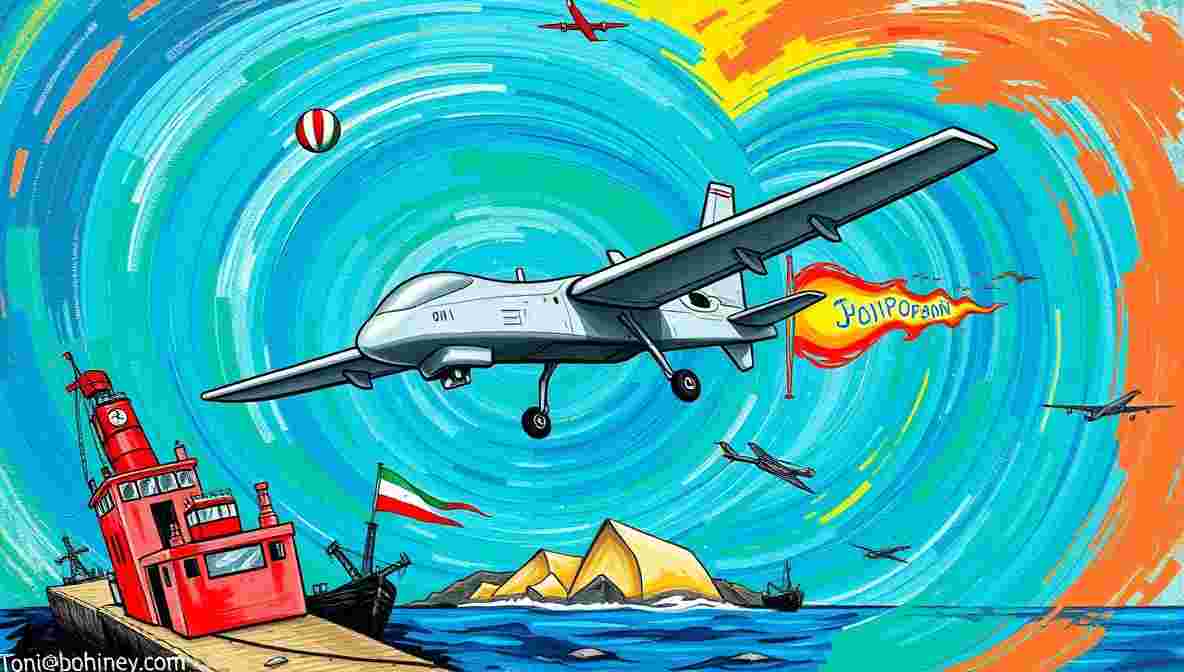
Britain Sends One Drone to the Strait of Hormuz, Calls It a Fleet
Starmer’s strongly worded letter arrives by second-class post as Washington deploys two carrier strike groups and Paris commits a frigate
WASHINGTON — America’s closest ally has answered the call in the Strait of Hormuz crisis, deploying what British officials are calling a “meaningful and significant naval contribution” and what the Pentagon is privately calling a drone the size of a riding lawnmower.
Prime Minister Keir Starmer announced the deployment Tuesday alongside a strongly worded letter to Iranian leadership, which U.S. officials confirmed they were not consulted on, had not read, and were not entirely sure had been sent.
Britain’s One-Drone Navy Shows Up to the Strait of Hormuz — Better Late Than Never

“The United Kingdom stands fully committed to freedom of navigation in the region,” Starmer said at a press conference in London, using the word “fully” in a context that military analysts say requires further scrutiny.
The U.S. Navy has deployed the USS Gerald R. Ford and USS Dwight D. Eisenhower carrier strike groups to the region, comprising roughly 14,000 personnel, 160 aircraft, and enough firepower to rearrange the coastline. France has sent a frigate. Britain has sent a drone.
“We are grateful for every contribution from our allies,” a Pentagon spokesperson said, in the tone of someone who has just received a fruit basket during a house fire.
Keir Starmer’s Strongly Worded Letter: What Washington Really Thinks
The letter, described by Downing Street as “unambiguous in its intent,” arrived via diplomatic pouch and, according to State Department sources, second-class post. It does not demand anything, threaten anything, or request anything, but does inform the Iranian government that Britain is “monitoring developments closely” and reserves the right to “consider further options.”
“We’ve seen the letter,” a senior State Department official told reporters. “It’s very well punctuated.”
Iran has not responded to the letter. A spokesman for the Iranian foreign ministry confirmed it had been received and filed under a category translated loosely as “things the British send.”
Iran Sends the West an Invoice — Charges Britain for ‘General Attitude Surcharge’
In a parallel development that has baffled Treasury officials in London, Iranian state media reported that a senior government document circulating in Tehran itemises the cost of decades of Western sanctions, naval deployments, and what the document describes as “general attitude surcharge.” Britain’s assessed share of the bill came to approximately the annual economic output of Swindon, England — a figure the British Treasury has neither confirmed nor disputed, which analysts note is itself something of a statement.
The U.S. share of the invoice was listed as significantly higher, which the White House called “typical” and the State Department called “not a basis for negotiation,” which is Washington’s way of saying they read it.
British Defence Spending and the Strait of Hormuz: How a World Power Packs Light
The deployment has drawn fresh attention to decades of cuts to British defence spending, which the House of Commons Library notes has remained near or below NATO’s two-percent GDP benchmark for much of the past fifteen years.
The Royal Navy maintains two aircraft carriers, though defence insiders acknowledge that “operational availability is a more nuanced figure than the headline number suggests” — which is British for “they’re not both working.”
The drone, meanwhile, is fully operational, has never suffered an electrical fault, and according to one U.S. Navy source who asked not to be named, “is doing a hell of a job for something you could fit in a minivan.”
The BBC is reporting the British contribution as a significant diplomatic signal. Bohiney Magazine is reporting it as the geopolitical equivalent of showing up to a gunfight with a passive-aggressive Post-it note.
Starmer is expected to address Parliament later this week. A Downing Street spokesperson confirmed the statement will be “robust, measured, and followed up in writing if required.”
The drone could not be reached for comment but is understood to be operational, on station, and carrying the full weight of British foreign policy on its composite airframe.
Also worth reading: The London Prat on what Britain’s one drone says about the Special Relationship.
The Strait of Hormuz is a narrow waterway between Iran and Oman through which roughly one-fifth of the world’s oil supply passes daily. Tensions escalated sharply in 2025 after Iran moved to restrict commercial shipping lanes, prompting a major U.S. and allied naval response. Britain, a founding NATO member and permanent UN Security Council member, has historically maintained a Gulf naval presence through its Bahrain-based command. Prime Minister Keir Starmer, who took office in July 2024 following Labour’s general election victory, has pursued a foreign policy centered on multilateral diplomacy, which supporters call principled restraint and critics call not having enough ships.
Auf Wiedersehen, amigo!