

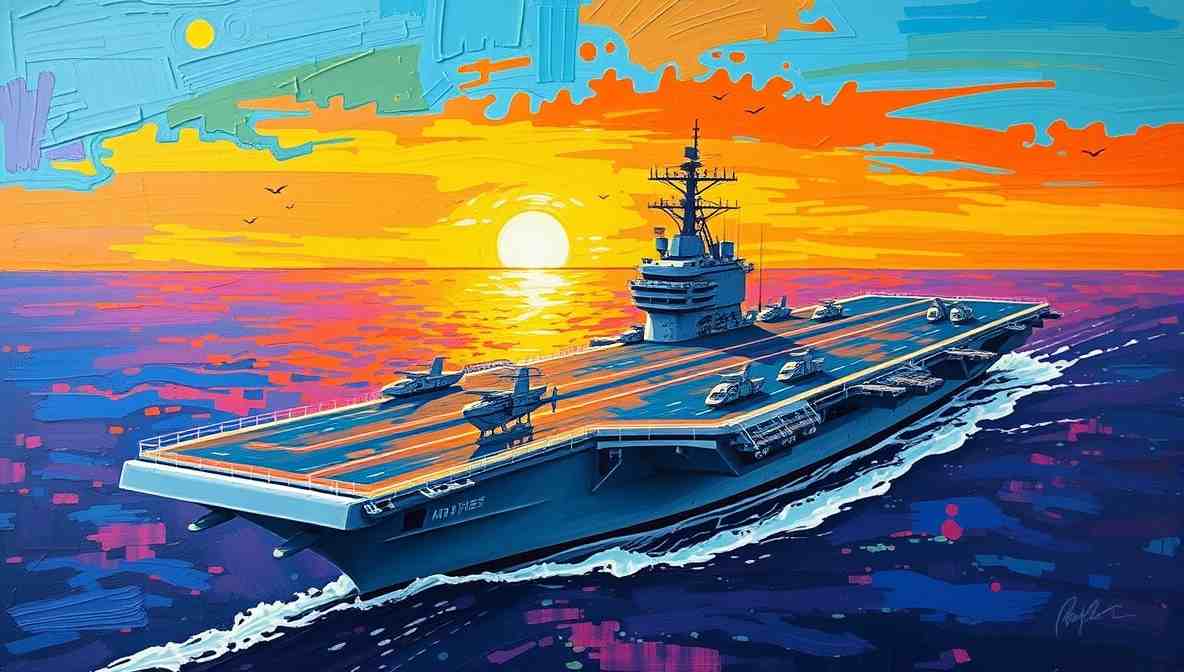
U.S. Navy Supercarrier Breaks Record for Longest Deployment, Crew Begins Identifying as “Ocean Adjacent”
“I’ve been on long trips, but never one where the return date is written in pencil and then erased.” — Jerry Seinfeld
“Any job that makes you miss your ex starts to look like a bad career choice.” — Ron White
“They told these sailors they’d see the world. Turns out it’s the same water, just from different angles.” — Amy Schumer

Out in the vast blue nowhere, somewhere between “strategic presence” and “did we forget something back home,” the USS Gerald R. Ford has officially drifted into history by breaking the record for the longest modern carrier deployment. The Navy calls it a “testament to readiness.” The crew calls it “a relationship that should have ended months ago but keeps texting ‘u up?’ at 2 a.m.”
According to a leaked internal memo, the deployment was originally scheduled to last a normal amount of time — defined by Navy standards as “long enough to miss birthdays but short enough to remember your own address.” However, due to “evolving global conditions,” “strategic recalibrations,” and one lieutenant accidentally hitting “extend calendar event,” the mission has now stretched into what sailors are calling “the nautical version of a hostage situation, but with better uniforms.”
Rear Admiral Curtis “Just One More Week” Henderson addressed reporters via satellite, explaining, “This deployment demonstrates the flexibility and resilience of the modern U.S. Navy.” When asked if that flexibility included returning home, Henderson paused, looked off-camera, and said, “Let’s not get ahead of ourselves.”
Life Aboard the Floating Forever: Crew Morale at Sea
Eyewitness accounts from sailors paint a picture of a crew slowly adapting to life as semi-permanent sea creatures.
“We’ve stopped saying ‘when we get back,'” said Petty Officer Luis Martinez, who now measures time exclusively in beard growth cycles. “Now it’s more like ‘if we get back’ or ‘in the event of land.'”
Another sailor, who asked to remain anonymous because he’s already been assigned three additional duties for asking questions, described the psychological toll. “At first, we counted days. Then weeks. Now we just name the waves. That one’s Kevin. Kevin’s been with us for a while.”
A recent onboard survey conducted by the highly respected Naval Institute of Guessing Things found that 87.3% of crew members now consider the ship their “primary residence,” while 42% believe the ocean is “low-key judging them.”
Expert Analysis: Naval Psychology and Extended Deployment Stress
Dr. Meredith Klein, a maritime psychologist at the prestigious and completely serious Coastal Behavioral Research Center, weighed in on the situation.
“Extended deployments can lead to a phenomenon known as Temporal Drift Syndrome,” she explained. “This is where individuals lose track of time and begin to believe the ship has always existed and will always exist. It’s similar to working in middle management, but with more water.”
Klein cited studies showing that after nine months at sea, the human brain begins to replace memories of land with vague impressions like “trees probably exist” and “cars were real, right?” — a condition the Navy officially classifies as “operationally acceptable” and unofficially classifies as “not our problem until it is.”
Pentagon Response: Carrier Readiness and the Record Books
Back in Washington, officials are celebrating the record as a major achievement, unveiling a commemorative plaque that reads: “Longest Deployment — Because We Could.” The Navy has logged over 281 days at sea, with Chief of Naval Operations Admiral Daryl Caudle projecting the Ford into its eleventh month of deployed operations — a figure he called “extraordinary” before his hat fell off from tipping it so hard.
An anonymous Pentagon staffer offered a more candid assessment. “Look, nobody wants to say it, but at this point, bringing them back would feel weird. Like ending a TV show after it’s already jumped the shark three times. We’re committed now.”
Another insider revealed that the deployment extension strategy closely mirrors corporate office culture. “We just keep adding ‘one more objective’ at the end. It’s like a meeting that should’ve been an email, except the email is 1,100 feet long and nuclear-powered.”
Public Reaction to Record-Breaking USS Ford Deployment
A nationwide poll conducted by the American Institute of Asking People Things They Barely Understand found that 63% of Americans support the deployment, 21% oppose it, and 16% thought the USS Gerald R. Ford was a Ford dealership promotion.
“I think it’s great,” said one respondent in Ohio. “Shows we’re strong. Also, I didn’t know ships could stay out that long. Does it run on gas or vibes?”
Meanwhile, family members of the crew have begun adjusting expectations in ways that suggest the Pentagon’s definition of “soon” requires its own dictionary entry.
“My husband left when our son was in kindergarten,” said one military spouse. “He’s in middle school now. At this point, we’re just hoping they recognize each other.”
The Ship Itself Speaks: Mechanical Failures and Broken Toilets at Sea
In a surprising twist, engineers reported that the ship itself appears to be developing what they described as “personality traits.” This would be alarming news under ordinary circumstances. Aboard a ship that has called for maintenance 32 times due to toilet failures alone, it qualifies as a Tuesday.
“It creaks differently now,” said Chief Engineer Dana Wallace. “Like it’s sighing. Yesterday, the radar system glitched and briefly displayed the word ‘why.’ We’re monitoring the situation.”
The ship also survived a laundry room fire in March that burned for 30 hours, damaged sleeping berths for hundreds of sailors, and — in a twist only the universe could arrange — left a warship projecting American naval dominance with nowhere to wash its socks.
What Happens Next? The Ford’s Return and Navy Retention Crisis
Officially, the Navy insists the deployment will end soon. Unofficially, sailors have begun preparing for the possibility that “soon” is a flexible concept, much like “scheduled maintenance” and “work-life balance.”
“I’ve started learning to fish,” Martinez admitted. “Not for food. Just in case this becomes permanent.”
Back on deck, as the sun sets over yet another identical horizon, the crew of the USS Gerald R. Ford continues its historic mission: projecting power, maintaining carrier readiness, and wondering if anyone back home accidentally lost the keys to the ocean.
The USS Gerald R. Ford departed Naval Station Norfolk on June 24, 2025, for what was described as a routine Mediterranean rotation. The deployment expanded to include the Caribbean, Venezuela operations, NATO exercises in the North Sea, and ultimately combat missions over Iran as part of Operation Epic Fury. The ship is now approaching 11 months at sea — one of the longest carrier deployments since the Vietnam War — surpassing the USS Abraham Lincoln’s 294-day record from 2019–2020, and challenging the USS Nimitz’s pandemic-era high of 341 days. Chief of Naval Operations Admiral Daryl Caudle confirmed the milestone, calling it “extraordinary.” The Navy is simultaneously grappling with pilot retention problems, Tomahawk missile stockpile depletion (over 850 fired at Iran at $3.6 million each), and a toilet system that was never properly designed in the first place. The Ford is expected to return to Norfolk for a major overhaul — which, ironically, is scheduled to be performed by the USS George H.W. Bush shipyard team. The Bush just deployed to replace the Ford.
Auf Wiedersehen, amigo!