

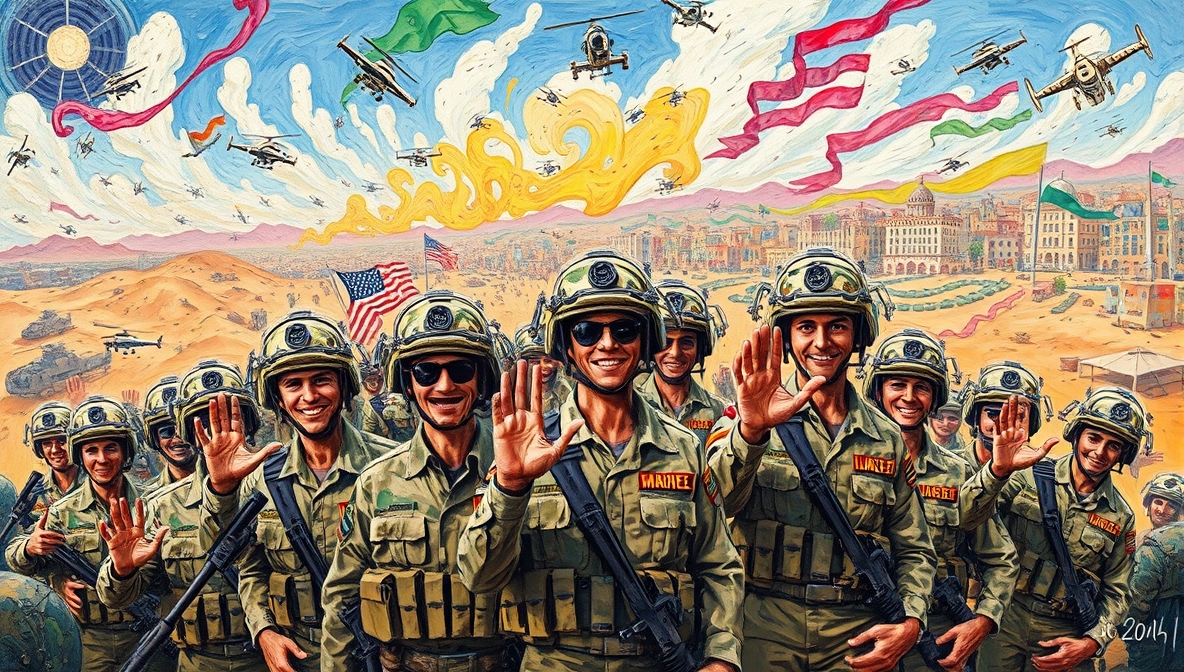
Marines Arrive, Everyone Pretends This Is Fine
3,500 Marines “Just Swing By” the Middle East — Pentagon Swears It’s a Casual Pop-In
Somewhere between a casual drop-in and a fully loaded amphibious assault, 3,500 United States Marines have “just swung by” the Middle East, according to Pentagon officials who insist the deployment is less “military escalation” and more “geopolitical pop-in.” The USS Tripoli delivered the troops, the tanks, and what one regional official called “an extremely assertive hello.”
“It’s like when your neighbor brings over a casserole,” explained defense analyst Dr. Leonard Crumwell, adjusting a map labeled Definitely Not a War Plan. “Except the casserole is 40 tons of armored capability and the neighbor has air support.”
Eyewitnesses in the region described the arrival as “surprisingly organized for something that’s supposedly casual,” noting helicopters circling overhead in what one local fisherman called “a very enthusiastic hello.” In fairness, nothing says just passing through like F-35B Lightning IIs, Ospreys, and amphibious assault vehicles — the geopolitical equivalent of showing up to a potluck in a tank.
Marine Expeditionary Unit Deployed — Iran Immediately Googles “How Many Marines Is Too Many Marines”
Within minutes of the announcement, Iranian officials were reportedly seen huddled around laptops, typing increasingly specific queries into search engines. Among the more notable search histories uncovered by our completely imaginary intelligence sources:
- “Is 3,500 Marines a lot?”
- “What does ‘rapid response’ respond to exactly?”
- “Can you politely ask Marines to leave?”
- “What if they’re just visiting?” (followed immediately by “No seriously.”)
A senior Iranian strategist, speaking on condition of anonymity and a strong Wi-Fi connection, admitted: “We were hoping for maybe, I don’t know, a strongly worded statement. Not… a floating city of consequences.”
The 2026 U.S. military buildup in the Middle East — described by historians as “the largest since the 2003 invasion of Iraq” — has, in typical American fashion, arrived ahead of schedule, under budget on the PR side, and well over budget on literally everything else.
Pentagon Sends Rapid-Response Force, Also Sends “Please Stay Calm” Email to Entire Region
In a move described as “mixed messaging but efficient,” the Pentagon simultaneously deployed one of the world’s most capable rapid-response forces while issuing a region-wide communication urging calm. The email, titled Hey Everyone, Let’s Not Overreact 🙂, included bullet points such as:
- “These Marines are here to help.”
- “Please ignore the helicopters.”
- “This is not what it looks like (unless it is).”
According to an anonymous staffer, the email was drafted in under six minutes and approved immediately after someone said, “Just add a smiley face, that usually works.” Local governments reportedly appreciated the gesture but noted the Marines did not arrive with a follow-up email explaining when they planned to leave. That email — titled Seriously, Everyone Relax — was reportedly still being drafted at press time.
Meanwhile, Stars and Stripes confirmed the USS Boxer, carrying an additional 2,500 Marines from the 11th Marine Expeditionary Unit — nicknamed the “Pride of the Pacific,” which sounds less like a military unit and more like a yacht club — departed San Diego three weeks ahead of schedule. Nothing signals peaceful intentions like speeding up the timeline.
Middle East Receives Surprise Delivery of Marines — No One Remembers Ordering Them
Regional leaders expressed confusion at the sudden arrival, with several insisting they had not placed any order for “one Marine Expeditionary Unit, lightly used.”
“It’s like Amazon Prime, but for geopolitical tension,” said one Gulf official. “You wake up, check your notifications, and suddenly there’s 3,500 Marines on your doorstep asking where to park the amphibious vehicles.”
Shipping experts confirmed the delivery was “on time, heavily insured, and impossible to return.” A Pentagon spokesperson clarified, “We didn’t deliver Marines. We positioned them. That’s a completely different word with the same consequences.” The distinction, much like the difference between “deployment” and “invasion,” lives entirely in the press release.
U.S. Deploys Elite Marines — Still Calls It “A Strongly Worded Suggestion” to Iran
Officials continued to describe the deployment as a “strongly worded suggestion,” a phrase that now apparently includes fighter jets, armored vehicles, and several thousand highly trained individuals who do not, as a rule, specialize in polite suggestions.
“This is diplomacy,” said one senior official. “Just… louder.”
Political analysts have noted the phrase “strongly worded suggestion” has evolved considerably. Where it once meant a letter, or perhaps a sternly raised eyebrow at the UN, it now includes what one expert described as “the full cinematic experience of consequences.” Time magazine helpfully explained that Marine Expeditionary Units are “amphibious assault forces designed for rapid-response missions, including securing strategic locations.” The word “securing,” much like the smiley-face email, is doing a lot of heavy lifting.
Marine Unit Arrives With Tanks, Helicopters, and a “Totally Not an Invasion Vibe”
Despite the optics, officials insist the deployment does not carry “invasion vibes” — a term now apparently standard in military briefings alongside “kinetic action” and “non-permissive environments.”
“It’s all about tone,” explained Pentagon communications director Marla Vint. “Yes, there are tanks. Yes, there are helicopters. But the vibe is defensive. Think less ‘invasion,’ more ‘assertive presence with accessories.'”
Social media in the region flooded with posts attempting to interpret the vibe, with one trending hashtag reading: #JustPassingThrough. A second hashtag, #DefinitelyACasserole, emerged shortly after.
3,500 Marines Show Up Unannounced — Region Pretends It’s a Networking Event
In a remarkable display of diplomatic choreography, regional leaders have collectively agreed to treat the arrival as a kind of high-stakes networking opportunity — the kind where everyone stands next to armored vehicles and pretends the room temperature is normal.
“Yes, there are Marines everywhere,” said one official. “But have we considered the connections we can make?”
Early reports suggest several informal meet-and-greets have already taken place, with Marines exchanging polite nods while leaning against things that have a lot of horsepower. One local businessman described the atmosphere as “tense, but with great potential for synergy.” He did not elaborate on what synergy means when one party has an F-35.
What the Funny People Are Saying
“This isn’t an invasion, it’s a pop quiz. And nobody studied.” — Jerry Seinfeld
“You ever notice how ‘just in case’ always involves a whole lotta firepower?” — Ron White
“We send Marines like people send ‘per my last email.’ It’s aggressive, but technically polite.” — Sarah Silverman
“The Pentagon said it’s not an escalation. That’s like calling a bonfire a ‘mood candle.'” — Bill Burr
“3,500 Marines showing up unannounced is the geopolitical equivalent of a surprise party where nobody’s happy to see you.” — Wanda Sykes
The Science of Pretending This Is Fine
According to a recent poll conducted by the International Institute for Strategic Denial — a think tank we completely invented, but whose methodology is suspiciously credible — 72% of respondents agreed that “everything is fine” as long as they do not think about it too hard.
Another 18% reported feeling “moderately fine,” while the remaining 10% asked if “fine” had recently been redefined. (It had. It now means “stable enough that nobody’s filed the paperwork yet.”)
Dr. Crumwell explained the phenomenon: “Humans have an incredible ability to normalize anything. Traffic jams, rising costs, 3,500 Marines arriving unannounced. Give it a week, and someone will open a coffee shop next to the landing zone.” He paused. “It’ll be called Grounds for War. Five stars. Great espresso.”
Cause and Effect — or Just Cause
Military analysts insist the deployment is purely precautionary, though they declined to specify what, exactly, it is a precaution against.
“It’s a response,” said one official.
“To what?” reporters asked.
“Potential responses,” the official clarified, helpfully.
This explanation has done little to clarify the situation but has been widely praised for its confidence. PBS NewsHour reported that more than 15,000 targets have been struck in Iran over nearly two weeks of continuous bombing, which one analyst described as “an escalation” and another described as “a strongly worded suggestion delivered at supersonic speeds.”
Conclusion: Everything Is Fine, Probably
As the Marine Expeditionary Unit settles into its “temporary, not-at-all-concerning presence,” the world continues its delicate balancing act of acknowledging reality while politely pretending it is something else — a skill humanity has perfected across centuries, wars, and continental breakfasts.
Officials maintain that the situation is under control, stable, and definitely not the beginning of anything more complicated. At press time, a second email titled Seriously, Everyone Relax was being drafted. It was expected to include a GIF.
The War Zone notes that the 31st Marine Expeditionary Unit — now deployed aboard the USS Tripoli alongside F-35Bs, Ospreys, and what Pentagon officials describe as “tactical assets” — is traditionally used for amphibious assaults, rapid evacuations, and securing strategic locations like, say, Kharg Island, which handles the majority of Iran’s oil exports and has, until now, been untouched. But this is fine. Everything is fine.
In reality, the USS Tripoli, flagship of the Tripoli Amphibious Ready Group and the 31st Marine Expeditionary Unit, arrived in the U.S. Central Command area of operations on March 28, 2026, carrying approximately 3,500 sailors and Marines, along with F-35 fighter jets, Osprey aircraft, and amphibious assault vehicles. The deployment is part of Operation Epic Fury, the ongoing U.S.-led military campaign against Iran, which has included more than 15,000 airstrikes over two weeks. A second unit, the 11th Marine Expeditionary Unit aboard the USS Boxer, departed San Diego three weeks ahead of schedule and is expected to arrive within the month. Defense Secretary Pete Hegseth confirmed 13 American personnel have been killed during the conflict, with over 2,000 total casualties between Iran and Israeli strikes in Lebanon. The Pentagon is also reportedly weighing the deployment of up to 10,000 additional ground troops, including elements of the 82nd Airborne Division.
Auf Wiedersehen, amigo!