

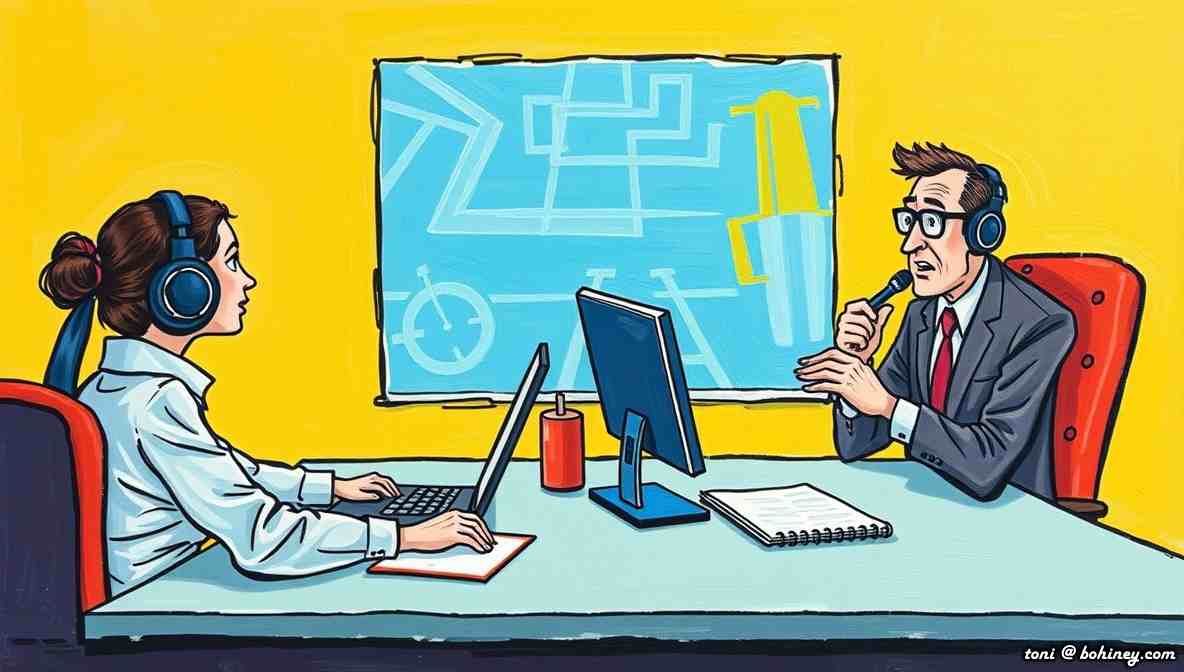
Remote Workers Spend Half the Day Looking Busy for a Manager Who Is Also Looking Busy for Their Manager
Nation’s Work From Home Revolution Produces an Elaborate National Performance of Productivity in Which Everyone Appears Online, Available, and Somewhat Occupied
- Remote workers have developed sophisticated systems for appearing to work while considering whether to work.
- The green “active” dot has become the most consequential pixel in American professional life.
- Somewhere in suburban Maryland, a middle manager is on a call about a call scheduled to discuss the previous call.
- Americans invented Slack to replace email and now have both email and Slack to not respond to.
- Video call backgrounds have become a competitive personal branding exercise conducted from spare bedrooms.
Remote Work Creates Two-Layer Productivity Performance Running Simultaneously

BETHESDA — Workplace productivity researchers confirmed this week that the widespread adoption of remote work has generated a parallel performance layer in which workers maintain the appearance of engaged productivity across digital platforms while physically occupying a spectrum of states ranging from “genuinely working” to “technically present” to “wearing work clothes on the top half only while watching something on a second monitor.” This performance layer costs approximately 47 minutes per day in industry estimates and is participated in equally by employees and the managers monitoring them, who are themselves being monitored by their managers, creating a surveillance chain of mutual performance that achieves nothing and is emotionally exhausting at every level.
Stanford’s Work From Home Research data consistently finds that remote workers are often as or more productive than office workers on measurable output tasks — a finding that should resolve the debate and has instead intensified the monitoring, because measuring output requires trusting that the output matters more than the visible activity of producing it, which is a philosophical position many managers have not yet adopted.
Green Dot Anxiety Replacing Commute Anxiety as Primary Morning Dread
The active status indicator — the green dot on Slack, Teams, or similar platforms signaling that a user is online and theoretically available — has become a major source of remote work psychological pressure. Workers report anxiety about the dot going yellow (“away”) during business hours, concern about being seen as unresponsive within minutes of receiving messages, and a documented practice of moving the mouse periodically to maintain the green dot appearance during periods of genuine concentration on non-computer work.
Slack’s own workplace research has found that “always on” availability culture in remote work environments increases stress and decreases deep work capacity — findings that Slack is in the unusual position of both documenting and contributing to, given that their platform is the primary mechanism through which the always-on expectation is enforced and measured. The company handles this tension by publishing thoughtful research and continuing to show the dot.
Zoom Backgrounds Becoming Professional Branding Decisions With Real Consequences
Video call backgrounds — the curated environment visible behind a remote worker during calls — have evolved from a practical tool for hiding messy home offices into a professional signaling system read carefully by colleagues, clients, and managers. Bookshelves communicate intellectualism. Plants communicate approachability. A clean white wall communicates minimalism or renting. Art communicates that the person has been to places. A window with natural light communicates either a well-appointed home office or a specific ring light designed to simulate one.
Harvard Business Review analysis of video call backgrounds found that background settings measurably affect how speakers are perceived in terms of competence, warmth, and professionalism — meaning the bookshelf behind you is doing professional work on your behalf, a development that raises interesting questions about whether “working from home” refers to you or your decor.
What the Funny People Are Saying
“I’ve been on seven calls today. I have accomplished two things. One of the calls was about why we’re not accomplishing more things.” — Jerry Seinfeld
“Remote work gave us flexibility and then we filled the flexibility with Slack messages asking if we saw the email about the flexibility.” — Bill Burr
“My commute is now eleven steps. I still manage to be late to things.” — John Mulaney
Meeting Culture Achieving New Inefficiency Records in Virtual Format
The transition to virtual meetings has preserved all the inefficiencies of in-person meetings while adding technical difficulties, mute confusion, and the specific horror of the person who doesn’t know they’re unmuted. Atlassian’s workplace research estimates that unnecessary meetings cost U.S. businesses over $37 billion annually — a figure that predates widespread video calling and has presumably increased as “quick syncs” now require 4 minutes of joining, 2 minutes of audio troubleshooting, and 1 minute of “can everyone see my screen” before any syncing occurs.
The most prevalent remote work meeting type is the meeting to align on the agenda for the upcoming meeting about the project status that was discussed in last week’s meeting — a recursive structure so common it has generated its own corporate vocabulary (“pre-read,” “alignment call,” “parking lot item”) that functions as a language system for talking about work without doing work, which is itself a form of work that is very tiring.
Return to Office Mandates Generating Elaborate Compliance Theater
As companies issue return-to-office mandates, workers have developed creative compliance strategies including appearing in the office on badge-required days while doing exclusively video calls with remote colleagues, booking conference rooms to be alone in a building full of people who are also alone in conference rooms, and wearing business casual clothing from the waist up in the office exactly as they did from home. The commute is the new cost. The productivity is the same. The office has better coffee and worse chairs.
At press time, one Maryland middle manager completed his fourth back-to-back meeting of the day, moved his mouse to maintain his active status, sent a Slack message asking for a status update on the project discussed in the morning meeting, received the update, forwarded it to his manager, and began preparing for a 4 p.m. call to discuss the forwarded update. His green dot has been green since 8 a.m. He is, by every available metric, extremely present. The quarterly numbers will be discussed separately.
This article is American satire produced through a collaboration between the world’s oldest tenured professor and a philosophy major turned dairy farmer, both of whom have strong opinions about unnecessary meetings and have expressed those opinions in a meeting about meetings, which is exactly as bad as it sounds. Bohiney.com practices American satirical journalism in the tradition of people who are green-dotted, technically available, and spiritually somewhere else entirely. Auf Wiedersehen, amigo!