

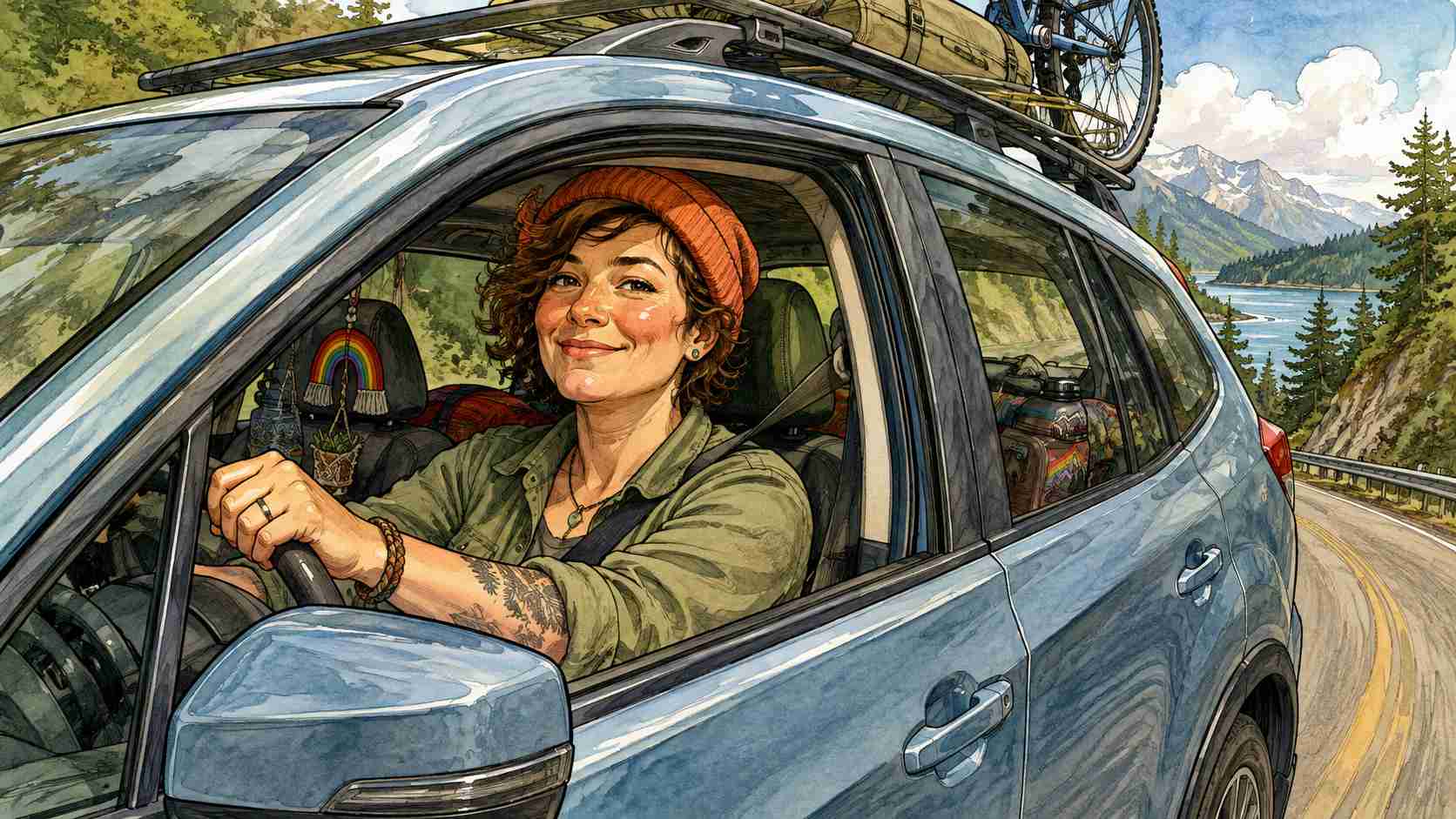
Subaru Confirms It Didn’t Choose the Lesbian Market, the Lesbian Market Chose It
Meanwhile, local woman buys a Forester for the cargo space and immediately fills it with emotional baggage from college
CHERRY HILL, New Jersey — Subaru of America issued a rare corporate clarification this week, insisting that the automaker never set out to become the official vehicle of American lesbians, but that the lesbian community arrived, unannounced, sometime in 1994, and simply never left.
“We didn’t choose this demographic,” said Subaru brand historian Carl Fenwick, adjusting a tie clip shaped like a roof rack. “We built a reliable all-wheel-drive wagon for people who haul kayaks. The market decided the kayaks were symbolic.”
Fenwick was referring to Subaru’s famously coded 1990s ad campaign, which included a license plate reading “XENA LVR” placed just visibly enough for one specific audience to notice and everyone else to assume was a typo. The campaign is now studied in marketing schools the way historians study the Rosetta Stone, except instead of decoding ancient Egyptian, business students are decoding a station wagon’s carabiner.
The Forester as Emotional Storage Unit
The announcement coincided with local news out of Northampton, Massachusetts, where 34-year-old Denise Okafor purchased a Subaru Forester “strictly for the cargo space” and had, within 72 hours, filled that cargo space entirely with unresolved feelings from her sophomore year of college.
“I needed the room for camping gear,” Okafor explained, gesturing toward a rear compartment containing a rolled-up sleeping bag, a cooler, and what she described only as “the whole Meredith situation.”
Okafor’s Forester reportedly gets 29 miles per gallon and roughly one unprompted memory of a 2 a.m. dining-hall conversation about Ani DiFranco per mile. Subaru does not currently advertise this feature, though internal documents suggest it has been standard since the 2009 model year.
“The cargo space is technically 76.1 cubic feet,” Fenwick confirmed. “We’ve never measured how much of that gets used for gear versus processing, but anecdotally, it’s close to even.”
Dealerships Report a Familiar Pattern
Sales staff at Subaru dealerships nationwide describe a recognizable customer journey. A woman walks in alone, test-drives an Outback, mentions she’s “just looking,” and drives off the lot ninety minutes later having also mentioned her ex, her ex’s dog, and a U-Haul that arrived at her apartment before the Subaru had finished being detailed.
“We used to think it was a coincidence,” said sales manager Rhonda Feist of a dealership outside Portland, Oregon. “Then we started keeping a tally. It is not a coincidence. It is closer to a liturgical calendar.”
Feist noted that financing paperwork now unofficially includes a verbal checkpoint her staff refers to as “the pause” — the moment a customer signs for a five-year loan on a vehicle roughly the size of a starter home, while also, somehow, deciding to merge finances with someone she met four months ago at a Melissa Etheridge tribute night.
Subaru corporate declined to confirm whether this pattern factors into inventory planning, though Fenwick allowed that the Pacific Northwest region does receive “a statistically unusual number of roof rack orders relative to actual kayak ownership.”
A Market Research Story, Not a Conspiracy
Marketing historians are quick to note that Subaru’s success with lesbian consumers wasn’t luck. Ad executive Martha Barletta’s research in the 1990s identified an underserved, famously brand-loyal demographic that other automakers were ignoring entirely, on the theory that ignoring a demographic is a sound business strategy. Subaru bet the other way, and the bet paid for several regional dealership expansions.
“It wasn’t rocket science,” Fenwick said. “It was a car that starts in the snow, holds a dog crate and two mountain bikes, and doesn’t ask a lot of emotionally invasive questions. Compare that to the competition.”
Asked to name the competition, Fenwick paused for a long moment and said only, “BMW,” with the tone of a man describing a breakup he still isn’t over.
The Broader Cultural Verdict
Sociologists studying the phenomenon caution against reducing it to a punchline, even as they concede the punchline is extremely funny and mostly accurate. The Subaru-lesbian association, they argue, reflects a broader truth about American consumer identity: people don’t just buy vehicles, they buy a story about who they are, and the story a Forester tells is “I am prepared for weather, and also for feelings.”
Jeep Wrangler owners, for comparison, buy a story about freedom that mostly plays out in a Chick-fil-A parking lot. Subaru owners buy a story about resilience that mostly plays out in a Trader Joe’s parking lot, in the rain, without complaint.
Both demographics, researchers note, are fiercely loyal to their brand, deeply suspicious of the other brand, and have never once considered driving a minivan, on principle.
Six Humorous Observations From This Report
- A Subaru’s resale value depends almost entirely on how many bumper stickers can be safely removed without also removing the paint.
- Nobody has ever successfully test-driven a Forester without accidentally test-driving a memory.
- The cargo space is advertised in cubic feet; it should be advertised in “college semesters.”
- Every Outback eventually contains a dog, a cooler, and exactly one item nobody in the car will discuss.
- The “XENA LVR” license plate frame has outsold several actual Subaru accessories.
- A U-Haul has never once beaten a Subaru to the apartment, but not for lack of trying.
Disclaimer
This is satire. Subaru’s 1990s marketing outreach to LGBTQ consumers, including work by ad strategist Martha Barletta, is a documented piece of advertising history; the emotional-baggage cargo space is not. No actual Subaru dealership tracks relationship timelines, and no actual Forester owner named Denise Okafor exists. This story is a work of satirical journalism and satirical news commentary, entirely a human collaboration between two sentient beings — the world’s oldest tenured professor and a philosophy major turned dairy farmer.