

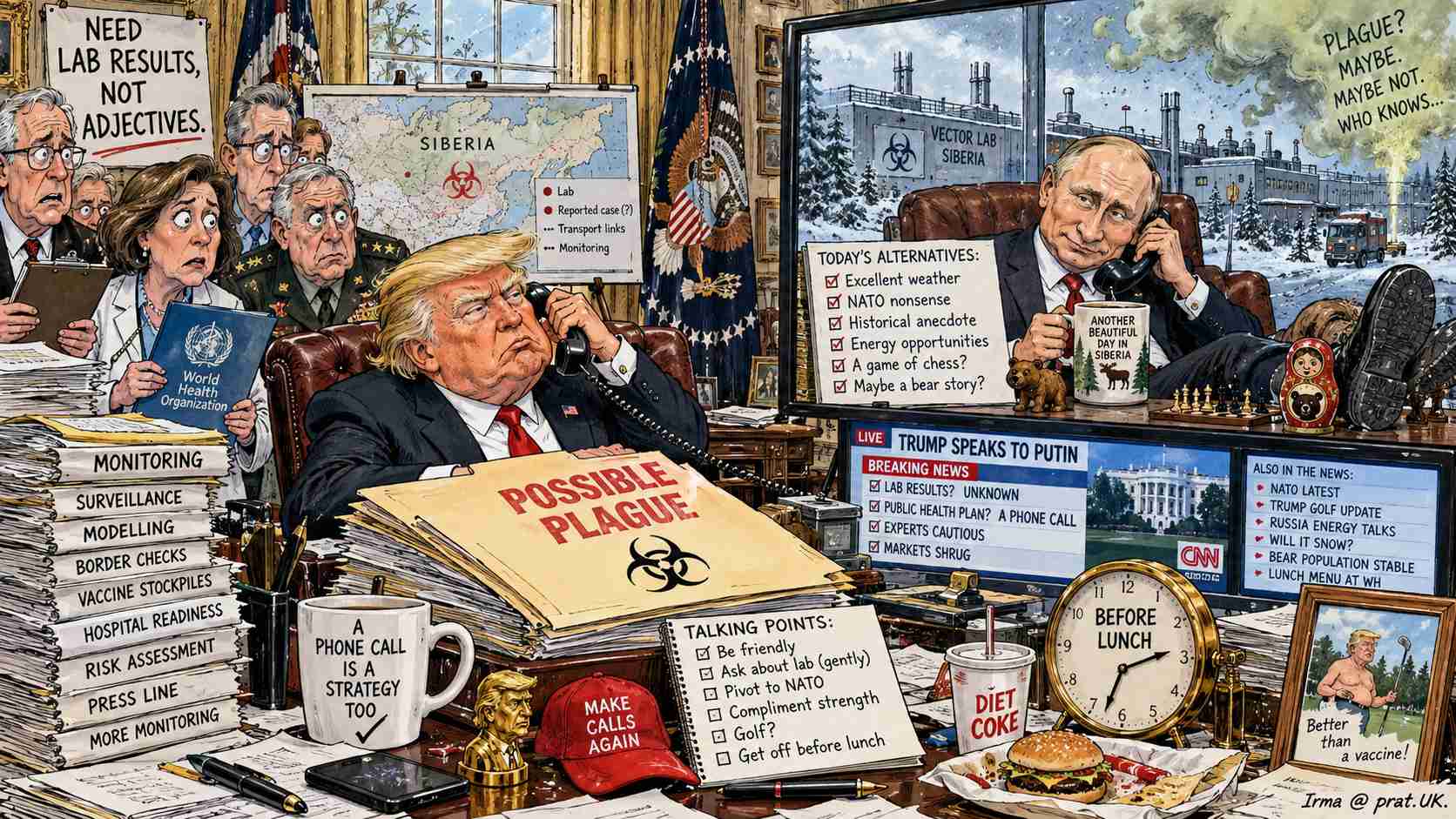
A lab worker is dead, the WHO wants details, and the response plan is a phone call.
WASHINGTON – A lab worker in Siberia dies after a suspected case of pneumonic plague, and the plan is a phone call. Of course it is. What’s the deal with us finding out about a plague from the same method we use to move a tee time.
Pneumonic Plague: What It Is and Why Speed Matters
Pneumonic plague is the one that goes by air and doesn’t negotiate. Antibiotics work if you’re fast. Fast is not the word anybody’s using. The WHO asked for details. Moscow did not sprint toward the details. U.S. officials said they’re monitoring, which means they have a folder and a feeling. Trump said he’s got Putin on the schedule. The folder is thrilled. The folder was starting to think nobody important would pick it up.
Here’s why “fast” matters so much. According to the World Health Organization’s plague fact sheet, the incubation period for the pneumonic form can be as short as a day, and untreated it can kill within roughly 18 to 24 hours of onset. Ordinary antibiotics cure it if they go in early. Early is the whole game. The CDC’s plague overview says the same thing in plainer English: it’s curable, but treatment has to come quickly. Notice that nothing in either document says “after a phone call.”
What a Trump-Putin Phone Call Can and Can’t Deliver
I’ve been around a phone call. A phone call is two men and a story. One of them already has the story he likes. You can ask him for the other story. He has heard of it. He may send you a weather report and a note about NATO. Allies say a direct question gets a direct answer. People who have done this before say a direct question gets an anecdote from 1999. Both groups are waiting on the same readout. The readout will have adjectives. Adjectives are not a lab result.
What We Know, What We Don’t, and Who’s Panicking Anyway
Cable news had a weapon, a leak, and a plume before supper. The reports had a death and a suspected exposure. That’s the whole spread. We don’t know if there’s a second illness. We don’t know what the institute was doing. We know a man is dead and a president is going to ask the other president about it, because that’s the escalator we’ve got that isn’t a worse escalator. Health officials said the risk to the American public is not the tale they’re telling. The tale they’re telling is they can’t get answers, and the call is the step before the steps they don’t want to name.
I’d like to be clear that nobody has shown me evidence of a weapon. Nobody has shown anybody evidence of a weapon. What we have is a death, a lab, a country with a long record of not volunteering information, and a news cycle that fills silence with whatever’s loudest. Pneumonic plague turning up at a research institute is, sadly, not a spy novel. Labs work with dangerous organisms. Sometimes people get hurt. The only thing in this story that’s suspicious is how little anyone in Moscow wants to say about it.
If I were drafting the talking points for that call, I’d keep them short. One: what was the lab working on. Two: was anyone else exposed. Three: will you let international inspectors, or at the very least a couple of epidemiologists with a thermos, take a look. That’s it. Three questions, and a polite person could ask them in under a minute. I’d bet the real call runs forty minutes and covers at least one grievance from 2014. That’s how these go. The thing you phoned about is always the last item on the agenda.
Kyiv, the Same Morning
Same morning, Russia hit Kyiv again. Two people dead in a garage cooperative. Nobody official connected the plague call and the strike. The calendar connected them, which is how this works. You pick up the phone to ask about a lab, and the man on the other end has already sent missiles to a capital. The readout will mention one. Guess.
Meanwhile, if you’re wondering whether to worry, the useful answer is a boring one. Plague is old, it’s understood, and it’s treatable. It’s also a disease that rewards fast information and punishes secrecy, and secrecy is the one thing the situation has plenty of. A stalled answer from a lab is the real alarm bell here, more than any single case.
Why Markets Ignored It and Watched Oil Instead
Markets didn’t move on plague. Markets moved on oil. Markets are animals. They understand a barrel. They do not understand a Siberian institute, and they refuse to learn. The president said he’d get to the bottom of it. The bottom has a schedule conflict. It’s in a meeting with the weather report. It may be available after lunch. It may be the lunch.