

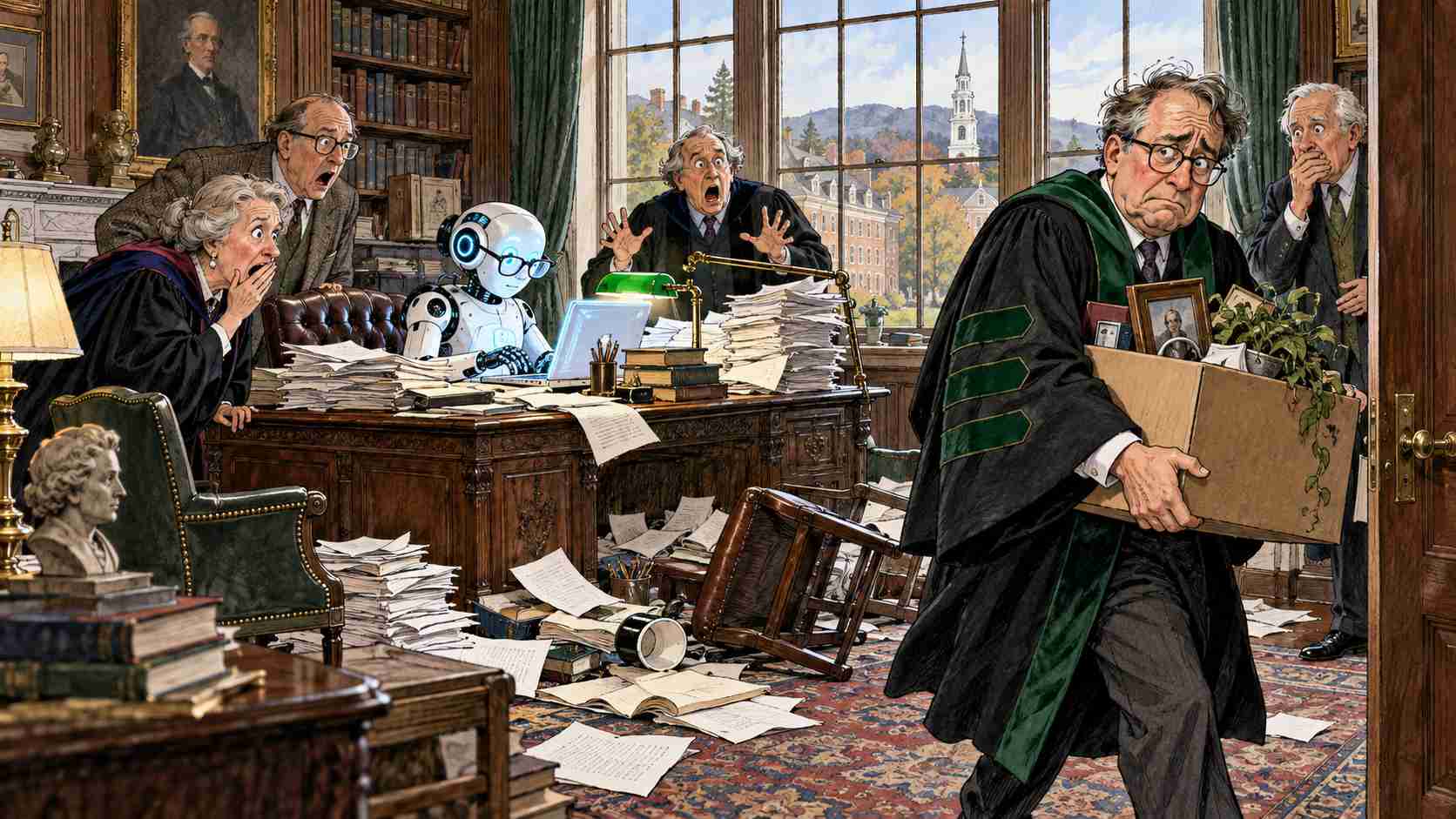
The Faculty Now Gets Caught Cutting the Same Corners as the Freshmen.
HANOVER, New Hampshire — Dartmouth College’s provost has resigned after a faculty review found that his use and disclosure of artificial intelligence in published writing fell short of institutional and publication standards. America’s elite universities have finally achieved educational equality: the faculty can now get caught cutting the same corners as the freshmen.
What the Dartmouth Provost Review Found
Santiago Schnell’s departure followed an official Dartmouth review released October 28. The committee described failures to disclose AI use and shortcomings in candor. That is a real academic-integrity finding, not proof that every word he ever wrote came from a machine. Subtlety matters, especially when your university tuition could buy a decent house in parts of America.
For generations, professors have delivered lectures about original thinking. Students were warned that shortcuts undermine learning, damage trust and threaten the sanctity of the footnote. Meanwhile, modern universities have been experimenting with a new educational method known as “Do as I assign, not as I submit.”
Academic Integrity and AI Cheating: A Hearing Transcript
A transcript of an undergraduate disciplinary hearing, circulated on a campus message board, shows how the proceeding went badly.
“Did you use a chatbot?” demanded the professor.
“Only to improve clarity,” replied the student.
“That is unacceptable.”
“Great,” said the student, “because I learned the phrase from the administration.”
The transcript notes that the hearing was adjourned at 4:12 p.m., after the professor asked for a short recess and was seen Googling “how to disclose.”
The scandal illustrates an ancient law of higher education: nothing becomes a crisis until somebody discovers the person setting the rules is subject to the rules. Before that, it is a complex governance issue requiring eighteen committees and a symposium catered with miniature sandwiches.
Is Using AI to Edit Writing Actually Cheating?
AI can be a useful editing tool, and universities are still developing standards for appropriate assistance and disclosure. The problem is not that somebody consulted software. It is that the university’s top academic officer was expected to model candor about doing so. Academic honesty is a peculiar concept, but it generally includes telling the truth. Guidance from groups like the Office of Research Integrity and the American Association of University Professors keeps getting longer, which suggests nobody is reading it.
A Campus Spokesman Explains the New Policy
A campus spokesman introduced a comprehensive new policy: all students and administrators must disclose technological assistance, except when the document is particularly embarrassing, in which case the document will be classified as “an evolving conversation around authorship.” Asked who decides what counts as embarrassing, the spokesman said a committee would be formed, and that the committee had drafted its own charter in under eight seconds.
What Students Are Saying
A show-of-hands poll in a dining hall found that 84 percent of undergraduates believed disclosure rules should apply to everyone, 11 percent believed they should apply only to students, and 5 percent were holding a sandwich and did not hear the question. The poll’s margin of error was one sophomore who raised both hands.
Students promptly proposed a fresh grading scale. An A means original work. A B means minor editorial assistance. A C means a chatbot substantially improved the prose. An F means a freshman did it. Senior administrators receive an honorary degree and a professionally drafted statement thanking colleagues for their support.
The lesson is neither that software is evil nor that professors are uniquely corrupt. Standards just get funnier when they climb the stairs to the executive office. The same rules should apply whether the author is nineteen years old or has an office with a fireplace.
A sophomore who watched the news break from a library carrel said the whole episode felt familiar. “I got a warning for using a grammar checker,” she said. “Now I’m told the provost has an assistant that does the grammar, the thesis and the tone. I’d like to apply for that position. I understand it pays nothing and requires no sleep.”
Dartmouth now faces the difficult task of rebuilding trust. Fortunately, there is already a convenient tool for producing a heartfelt apology in under eight seconds.
5 Humorous Observations About AI in Higher Education
- Four years, two hundred grand, and the main lesson is “don’t get caught.” That’s the real degree. The diploma is just the receipt.
- When a freshman uses a chatbot, it’s a hearing, a lawyer and a letter to your parents. When the provost does it, it’s a “review.” Same thing, different parking spot.
- You ever notice professors say “show your work” and then the work shows up in perfect paragraphs at 3 a.m.? Nobody writes that well at 3 a.m. At 3 a.m. I write texts to my ex.
- “An evolving conversation around authorship.” That’s not a policy, that’s what you say when you borrowed a lawn mower and it came back different.
- The scariest part is the apology letter. It’s so good. It’s so sincere. It has a little tear in it. And you realize the machine is better at being sorry than we are.