

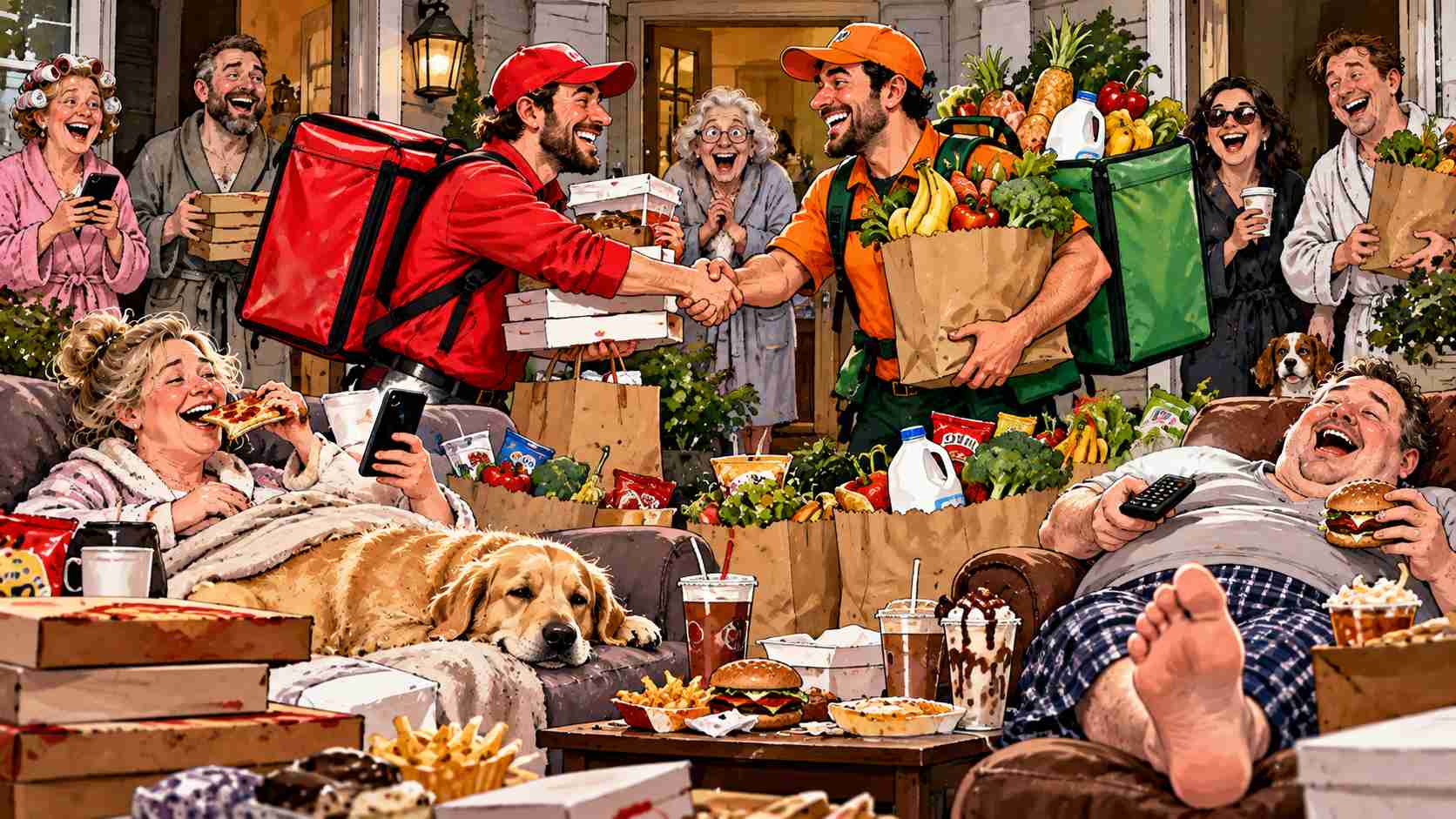
Nobody Leaves the Couch Except the People Carrying the Groceries.
SAN FRANCISCO, California — DoorDash has agreed to buy Instacart in a transaction valued at roughly $17 billion, bringing America a step closer to the glorious day when nobody has to leave the couch except the people being paid to carry everyone else’s groceries.
DoorDash Instacart Acquisition: What Was Announced
The companies announced the agreement Thursday, describing a plan to help local stores compete and give customers more delivery options. The acquisition is not yet the same thing as a completed merger. In Silicon Valley, however, the celebration begins as soon as somebody draws two company logos inside one PowerPoint circle. Antitrust reviewers at the Justice Department’s Antitrust Division and the Federal Trade Commission will now take a look, which in Washington means everybody gets a binder.
Traditional civilization required a person to visit the grocery store, select dinner ingredients, carry them home and cook. The next stage allowed dinner to arrive by motorcycle. Now a single corporate empire may coordinate both experiences, eliminating the terrifying possibility that an American might accidentally take six thousand steps.
The Hidden Cost of Grocery Delivery Fees
The modern consumer is willing to pay a delivery fee, a service fee, a small-order fee and a tip to avoid a five-minute conversation with a cashier. Asked why, one customer replied, “The grocery store has people in it.” This is the kind of compelling market research that sends venture capitalists into religious ecstasy.
Exhibit A: The Banana Receipt

Consider the economics of a banana. At the supermarket it is a banana. In the delivery economy, it is a banana plus platform infrastructure, personalized convenience, dynamic logistics, municipal surcharges, a recommended gratuity and an optional subscription that saves you money after you have spent another four hundred dollars. A receipt shared by a Sacramento man shows one banana at $0.29, a service fee of $3.99, a delivery fee of $5.49, a “regional adjustment” of $1.10 and a tip suggestion of 22 percent of the banana. The banana, he reports, was fine.
DoorDash and Instacart say the proposed combination would benefit shoppers, merchants and delivery workers. That could prove true. But Americans are entitled to wonder whether fewer independent platforms will eventually mean fewer competing checkout screens on which to discover that their nine-dollar lunch now costs twenty-seven dollars. The USDA’s food price outlook already makes grim reading before anybody adds a service fee.
A Company Spokesperson Explains the Vision
“The next opportunity is to acquire the business that reminds customers they’re hungry,” a company spokesperson said at a briefing for analysts. “Then we can charge them before they even order.” The room applauded. A person in the second row, who said later that he was only looking for the exit, was handed a term sheet.
The Step Count Study
A study of 1,200 households found that families using both grocery and restaurant delivery logged an average of 214 fewer steps per week to the front door, though the researchers noted that several participants had only walked there to move the packages inside, to avoid being seen by neighbors with the same problem.
The nation’s last remaining self-sufficient citizen, a seventy-year-old man who owns a pickup truck, has reportedly stunned analysts by buying groceries himself. He entered the store, selected tomatoes, paid the posted price and returned home without paying anyone to track his tomatoes on a map. Economists are studying him as a possible national security threat.
Delivery Workers Carry the Real Weight
Workers, of course, perform the actual lifting, navigating, driving and carrying that make convenience possible. Their labor deserves attention amid the celebratory talk about frictionless technology. The friction has not disappeared. It has merely been transferred to somebody’s knees, fuel bill and afternoon traffic.
Americans once feared a future in which robots did all the work. Instead they built a future where another human does all the walking while an app asks whether you’d like to round up for charity.
Soon the only thing that will not be delivered to your home is the financial discipline required to stop ordering delivery.
5 Humorous Observations About Grocery Delivery Apps
- Seventeen billion dollars so I never have to talk to a cashier. You know what a cashier costs? Nothing. She says “paper or plastic” and you say “plastic” and everybody goes home. That’s a free service. We paid seventeen billion to make it expensive.
- The app asks if I want to tip before the guy has even picked up my groceries. I haven’t gotten anything yet and I’m already apologizing. That’s not a tip, that’s a hostage payment with an emoji.
- Remember when “cooking” meant a stove? Now it means opening three apps and hoping the sushi and the milk arrive in the same decade. I’m not hungry anymore. I’m a logistics manager with a headache.
- My grandfather walked two miles for a loaf of bread. Uphill. Both ways. And now I’m panicking because the driver is four minutes away and I’m out of ice. That’s not progress, that’s a very comfortable emergency.
- The scary part isn’t that they’ll deliver everything. It’s that someday the door will open and they’ll hand me my own life, in a bag, with a $4.99 service fee.