

Washington Orders Study as Deere Recalls 275 Workers
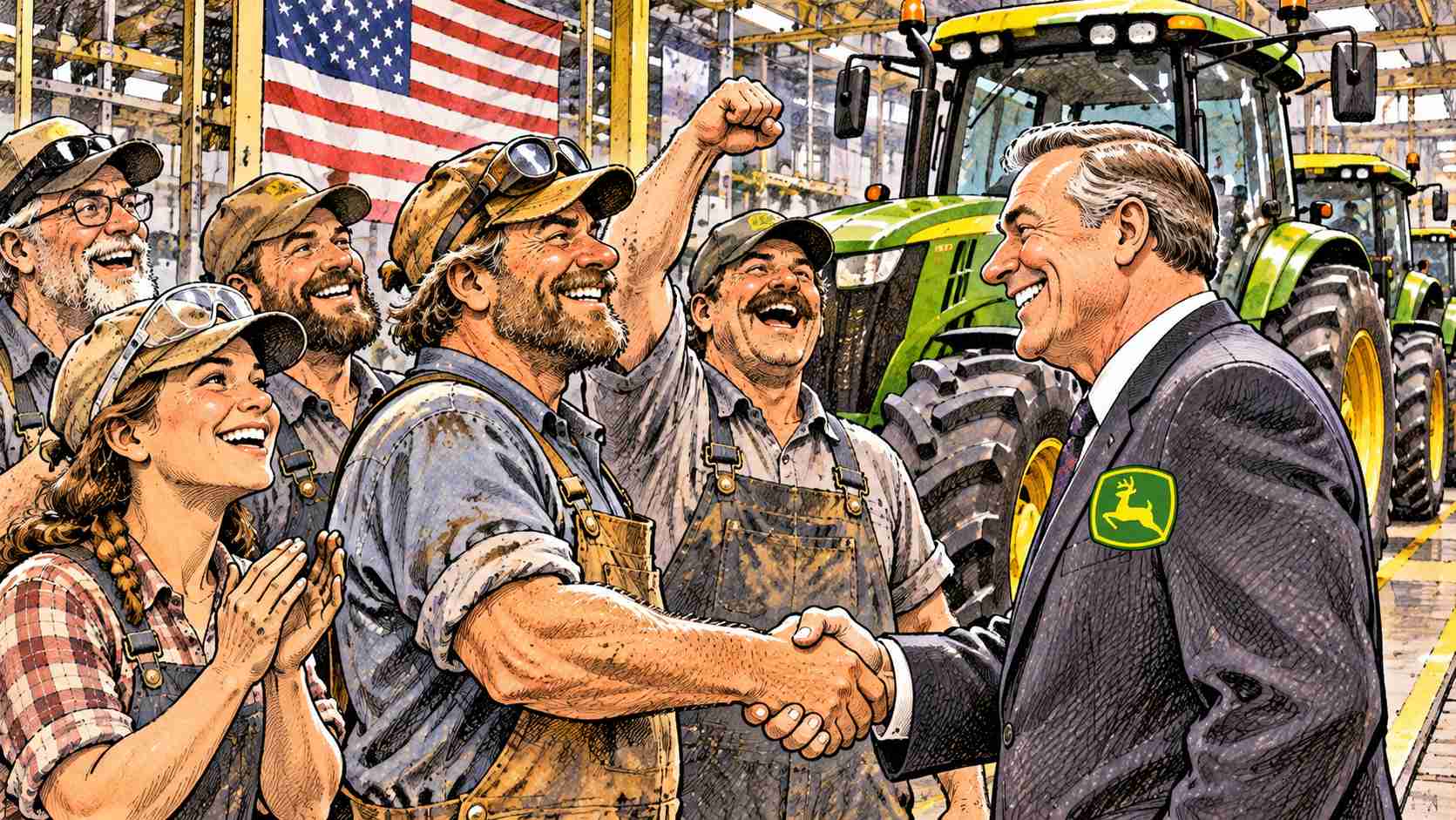
WATERLOO, Iowa — John Deere has announced plans to recall more than 275 Waterloo employees and hire more than 400 additional workers, providing fresh evidence for a controversial economic theory: American manufacturing might work better when Americans actually manufacture things.
The announcement is welcome news for Midwestern communities whose fortunes remain closely tied to agriculture, industrial employment and the mysterious ability of ordinary citizens to purchase groceries with money earned at work.
According to KCRG’s report on the Deere announcement, the decision follows a period of workforce reductions during weaker agricultural equipment demand.
The news has inspired economists to reconsider a theory largely abandoned during several decades of enthusiastic corporate restructuring. Apparently, paying Americans to manufacture American products can produce economic benefits that reach beyond the people who receive the paychecks.
Economists Rediscover the Paycheck and Its Local Economic Impact
Under the newly rediscovered system, a manufacturing employee works approximately 40 hours a week and receives compensation. The employee then spends part of that compensation at grocery stores, restaurants, automobile dealerships and other businesses. Those businesses employ additional workers who receive compensation and spend it elsewhere.
The process continues until the money encounters either federal taxation or a teenage daughter’s wedding.
One Waterloo restaurant owner explained the relationship.
“When people work, they come in here and buy lunch. When they’re laid off, they eat at home. It’s a complicated system, but we’ve been studying it since lunch was invented.”
Local barbers, mechanics and retailers reportedly expressed similar enthusiasm. A workforce expansion means more customers, stronger household finances and fewer uncomfortable conversations at the kitchen table about whether the family can afford new tires. The Bureau of Labor Statistics machinery manufacturing data shows how closely those household budgets track factory hiring.
Washington Announces Investigation Into Whether Employment Is Good
Federal policymakers reportedly greeted the announcement by proposing a comprehensive review of whether manufacturing jobs benefit manufacturing communities.
The study will require six congressional hearings, four economic consultants, a bipartisan advisory committee and approximately 11,000 pages explaining that people prefer receiving paychecks to not receiving paychecks. A preliminary recommendation suggests the United States should encourage companies to manufacture products domestically while ensuring customers can afford to purchase them.
Economists cautioned that implementing both policies at the same time could prove administratively challenging.
Agency Report Estimates $40 Million Cost to Confirm Jobs Are Helpful
A budget summary prepared for the proposed review, reviewed by this publication, estimates the total cost at $40 million. The largest line item, $12.6 million, is labeled “Site Visits.” A smaller item, $900,000, is labeled “Lunch.” A footnote explains that the lunch figure assumes the committee will eat at one of the local restaurants whose revenue the study is examining.
The report’s executive summary states that its goal is “to determine whether wages paid to workers contribute to the local economy.” The summary concludes on page two with the words “Early findings are encouraging.” The study has not yet started.
Hearing Minutes Record Question on Whether the Tractor Plant Is Open
Minutes from a preliminary hearing show a member of the advisory committee asking, “Is the plant open or closed?” A staff member answered that it was open. The member asked how many people work there. The staff member said several thousand.
The minutes record the member’s follow-up question as “Then why do we need a study?” and the chair’s answer as “Because we’ve already scheduled the room.” The motion to proceed passed without objection. The minutes note that lunch was served.
Historical Precedent: Henry Ford’s $5 Day Also Boosted Local Business
The idea that well-paid workers support the businesses around them isn’t new. Henry Ford’s decision to raise wages at his factories is widely cited by economists as an early example of workers becoming customers. Ford wanted people who built cars to be able to afford one.
The principle carries over directly to agricultural equipment. If the factory worker has a paycheck and the farmer has a profit, the tractor gets built and the tractor gets bought. The historical record doesn’t indicate that Ford required a $40 million study to reach the same conclusion. He had a calculator and a payroll.
Iowa Farmer Explains the Deere Hiring Plan in Four Steps
Meanwhile, Deere’s expansion faces an important reality: manufacturing prosperity depends on the economic health of its customers. Farmers must earn enough from crops and livestock to maintain equipment, invest in machinery and keep operating. Factory workers must earn enough to support their families. Communities need both groups doing well.
An Iowa farmer described the arrangement as common sense.
“If the factory worker has a job, he can buy groceries. If I make money farming, I can buy a tractor. If I buy a tractor, the factory worker keeps his job.”
He paused, considering the implications.
“That’s probably why nobody in Washington understands it. There aren’t enough steps.”
The farmer welcomed Deere’s announcement and congratulated the returning employees. The USDA’s farm income forecast suggests he may want to hold the congratulations loosely, since net farm income is projected to fall again.
He also offered a final observation about the company’s famous green equipment.
“The tractors are green, the corn is green, and everybody talks about going green.”
He looked at his bank statement.
“Now if somebody could figure out how to put a little green back in the farmer’s checking account, we’d have something worth celebrating.”
Five Humorous Observations
- Forty million dollars to find out whether people like getting paid. I could’ve told them that for a sandwich. Get me a pastrami and I’ll run the whole study from the parking lot.
- Twelve and a half million in site visits. That’s a lot of people driving to Iowa to look at a factory. Nobody’s ever driven to Iowa to look at a factory. They do it for the corn dogs, and then they expense it.
- “Is the plant open or closed?” Sir, you could’ve called. They have a phone. The phone has a number on it. You’ve got a $40 million budget and you didn’t Google the building.
- Money goes around until it hits federal taxes or a daughter’s wedding. Which one’s worse? The tax guy, at least, doesn’t ask for a deposit on a string quartet.
- Ford wanted his workers to afford a car, and Congress wants a committee to afford a lunch. We’ve gone from “build it and they will buy” to “study it and they will order dessert.”