

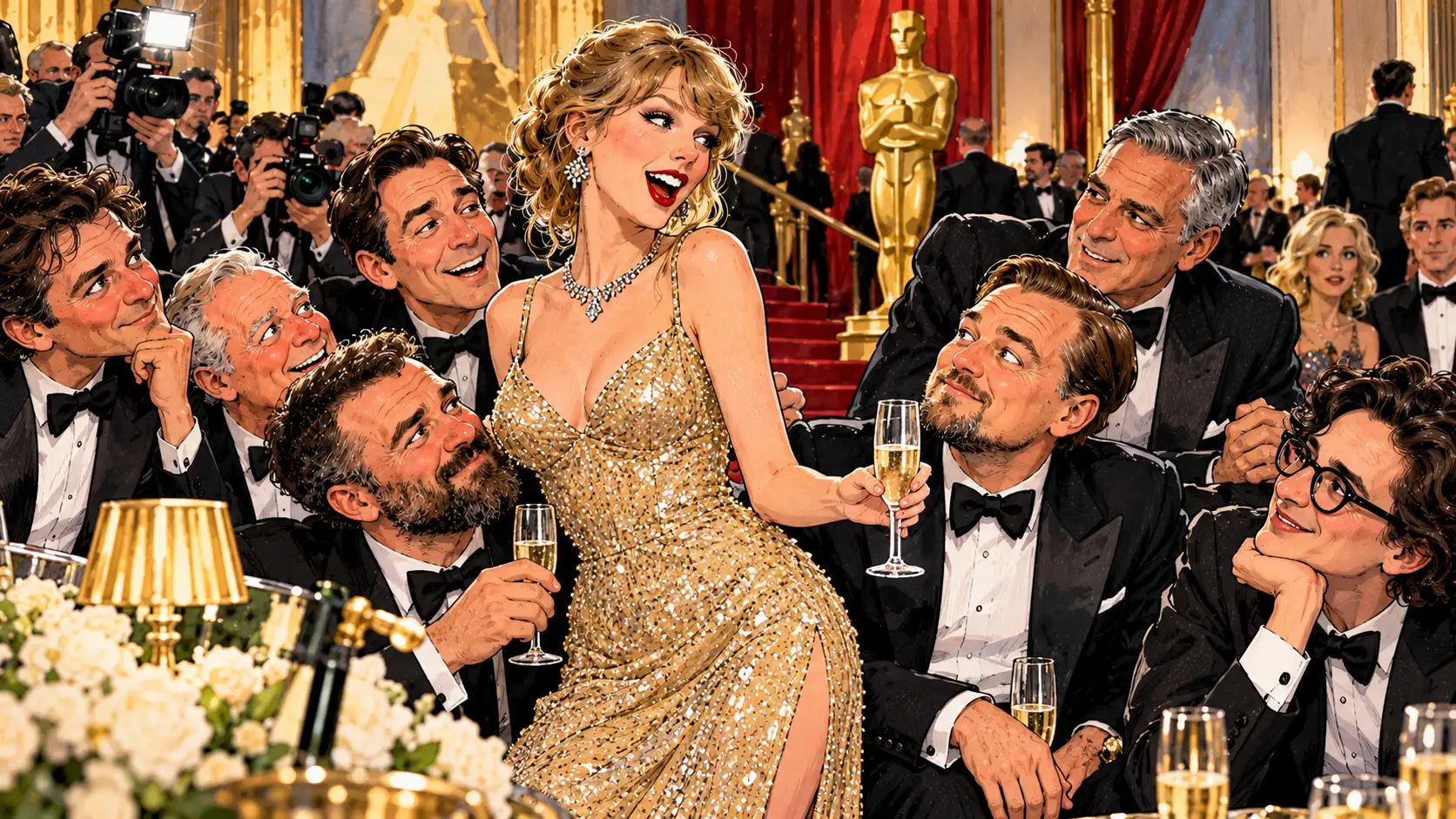
Hollywood Royalty Lines Up to Meet Someone Famous
LOS ANGELES – Hollywood experienced a serious disturbance in its celebrity hierarchy when Taylor Swift attended the Academy Museum Gala, performed four songs, and reportedly caused some of the world’s most celebrated actors to behave like ordinary people spotting a celebrity.
According to reports about Taylor Swift’s Hollywood charm offensive, attendees who already had Oscars, enormous fortunes, worldwide recognition, and professional publicists were suddenly desperate to meet the singer.
The incident handed Hollywood an unprecedented psychological crisis: What happens when everyone in a room believes they are the most important person in the room, and then somebody more important walks in?
Apparently, they form a line.
On October 17, Swift performed at the Academy Museum Gala in Los Angeles, an event honoring John Carpenter, Colman Domingo, and Charlize Theron. The evening raised more than $14 million for the museum’s exhibitions, educational initiatives, and public programs.
Swift performed “Blank Space,” “Love Story,” “The Fate of Ophelia,” and “I Knew It, I Knew You,” her original song from Toy Story 5, which is in contention for a possible Best Original Song nomination at the 2027 Academy Awards.
But according to industry insiders, the most important performance may have happened after the singing stopped.
One source described Swift as working the room like a master politician.
This is an enormous compliment in Hollywood, where politicians are generally considered disgusting opportunists unless they’re raising money for a film, endorsing an actor, or attending a fundraiser at somebody’s Malibu estate.
Hollywood Egos Meet Someone More Famous at the Academy Museum Gala
There are few places on Earth with a higher concentration of self-importance than an Academy Museum Gala.
The average guest has spent decades cultivating an image of effortless superiority, usually with help from a publicist, three stylists, two personal assistants, and a therapist who specializes in insufficient applause.
These are people with their own dressing rooms, private entrances, reserved restaurant tables, and security guards trained to stop ordinary Americans from asking how their day is going.
And yet all it took was Taylor Swift walking into the building to turn Hollywood royalty into teenagers hoping someone would sign their yearbook.
One entertainment insider told Rob Shuter that the room held people with Oscars, millions of dollars, and enormous influence, but that everyone suddenly wanted to meet Swift.
Hollywood had discovered something more powerful than celebrity.
Better celebrity.
There is always someone more famous. That’s the cruelty of the entertainment business. You spend 30 years climbing the ladder, reach the top, and discover Taylor Swift has installed an elevator.
The industry now faces the delicate task of explaining to award-winning actors why their accomplishments no longer command everyone’s attention at dinner.
In Hollywood, success is relative. You can have three Oscars and a mansion overlooking the Pacific, but if the person beside you gets more Instagram likes, you’ve somehow fallen into poverty.
Taylor Swift’s Best Original Song Oscar Push for Toy Story 5
Swift’s appearance also produced speculation about whether her performance might strengthen her prospects for Best Original Song at the 2027 Academy Awards.
Her song, “I Knew It, I Knew You,” appears in Pixar’s Toy Story 5, giving Hollywood the chance to combine its three favorite activities: celebrating famous people, campaigning for awards, and congratulating itself for making children’s entertainment.
The Academy Museum’s official announcement described the event as a celebration of filmmaking and support for museum programming.
But Hollywood knows every serious awards campaign also requires visibility.
You cannot simply write a wonderful song and expect someone to recognize it. That would place an unreasonable burden on the people responsible for recognizing wonderful songs.
First, voters must become aware of your existence.
Then they must be reminded of your existence.
Then somebody should mention that your existence has contributed significantly to the motion-picture industry.
Finally, they should receive a friendly reminder that ballots are approaching.
Swift has already collected 14 Grammy Awards. Somehow, Hollywood still wants additional proof that she understands music.
It’s rather like asking a Michelin-starred chef to demonstrate that he knows what a potato is.
What the Academy Rules Say About Best Original Song
The Academy’s actual Best Original Song voting rules require evaluation of musical craftsmanship, creative substance, and relevance to the film.
How Hollywood Actually Hears the Rules
The unofficial Hollywood interpretation is considerably simpler.
Was the song good?
Was the singer charming?
Did she remember my name?
Can we take a picture together?
The first question concerns artistic merit. The other three concern the entertainment industry’s entire social infrastructure.
Celebrities Who Demand Privacy Discover Celebrity Worship
Perhaps the greatest irony of Swift’s appearance was the behavior of Hollywood’s notoriously privacy-conscious elite.
These are people who routinely complain about public attention while attending events designed specifically to attract photographers.
They demand that the public respect their personal boundaries, then hire professionals to announce where they’ll be standing on Thursday evening.
They object to being treated as objects of fascination, unless the fascination produces a magazine cover, an advertising contract, or a lucrative documentary.
But put them in a room with Taylor Swift and suddenly celebrity worship becomes an important cultural tradition.
Ordinary Americans who approach an actor for a photograph are frequently described as intrusive.
Actors who approach Taylor Swift for a photograph are simply networking.
It’s a fascinating distinction.
When a supermarket employee asks a movie star for an autograph, he’s invading personal space.
When that same movie star approaches Taylor Swift, he’s celebrating artistic excellence.
The difference, apparently, is whether your own photograph has appeared on a billboard along Sunset Boulevard.
Hollywood could resolve the contradiction by adopting a universal policy on celebrity encounters.
Unfortunately, the policy would need separate provisions for famous people, very famous people, extraordinarily famous people, and Taylor Swift.
An entirely unofficial survey, conducted by watching how the industry generally behaves, suggests that 100% of celebrities support privacy for themselves and unlimited access to anybody more famous.
The margin of error is approximately one publicist.
Swift Reportedly Performed Free at the $14 Million Academy Museum Gala
Another striking detail emerged from reports that Swift bought her own gala ticket and performed without accepting a fee.
These claims, attributed to unnamed insiders, have not been independently established.
Nevertheless, the reported arrangement inspired considerable admiration, because Hollywood rarely encounters the concept of someone attending an event without charging somebody else.
For an industry accustomed to multimillion-dollar contracts, a celebrity performing without an appearance fee is a disturbing development.
What’s next?
Actors attending premieres without demanding customized dressing rooms?
Directors flying commercial?
Movie stars paying for their own sandwiches?
The Academy Museum Gala raised more than $14 million, according to the museum. It was an impressive total, particularly because the entertainment industry’s wealthiest personalities had gathered to demonstrate their commitment to the arts.
Hollywood is uniquely skilled at turning extraordinary wealth into an opportunity to discuss generosity.
A millionaire hosts a dinner for billionaires to raise money for a museum where future generations can admire the accomplishments of millionaires and billionaires.
Everyone goes home feeling they’ve made the world a better place.
And in fairness, supporting museum education and public access is a worthy purpose.
It’s the surrounding ceremony that deserves examination.
In most American communities, volunteers raise money by selling cookies, organizing raffles, or washing cars.
In Hollywood, they wear designer clothing worth more than a used sedan and applaud one another beneath corporate sponsorship banners.
It’s charity with a better lighting department.
Oscar Campaigning Has More in Common With Politics Than Music
The most revealing description of Swift’s appearance came from an insider who reportedly said she worked the room like a master politician.
According to the account, Swift was gracious, charming, and made guests feel special.
In Washington, this is called campaigning.
In Hollywood, it’s called an extraordinary display of personal authenticity.
Both industries run on a nearly identical system.
You meet influential people, compliment their achievements, express sincere interest in their work, remember their names, and try to leave them believing you’re the most delightful person they’ve met all evening.
The difference is that politicians do this hoping to obtain votes, while Hollywood celebrities do it hoping to obtain votes.
Washington has campaign consultants. Hollywood has awards consultants.
Washington produces political endorsements. Hollywood produces awards predictions.
Washington distributes campaign literature. Hollywood distributes screeners and promotional materials under detailed Academy regulations.
Both industries eventually gather in an expensive building, count votes, announce winners, and thank people nobody watching television has ever heard of.
The principal distinction is that Hollywood’s acceptance speeches generally run longer.
Swift, however, holds one major advantage over conventional politicians.
She can fill stadiums without promising to lower taxes.
A politician has to spend months convincing voters he’s sincere.
Swift can sing “Love Story” and have an entire room convinced they’ve known her personally since 2008.
None of this is an accusation of improper campaigning. There is no established evidence that her gala appearance violated awards rules or secured anybody’s vote.
What it shows is how far charm goes in a room where everyone has a vote, a publicist, and a highly developed sense of personal importance.
Steven Spielberg and Hollywood’s Ultimate Popularity Contest
Among the gala’s co-chairs was Steven Spielberg, one of the most successful filmmakers in motion-picture history.
The evening honored Charlize Theron, Colman Domingo, and John Carpenter, three artists from substantially different corners of cinematic achievement.
And yet reports suggest that Swift’s presence became the major social attraction.
That’s a remarkable feat in a room full of people who have spent their entire professional lives attracting attention.
Hollywood has finally met a practical demonstration of supply and demand.
When everyone is a celebrity, ordinary celebrity loses value.
The market demands a scarce commodity.
Someone who is a celebrity to celebrities.
Swift fills that position with considerable efficiency. She has persuaded millions of consumers to buy concert tickets, recordings, merchandise, and the emotional reassurance that their favorite song understands them.
Hollywood executives spend fortunes trying to manufacture precisely that relationship with audiences.
Then Swift walks into their fundraising dinner and demonstrates it without a PowerPoint presentation.
The situation raises an uncomfortable question.
If a singer can dominate Hollywood’s attention simply by attending a party, what exactly have the entertainment industry’s marketing departments been doing with all that money?
Academy Awards Campaigns: Where Artistic Excellence Meets Table Manners
According to the entertainment press, Swift’s appearance could generate goodwill among Academy members.
Goodwill is an interesting term.
In ordinary life, it means treating people decently.
In politics, it means persuading voters you’re worth supporting.
In Hollywood, it apparently involves performing songs, attending dinners, complimenting powerful people, and staying delightful enough that someone remembers you when voting begins.
None of this means Swift doesn’t deserve consideration.
Quite the opposite. She has already demonstrated her songwriting ability through decades of commercial success and industry recognition.
Nobody in the room objected to a successful musician being pleasant to people.
The industry insists artistic recognition is determined by pure creative excellence, while maintaining an elaborate social calendar that looks remarkably like an election campaign with better jewelry.
Most Americans believe musical awards should recognize excellent music.
Hollywood agrees, provided everyone has attended the appropriate reception.
Perhaps the system could be simplified.
Let voters listen to the songs without knowing who wrote them.
No celebrity introductions. No champagne receptions. No recognizable faces. No influential friends.
Just the music.
Naturally, this would devastate the awards-campaign industry, put hundreds of consultants out of work, and force Hollywood to face the terrifying possibility that it could make decisions without first organizing a banquet.
Such reforms are unlikely.
Too many powerful people depend on the existing arrangement, and nobody wants to be the executive who cancels a party attended by Steven Spielberg.
Will Taylor Swift Win an Oscar? Hollywood Has Already Lost the Celebrity Contest
Swift has not secured an Oscar nomination or victory merely by performing at the Academy Museum Gala.
The relevant votes remain ahead, and her song must compete through the Academy’s established selection process.
But Hollywood has already learned something valuable.
The entertainment industry may produce the world’s biggest stars, but it still has a remarkable ability to get starstruck.
A room full of Oscar winners, celebrated directors, wealthy producers, and veteran celebrities reportedly got excited about meeting someone famous.
Nobody would call that embarrassing.
It’s human.
Hollywood has spent decades insisting its celebrities are a different species from ordinary people.
They aren’t.
They want attention, recognition, flattering photographs, and the chance to tell their friends they met Taylor Swift.
Just like everyone else.
And if Swift eventually wins an Oscar for Toy Story 5, Hollywood will celebrate the triumph of artistic achievement.
If she loses, executives can announce that awards were never important in the first place.
Either way, there will undoubtedly be another reception.
Because Hollywood’s greatest talent has never been making movies. It’s making sure everyone knows who attended the party afterward.
Five Humorous Observations About Taylor Swift and the Oscar Gala
- You ever notice a room full of Oscar winners can’t handle one woman with a microphone? These people have gold statues on their shelves. Naked gold men. With their names on the base! Go home and talk to the statue. It’s not going anywhere.
- They say she worked the room like a politician. A politician kisses babies. Hollywood doesn’t have babies, it has agents. So she’s kissing agents. Same germs, worse breath.
- She bought her own ticket to a fundraiser, where she performed, for free. That’s not a gala, that’s a woman paying to go to work. My cousin did that. He called it a small business.
- Fourteen Grammys, and they still need to find out if she can write a song? Fourteen. At that point it’s not a résumé, it’s a hostage situation on your mantel.
- Hollywood throws a $14 million party for a museum about movies. Movies! You can watch those for free, in your underwear, with the dog. But sure, let’s get a lobby.
Satirical Disclaimer
This article satirizes Hollywood celebrity culture, Academy Awards campaigning, public relations, and the entertainment industry’s elaborate rituals of self-congratulation. Its comic commentary, exaggerated statistics, and institutional descriptions are intended as satire. Reported celebrity encounters and behind-the-scenes claims are attributed to entertainment sources, and no improper conduct by Taylor Swift or Academy members is alleged.
This story is entirely a human collaboration between two sentient beings: the world’s oldest tenured professor and a philosophy major turned dairy farmer.
SOURCE: https://www.yahoo.com/entertainment/music/articles/desperate-meet-her-taylor-swift-105052110.html
Reporting verified: The October 17 performance, four-song set, gala fundraising total, and Oscar eligibility are supported by contemporary entertainment coverage and official Academy material. The claims about working the room and declining a performance fee come from anonymous entertainment sources, not official confirmations.