

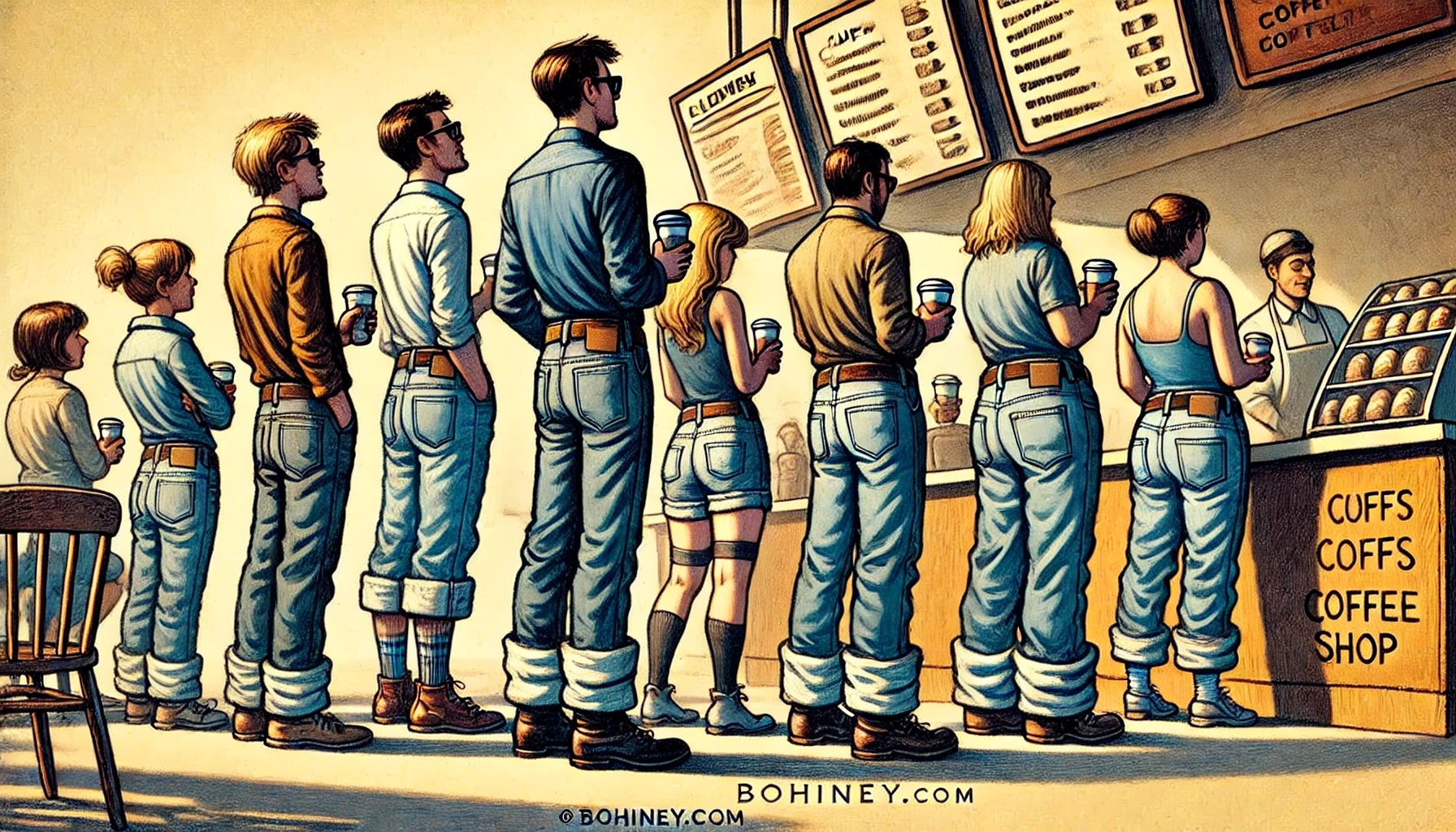
The Great Cuffed Jeans Conspiracy: Are We Just Rolling Up Our Lives?
Fashion’s Greatest Deception – Cuffed Jeans
Cuffed jeans are not just a passing trend—they are a full-blown psychological experiment orchestrated by Big Denim. While we were distracted by the rise and fall of skinny jeans, the reemergence of mom jeans, and the misguided attempt to bring back JNCOs, a sinister force was at work: the silent but relentless indoctrination of the cuffed jean lifestyle.
For decades, people lived happily with pants that reached the ground. Then, one day, a fashion guru with too much time and not enough inseam decided pants should end mid-shin—and we all just went along with it. But why? What do they gain from having millions of people meticulously rolling up their pants every morning like they’re preparing for battle against a rogue puddle?
According to Dr. Alana Mitchell, a professor of Sartorial Studies at the University of Extremely Expensive Fashion Degrees, “Cuffed jeans are an illusion of control. We believe we are making a style choice, but really, we are falling into an elaborate marketing scheme designed to sell more ankle lotions.”
A Timeline of Manipulation
Historians trace the first known occurrence of cuffed jeans to the 1950s, when rebellious teenagers began rolling up their pants to defy society. These were the same people who chewed gum too loudly, loitered outside diners, and thought combining leather jackets and slicked-back hair was the height of personal expression. The world moved on, but the cuffed jeans stayed.
In the 1990s, skateboarders adopted the cuff as a practical necessity. “I used to cuff my jeans to keep them out of my wheels,” said former skater and current suburban dad Greg Simmons. “Now I do it to keep up appearances at PTA meetings where all the other dads also cuff their jeans. It’s exhausting.”
By the 2010s, cuffed jeans had become a staple of the hipster aesthetic, nestled between overpriced cold brew and the word vibes. Their association with people who insist vinyl sounds warmer has done little to deter their popularity. Instead, the cuffed jeans phenomenon has continued to evolve into what it is today: a compulsory fashion choice forced upon us by unseen powers.
The Science of Cuffing: Ankle Exposure and Its Societal Impact
There’s a reason cuffed jeans exist, and it has nothing to do with fashion. Studies conducted by the Institute for Unnecessary Research suggest that exposing one’s ankles creates a subconscious sense of vulnerability, making people more susceptible to overpriced artisanal purchases.
Dr. Leonard Perkins, an expert in Consumer Psychology, states, “Our studies indicate that individuals wearing cuffed jeans are 63% more likely to pay $7 for a latte, 48% more likely to buy candles labeled hand-poured, and 92% more likely to own a bicycle with a basket that they don’t actually use.”
Furthermore, according to research published in The Journal of Completely Real Science, people who cuff their jeans also exhibit a distinct personality shift. “They become more inclined to discuss obscure bands, aggressively support local farmers’ markets, and develop an irrational hatred of socks,” the study notes.
One anonymous cuffed-jeans wearer admitted, “I used to just wear regular pants. Then one day I cuffed them, and suddenly I found myself nodding along to a conversation about ethically sourced kombucha.”
The Hidden Agenda of Big Denim
Cuffing your jeans might feel like a personal choice, but experts argue that it’s all part of a corporate scheme to manipulate the masses. Jean companies have been secretly adjusting pant lengths so that cuffs become a necessity rather than a fashion preference.
Take Levi’s, for example. In the 1990s, their standard inseam for men’s jeans was 32 inches. Today, it’s mysteriously grown to 34 inches, forcing consumers to either trip over their pants or adopt the cuff. The same phenomenon has been observed across major denim brands, leading to widespread speculation that the cuffed-jeans movement is a calculated effort to normalize pre-folded pants—an innovation currently being tested in European markets.
According to fashion insider Ava Rodriguez, “The next step is selling jeans that are permanently cuffed. It’s like how distressed jeans tricked people into paying more for holes. Soon, they’ll charge extra for pre-cuffed jeans because it saves you the effort.”
Rodriguez also warns of a more sinister possibility: “Some executives are floating the idea of reverse cuffs, where the fabric is sewn on the outside instead of rolled up. If that happens, we’ll all be walking around looking like rejected pirates.”
The Psychological Toll of Uneven Cuffs
Anyone who has ever attempted to cuff their jeans knows the existential despair that follows when one side is slightly higher than the other. It doesn’t matter how many times you re-roll, unroll, or smooth it out—one cuff will always be wrong, and society will judge you accordingly.
This asymmetry has led to what psychologists now call Cuff Anxiety Syndrome (CAS). Sufferers report spending up to 20 minutes adjusting their cuffs before leaving the house, only to realize they have wasted precious time they could have spent rewatching The Office for the 47th time.
“I missed my own birthday party because I was trying to fix my cuffs,” admitted one anonymous CAS victim. “By the time I got them even, my cake had already been eaten, and my friends had all left.”
Even those who manage to leave the house are not safe. Cuffed-jeans wearers often live in a constant state of paranoia, fearing that someone will notice the minuscule difference in their cuffs and whisper about it behind their backs. Some report catching judgmental stares from baristas, librarians, and small children who have not yet been corrupted by fashion.
The Unexpected Benefits of Cuffed Jeans
Despite their obvious drawbacks, cuffed jeans do provide some practical advantages. They are ideal for detecting early signs of rising sea levels, which is helpful if you live in Florida. They also make great conversation starters at parties where people pretend to care about small talk but really just want to talk about their astrology sign.
Additionally, cuffed jeans offer unparalleled versatility. You can roll them down for a formal event, roll them up for a casual outing, and even unroll them completely if you suddenly decide to become a person who no longer cares about joy.
For pet owners, cuffed jeans are a convenient way to collect and transport stray fur. “I thought my dog was shedding less,” said longtime cuffed-jean enthusiast Rachel Carter. “Turns out, all the hair was just accumulating inside my pant cuffs like a portable lint trap.”
A Call to Action: To Cuff or Not to Cuff?
So what can we do about the great cuffed-jeans conspiracy? Should we resist, fight back, and reclaim our unaltered pant legs? Or should we lean into the madness, embrace the cuffs, and prepare for the inevitable introduction of cuffed shorts—a trend so ridiculous that it may already be brewing in a Brooklyn loft as we speak?
Fashion experts argue that true rebellion lies not in rejecting cuffed jeans, but in wearing them in increasingly absurd ways. “We need to go beyond just rolling them up,” said activist and fashion disruptor Devin Marks. “We should start triple-cuffing or even quadruple-cuffing. We should wear one leg cuffed and one unrolled. We should cuff our jeans over our shoes. If we’re going to be manipulated by the fashion industry, we might as well make it weird.”
Marks’s movement, known as Cuff Chaos, is already gaining traction on social media. Thousands of people are sharing photos of experimental cuffing styles, including Inside-Out Cuffs, Diagonal Cuffs, and The No-Cuff Cuff (which involves aggressively denying that you ever cuffed your jeans in the first place).
Conclusion: The Future of Cuffed Jeans
Cuffed jeans may be a fashion statement, a corporate scam, or a social experiment designed to measure our patience—but one thing is certain: they are here to stay. Whether you embrace them, reject them, or spiral into an existential crisis over their implications, the cuffed-jeans revolution continues to roll forward—quite literally.
Perhaps, in the end, cuffed jeans are less about fashion and more about acceptance. The sooner we accept that we are all just rolling up our insecurities, the sooner we can focus on life’s bigger questions—like why anyone would pay $200 for jeans that already have holes in them.

Cuffed jeans: the fashion statement…
Cuffed jeans: the fashion statement that says, “I’m stylish, but also prepared for a surprise flood.”
Here are 15 observations about this controversial pant-folding technique:
-
Cuffed jeans are perfect for showing off your ankles—because nothing screams high fashion like drawing attention to the least exciting part of the human body.
-
The height of the cuff determines your personality. Small cuff? You play it safe. Medium cuff? You’re a fashionista. Giant cuff? You might be in a ska band.
-
Nothing is more terrifying than cuffing your jeans evenly on both sides. One inch off and suddenly, you’re the town jester.
-
People with cuffed jeans look like they’re always ready to step into a canoe at any given moment.
-
Ever notice how people who wear cuffed jeans always have a mysterious confidence? It’s like they know something the rest of us don’t—probably where to find the best overpriced cold brew.
-
Cuffed jeans are the middle ground between “I care about fashion” and “I gave up halfway but still need to function in society.”
-
The true sign of adulthood isn’t paying bills—it’s realizing you no longer have the patience to roll up your jeans every morning.
-
A single cuff says, “I’m chill.” A double cuff says, “I’m trying too hard.” A triple cuff says, “I’m legally required to be 500 feet from a middle school.”
-
The only thing worse than uneven cuffs? Uncuffing them midday and realizing your jeans now have permanent creases that make you look like you shop exclusively at a thrift store run by time travelers.
-
You spend all that time getting the perfect cuff height, only for it to slowly unravel throughout the day—because gravity is the enemy of fashion.
-
Cuffed jeans make your outfit look effortless—as long as you don’t mention the 15 minutes you spent getting them just right.
-
If you cuff your jeans in the summer, you’re trendy. If you cuff your jeans in the winter, you’ve made a terrible life choice.
-
Cuffed jeans make people think you have a deep appreciation for indie music, overpriced matcha, and conversations about vibes.
-
Wearing cuffed jeans is the closest you’ll ever get to time travel—it instantly transforms you into a 1950s greaser, a 90s skater, or someone in Brooklyn who only listens to music on vinyl.
-
Nothing makes you question your existence more than unrolling your cuffs at the end of the day and realizing your jeans are actually three inches longer than you thought.