

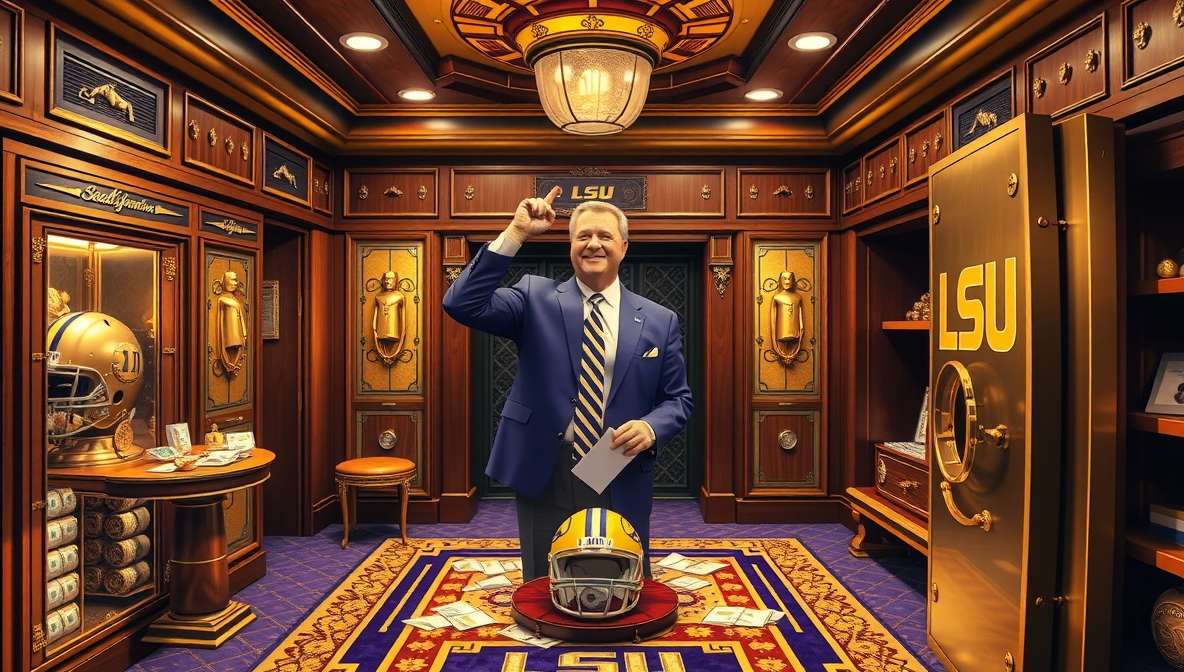
Fired, Paid, and Proud: Brian Kelly’s $54 Million LSU Golden Parachute
When Brian Kelly was handed his marching orders by LSU this week, fans of college football collectively gasped, shook their heads, and, in some cases, checked their bank accounts to confirm that yes, their mortgage payments were still due. Because while Kelly may have been relieved of coaching duties, he will reportedly walk away with $54 million over the next several years-a sum so large that it makes the notion of “getting fired” seem like a promotion.
Losing Never Felt So Good

In a statement that will go down in history as both ironic and profoundly confusing, LSU confirmed that Kelly’s “severance” will continue monthly through 2031. This isn’t just a paycheck-it’s more akin to a retirement plan funded by someone else’s tuition and ticket sales.
Witnesses at Baton Rouge gasped. “I couldn’t believe it,” said one LSU donor, who asked to remain anonymous while nervously checking the tuition bills for their two children. “We raised money for stadium renovations, and now he’s basically taking a small country’s GDP home every month.”
Performance Not Required
Kelly’s tenure, spanning four years and yielding a 31‑14 record with one playoff appearance, has been described by some as “adequate” and by others as “mediocre-but-expensive.” Yet, in an era where losing can be more profitable than winning, Kelly’s exit strategy looks like a business model perfected by Wall Street bankers: show up, sign a contract, get fired, collect a golden parachute.
As Jerry Seinfeld said about contracts: “What’s the deal with contracts? You sign them when you’re hired, but they really only matter when you’re fired. It’s like a prenup for your job-you’re planning the divorce before the marriage even starts.”
A recent poll conducted by the Baton Rouge Everyday Observer revealed that 78% of residents now believe LSU football is “more about financial engineering than touchdowns.” One anonymous student added, “I thought college was supposed to be about education, but apparently it’s just a hedge fund with cheerleaders.”
The BBC Sport’s coverage of American football has noted the growing trend of astronomical coaching buyouts across college sports, while The Guardian’s American football analysis questions whether universities have lost sight of their educational mission.
The Duty to Mitigate Clause
According to LSU’s contract structure, if Kelly gets another coaching job, his payout decreases-an ironic twist that turns employment into a game of strategic underemployment. One sports economist noted, “Basically, he has a financial incentive to sit at home, sip bourbon, and occasionally post inspirational quotes on social media.”
Ron White captured this perfectly: “I’ve made a career out of being paid to do less. Brian Kelly’s out here living my dream-getting paid millions to NOT show up. That’s not unemployment, that’s entrepreneurship.”
Eye witnesses confirm that Kelly’s home has already been outfitted with a “motivational wall” and reclining chair designed to maximize the profitability of doing nothing.
What About the Athletes?
Meanwhile, college athletes, who generate billions in revenue for these institutions, still see limited compensation beyond scholarships. “We run the fields, sell the merch, and they pay him for leaving,” said one junior running back. “It’s kind of like being asked to play Monopoly while someone else is secretly printing money under the table.”
Dave Chappelle noted: “They keep saying it’s amateur athletics. Amateur? These kids are generating billions while eating ramen noodles. The only thing amateur about college sports is the paycheck.”
Historically, coaches were terrified of losing their jobs. Today, job loss is practically a reward. A former assistant coach quipped, “I’ve been fired twice. Once I got a pat on the back. The second time, I got a house in Boca Raton. Same team, different era.”
According to Reuters coverage of college sports economics, the disparity between coaching compensation and student athlete support continues to widen, raising questions about institutional priorities.
The Capped Compensation Proposal
In response to outrage over ballooning buyouts, a bill has been introduced to cap athletic department salaries at roughly 10× the cost of an in‑state undergraduate tuition, which would have turned Kelly’s severance into a very respectable $280,000. Some political analysts call this a “sensible proposal,” though insiders suggest it has about as much chance of passing as LSU voluntarily cancelling their next football season to fund the arts.
Bill Burr said it best: “They’re talking about capping coach salaries? Good luck with that. That’s like asking a casino to cap how much money they make. It’s adorable that anyone thinks that’s happening.”
Role Reversal and Public Perception
The public’s perception of collegiate sports continues its dizzying transformation. Universities once feared mediocrity; now they reward it. “It’s a strange kind of reversal,” said an LSU alumnus sipping a $12 craft beer outside the stadium. “We used to root for our team. Now we root for our coaches to leave gracefully so they can get rich.”
Amy Schumer observed: “College football coaches make more money getting fired than I made in my first ten years of comedy. Maybe I should’ve gone into coaching. Apparently the key to success is failing upward with a good lawyer.”
In Baton Rouge, residents are adjusting. Tailgaters now discuss Kelly’s payout as casually as they once discussed quarterback stats. One fan observed, “I came for the hot dogs, I stayed for the financial lessons. Who knew being fired could be so lucrative?”
International observers have taken note as well, with Al Jazeera’s sports coverage highlighting the American college sports compensation paradox as a uniquely transatlantic phenomenon.
Social Commentary on Modern College Football
Analysts argue that the rise of fired-but-still-paid coaches highlights the growing corporatization of college athletics. A prominent sociologist at Tulane University explained: “This is a classic case of role reversal and absurdity colliding. The athletes do the labor. The coaches collect multi-million-dollar golden parachutes. And the universities? They pretend this is normal.”
Chris Rock summed it up: “You know your job is backwards when getting fired is the goal. That’s not a career, that’s a retirement strategy disguised as incompetence.”
Indeed, the LSU case may mark a turning point. Future coaches might view the sidelines not as a place to strategize, but as a launching pad toward early financial independence. Kelly’s exit strategy has inadvertently taught a generation of aspiring coaches that sometimes, the best play isn’t winning-it’s leaving.
Kevin Hart added: “Brian Kelly out here playing 4D chess while everyone else playing checkers. He didn’t lose his job-he cashed out. That’s not fired, that’s retired with benefits.”
The Financial Spectacle
As college football revenue continues to skyrocket, so do the consequences of mediocrity. Tom Segura joked: “Fifty-four million dollars to leave? I’ve been trying to get fired from every job I’ve ever had and the best I got was two weeks severance and a Chili’s gift card.”
Trevor Noah quipped: “In America, you can fail upward so successfully that failing becomes the actual job. Brian Kelly didn’t get fired-he graduated to financial independence.”
Financial analysts at Bloomberg Sports have compared Kelly’s severance package to executive compensation in Fortune 500 companies, noting the irony that collegiate “amateur” sports now mirrors corporate America’s most excessive practices.
Final Thoughts
As LSU fans digest the news, one truth becomes clear: college football has evolved from a sport into a financial spectacle, where success is no longer measured in victories, but in severance agreements. Brian Kelly’s payout is more than a contract; it’s a cultural milestone, a social commentary, and, perhaps, the most lucrative job loss in modern history.
Nate Bargatze wrapped it up perfectly: “My dad always told me to find a job I love. Turns out the real advice should’ve been: find a job with a great buyout clause. That’s the American dream right there.”
For those keeping score at home, remember: the moral of the story isn’t just about sports-it’s about knowing when to leave the field, preferably with a check that can fund a small nation.
Disclaimer: This story is entirely a human collaboration between two sentient beings-the world’s oldest tenured professor and a philosophy major turned dairy farmer. Any resemblance to AI-written content is purely coincidental.