

DeepSeek V4 Arrives, Global AI Industry Pretends It Was Totally Prepared
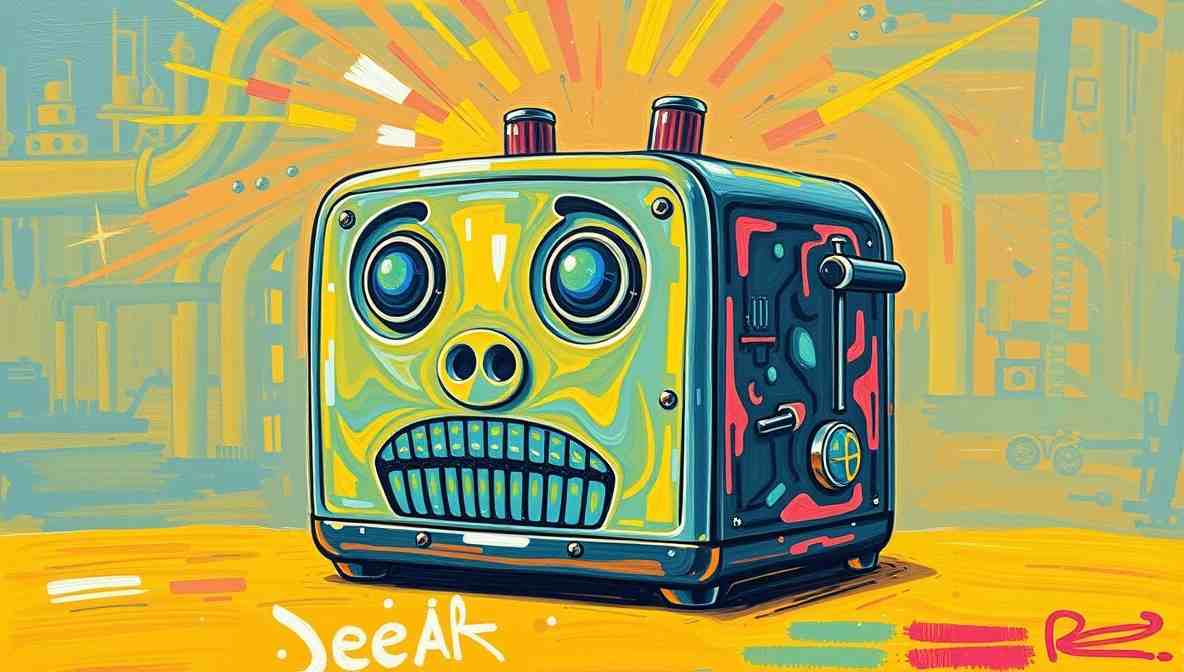
New Model So Cheap and Efficient It Reportedly Runs on Budget Hardware, Executive Panic, and One Warm Toaster
Five observations before we begin:
- Every time AI gets cheaper, investors become more expensive.
- Tech CEOs love “open models” the way kings loved democracy: from a safe distance.
- If a chatbot can run on a toaster, your toaster will soon ask for a subscription.
- Nothing terrifies Silicon Valley like hearing the words “lower cost.”
- Humanity wanted artificial intelligence, but mostly got meetings about token pricing.

Chinese AI lab DeepSeek unveiled DeepSeek V4 this week, a new family of models promising stronger performance, lower inference costs, a one-million-token context window, and support beyond the usual Western chip ecosystem. According to Fortune, the V4-Pro model costs $3.48 per million output tokens — compared to $30 from OpenAI and $25 from Anthropic for the same work. That is not a typo. That is a math problem Silicon Valley did not want assigned. Within minutes of the announcement, analysts described scenes of chaos across the tech sector. One venture capitalist reportedly stared into the middle distance and whispered, “But our whole valuation was based on charging twelve dollars for polite autocomplete.”
Wall Street Discovers Math, Hates It
DeepSeek’s preview pricing is, in the immortal words of market analysts, “aggressively unhelpful to existing business models.” Decrypt reports the V4-Pro costs 98% less than GPT-5.5 Pro and roughly one-twentieth the price of Claude Opus 4.7 — meaning the V4-Flash variant, at $0.28 per million output tokens, is cheaper than the cheapest model OpenAI offers. That meant finance professionals were forced to confront a rare and hostile concept: division.
At a San Francisco hedge fund, three interns were seen frantically erasing the phrase “AI moat” from a whiteboard and replacing it with “AI decorative pond.”
Dr. Lenora Spackle, chief economist at the Institute for Numbers Nobody Likes, explained:
“When competitors charge less for similar capability, margins shrink. This is known in economics as ‘bad vibes with decimals.'”
A flash poll of 1,217 software executives found:
- 62% said competition is healthy
- 62% also asked regulators to stop it
- 14% tried to pivot into artisanal robotics
- 9% claimed they had already invented DeepSeek last year in a memo nobody can locate
Silicon Valley Announces New Values: Efficiency Was Always the Plan, Obviously
For years, many firms insisted that true innovation required endless capital, moon-sized data centers, and enough GPUs to dim a regional power grid. Then DeepSeek arrived touting efficiency gains that would make a Walmart logistics manager weep with admiration. The Register reports that V4-Pro requires only 27% of the single-token inference compute and 10% of the memory cache that DeepSeek’s own previous model needed — at one million tokens of context. Suddenly every CEO remembered they too had always cared deeply about thrift.
One founder appeared on a podcast saying:
“We’re entering a lean era. That’s why we raised $11 billion yesterday.”
Another announced a new philosophy called “Minimalist Maximalism,” defined as spending less while posting photos of expensive servers. The press release used the word “intentional” seventeen times. Nobody asked what they were intending.
Toaster Industry Sees Opening, Files for Trademark on “Sentient Breakfast”
Reports that the model could run on modest hardware — developer Simon Willison noted a lightly quantized Flash variant might run on a 128GB MacBook Pro — inspired immediate excitement in household appliance circles. A consortium of kitchen brands announced the SmartToast Initiative.
Upcoming features include:
- Bread browning optimized by reinforcement learning
- Passive-aggressive bagel mode
- Hallucinated weather forecasts on rye
- “I’m sorry Dave, I cannot eject your muffin”
A spokesperson for KitchenAid said, “Consumers deserve breakfast that knows them.” When asked whether their toaster would eventually know them better than their therapist, the spokesperson said, “We’re not ruling anything out,” which was both terrifying and oddly comforting.
Huawei Hardware Mention Causes Geopolitical Sweating in Multiple Time Zones
The report noted that V4 was validated to run on Huawei Ascend accelerators alongside Nvidia platforms — a detail that arrived like a party favor nobody ordered. DeepSeek trained the new model partly on Huawei’s Ascend 950 chips, sidestepping U.S. export restrictions with the kind of efficiency that the model itself would probably benchmark favorably on. Shares in the chipmaker behind Huawei’s processors jumped 10% in Hong Kong trading. Washington officials scheduled an emergency summit titled: Why Are Other People Also Building Things?
One anonymous staffer said:
“We support competition, provided nobody competes.”
Meanwhile, ordinary people remained calm because they were busy resetting passwords and ignoring printer notifications, which remain the true geopolitical crisis of our era.
One-Million-Token Context Window Means AI Can Finally Read Your Entire Nonsense
DeepSeek’s giant context capacity — VentureBeat calls it “native one-million-token context,” noting it handles that scale at only 10% of the memory cost of its predecessor — means models can absorb far longer inputs. Experts say this could revolutionize enterprise productivity by allowing one chatbot to process:
- Entire legal contracts no one read before signing
- Forty-seven Slack threads about choosing a logo
- A city council meeting transcript about decorative shrubs
- Your uncle’s 8,000-word email on parking conspiracies
Professor Mildred Cogswell of the University of Administrative Futility said:
“At last, machines can absorb the full scale of human rambling. Whether they should is a separate course offering.”
What the Funny People Are Saying About AI That Now Runs on a Budget
“Every startup says they’re changing the world. Then a cheaper startup changes their world.” — Jerry Seinfeld
“You know you’ve got trouble when your competitor can run on a toaster and your app still needs six consultants and a go-live ceremony.” — Ron White
“Tech billionaires love disruption until it parks in their driveway and asks for a charging station.” — Amy Schumer
“If AI gets cheaper every six months, maybe they can finally afford customer support instead of a chatbot that suggests I restart my router.” — Dave Chappelle
Ordinary Users Respond With Alarming Sanity
Regular people greeted the news with pragmatic questions that, frankly, put investor Q&As to shame:
- Will it help me write emails faster?
- Can it explain taxes without crying?
- Will it stop apps from asking for notifications every forty seconds?
- Can it tell me why the Wi-Fi only fails during important calls?
These are stronger questions than many asked at investor conferences, where the preferred format remains: long pause, nod slowly, say “ecosystem.”
The Great Rebranding: When Your Premium Product Meets a $0.28 Competitor
By sunset, several premium AI vendors had quietly updated their marketing copy. The changes were subtle, tasteful, and slightly desperate:
- “Expensive” became “enterprise-grade”
- “Slow” became “deliberative”
- “Confusing” became “feature-rich”
- “Still in beta” became “visionary roadmap”
One company launched a new tier called Affordable Elite Prestige Basic Plus. The pricing page required a scroll bar, three clicks, and a philosophy degree to navigate. Their FAQ answered the question “How much does it cost?” with a link to a webinar. The webinar was $49.
Humanity Marches On, Slightly Confused, Mostly Fine
The deeper lesson is not that one model beat another. It is that technology keeps doing what it always does: turning yesterday’s miracle into today’s commodity. Once people gasped at calculators. Now they complain calculators are hidden in phone menus. Once DeepSeek’s R1 wiped $600 billion from Nvidia’s market cap in a single day. Now the same lab drops a 1.6-trillion-parameter open-source model and the main surprise is that the Flash version might run on a laptop.
Soon enough, users may treat advanced AI the same way they treat electricity, plumbing, and maps: useful, expected, and only noticed when broken. The toaster will know your breakfast preferences, your uncle’s conspiracy theories will be summarized in seconds, and somewhere a venture capitalist will be pitching a startup called “Premium Electricity.”
Until then, executives will continue giving brave speeches about innovation while nervously checking competitors’ pricing pages every eleven minutes, refreshing with the focused panic of a man who has just realized the buffet at his very expensive restaurant also exists at Denny’s.
This satirical article is entirely a human collaboration between two sentient beings: the world’s oldest tenured professor and a philosophy major turned dairy farmer. Any resemblance to real boardroom panic, toaster consciousness, or valuation-induced dizziness is purely efficient. Auf Wiedersehen, amigo!