

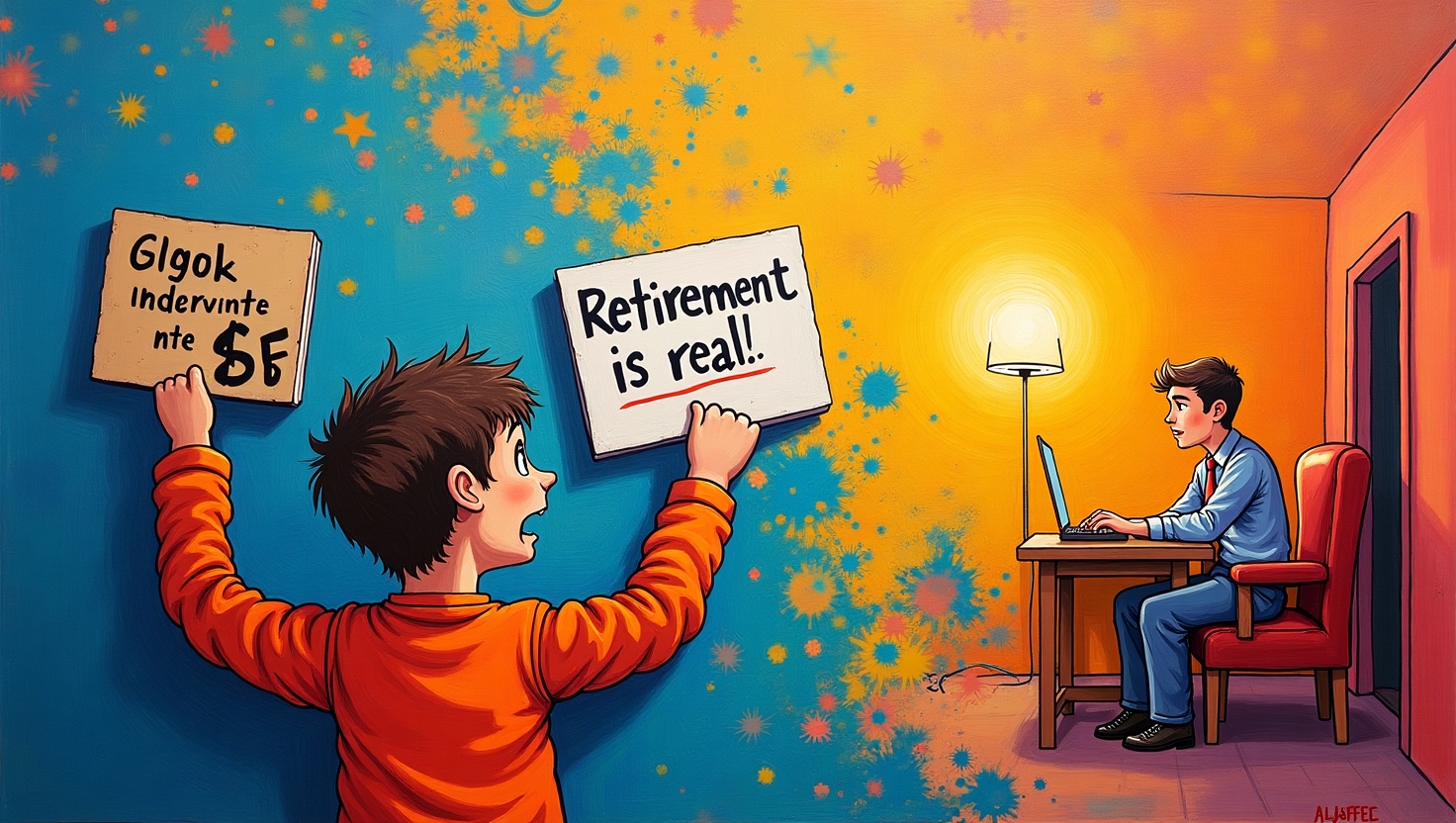
Gen Z Discovers Retirement is Real, Panics Upon Learning It Requires 40+ Years of Employment
“Wait, You Have to Work Until You’re 65?” Reports Shocked 22-Year-Old
Generation Raised on Influencer Culture Confronts Reality of Traditional Career Timelines
In what financial advisors are calling “the most predictable existential crisis in generational history,” members of Generation Z have begun experiencing collective panic attacks after discovering that retirement is a real concept that requires decades of consistent employment rather than achieving viral fame through dance videos or cryptocurrency speculation.
The revelation began when University of Texas senior Kaylee Chen-Williams, 21, attended a mandatory personal finance seminar and learned that traditional retirement planning assumes 40-45 years of steady employment with gradual wealth accumulation through compound interest rather than overnight success through social media monetization or NFT trading.
“I literally thought retirement was something that happened to boomers because they didn’t understand technology,” explained Chen-Williams while staring at retirement calculators that suggested she needed to save $2 million over four decades of work. “Nobody told me that being an adult means working the same job every day for longer than I’ve been alive just to afford not working when I’m old and probably dead anyway.”
The generational crisis has intensified as Gen Z discovers that most successful retirees achieved financial security through consistent employment, regular savings contributions, and long-term investment strategies rather than launching successful OnlyFans accounts, becoming viral TikTok stars, or timing the cryptocurrency market perfectly.
The Great Reality Check
The retirement awareness crisis began spreading through Gen Z social networks as college students and recent graduates started encountering workplace benefits orientations that included presentations about 401(k) plans, compound interest calculations, and the brutal mathematics of saving for financial independence over multi-decade timeframes.
“I went to orientation at my new job and they explained that I should contribute 15% of my salary to retirement accounts for the next 45 years,” reported recent graduate Madison Parker, 23, while calculating that her entry-level marketing salary would require living like a monk for nearly half a century to achieve basic financial security. “That’s literally more than twice as long as I’ve been alive. How is that legal?”
The discovery process typically follows predictable stages: initial confusion about retirement concept, horror at timeline requirements, desperate research into alternative wealth-building strategies, and eventual resignation to the reality that most people cannot escape traditional employment through creative entrepreneurship or internet fame.
“I spent three days researching whether I could retire early through dropshipping, affiliate marketing, or starting a successful podcast,” explained Denver resident Jake Rodriguez, 24, while reviewing business plans that assumed unrealistic success rates and ignored market saturation in influencer-driven income strategies. “Turns out that 99.9% of people who try to make money online just end up working regular jobs anyway, except they wasted years pretending social media was a career path.”
The mathematical reality of retirement planning has proven particularly shocking to a generation raised on success stories about young entrepreneurs, social media millionaires, and cryptocurrency early adopters who achieved financial independence through timing and luck rather than systematic wealth building.
Financial Literacy Meets Harsh Reality
Educational institutions have begun implementing emergency financial literacy programs after discovering that most Gen Z students had assumed retirement was either automatic, government-provided, or achievable through non-traditional income streams that don’t require decades of consistent employment.
“Students arrive at college with detailed knowledge about influencer marketing strategies and cryptocurrency trading but no understanding of compound interest, employer matching, or the basic mathematics of long-term wealth accumulation,” explained University of California financial literacy coordinator Dr. Sarah Martinez while reviewing curriculum designed to bridge the gap between social media financial advice and actual economic reality.
The educational interventions typically involve showing students retirement calculators that demonstrate the relationship between time, consistent contributions, and final account balances, often resulting in what counselors describe as “mathematical trauma” as young adults realize that financial security requires patience and consistency rather than viral success or investment genius.
“We have to start with explaining that most people work jobs for money rather than pursuing their passion for 40+ years,” noted financial advisor Dr. Michael Chen while conducting workshops that essentially function as reality orientation for students who had assumed adult financial security would come from personal branding and creative entrepreneurship.
The curriculum includes modules on “Why You Probably Won’t Become a Successful YouTuber,” “The Statistics of Influencer Income,” and “Compound Interest: How Boring People Get Rich Slowly,” designed to redirect student expectations toward achievable rather than aspirational financial strategies.
Career Planning Meets Existential Dread
The transition from college to workforce has become particularly traumatic for Gen Z as they discover that most available employment involves repetitive tasks, hierarchical management structures, and advancement timelines that span decades rather than the immediate feedback and rapid growth cycles characterizing social media success.
“I thought I’d work for maybe five years, build my personal brand, and then transition to being my own boss through online business,” explained recent graduate Emma Thompson, 22, while interviewing for entry-level positions that offer health insurance and retirement contributions but require showing up to the same location every day for potentially 45 years.
Career counselors report increased demand for therapy and guidance as Gen Z discovers that traditional employment involves long-term commitment, gradual skill development, and institutional loyalty rather than the portfolio career flexibility and rapid pivoting that characterizes influencer culture.
“Students ask whether they can ‘hack’ traditional careers by working really hard for three years and then retiring early,” noted career development specialist Dr. Patricia Wong while explaining that even aggressive savings strategies typically require 15-20 years of high-income employment rather than the abbreviated timelines that young adults expect based on entrepreneurship success stories.
The adjustment has been particularly difficult for students who spent college developing skills in content creation, social media marketing, and personal branding under the assumption that these abilities would translate directly to sustainable income without traditional employment requirements.
Economic Reality vs. Social Media Fantasy
The collision between Gen Z financial expectations and economic reality has created what researchers call “influencer disillusionment syndrome,” where young adults discover that social media success stories represent statistical outliers rather than achievable career paths for most people.
“Social media algorithms show us the 0.1% of people who got rich through content creation while hiding the 99.9% who tried the same strategies and ended up working at Starbucks,” explained social media researcher Dr. Elena Rodriguez while studying how platform curation creates unrealistic expectations about alternative career viability.
The mathematical analysis of influencer economics reveals that successful content creators often work more hours than traditional employees while facing income volatility, lack of benefits, and career uncertainty that makes traditional retirement planning nearly impossible without supplementary employment.
“Successful YouTubers and TikTok stars typically reinvest earnings into content production and struggle with irregular income that makes consistent retirement savings difficult,” noted digital economy analyst Dr. Jennifer Walsh while reviewing financial disclosure data from content creators who appear successful but often lack traditional financial security.
The research has implications for financial education as young adults need frameworks for evaluating income strategies that account for survival bias, market saturation, and the hidden infrastructure costs of maintaining successful online businesses.
Mental Health Implications
The retirement reality crisis has created significant mental health challenges as Gen Z processes the gap between cultural messaging about following passion and achieving rapid success versus the economic necessity of long-term employment for basic financial security.
“Students experience genuine grief when they realize that most adults spend decades doing jobs they don’t love in order to afford basic security,” explained college counseling psychologist Dr. David Martinez while treating students who describe traditional career paths as “existential nightmares” and “systematic soul crushing.”
The therapeutic interventions focus on helping young adults develop realistic expectations about work, meaning, and financial security while maintaining motivation for long-term goal achievement despite the delayed gratification requirements of traditional wealth building.
“We’re essentially providing grief counseling for the death of entrepreneurial fantasies and helping students find meaning in conventional career paths,” noted mental health specialist Dr. Sarah Patterson while developing support groups for students adjusting to “life after influencer dreams.”
The psychological adjustment includes accepting that most people find fulfillment through relationships, hobbies, and community involvement rather than deriving primary identity and satisfaction from employment, regardless of whether that employment involves creative passion or simply reliable income generation.
Workplace Adaptation Strategies
Employers have begun adapting recruitment and retention strategies to accommodate Gen Z expectations while gradually introducing the reality of long-term employment commitments and traditional career development timelines.
“We’ve learned to emphasize skill development, networking opportunities, and transferable experience rather than focusing on retirement benefits that seem abstract and depressing to 22-year-olds,” explained corporate HR director Dr. Patricia Chen while reviewing orientation programs designed to ease Gen Z into traditional employment expectations.
The workplace adaptations include mentorship programs that help young employees understand career progression, financial literacy training that makes retirement planning seem achievable rather than overwhelming, and workplace culture that acknowledges the adjustment challenges facing a generation raised on entrepreneurial messaging.
“Young employees often arrive with impressive technical skills and creative thinking but need support understanding institutional culture, long-term planning, and the relationship between immediate work and future financial security,” noted workforce development specialist Dr. Michael Rodriguez while studying generational adaptation to traditional employment structures.
Alternative Path Exploration
The retirement crisis has sparked interest in alternative financial strategies including FIRE (Financial Independence, Retire Early) movements, geographic arbitrage, and lifestyle optimization approaches that might reduce the timeline and income requirements for achieving financial security.
“Students are researching whether they can retire to countries with lower cost of living, minimize expenses through intentional lifestyle choices, or achieve financial independence through aggressive saving rather than long-term employment,” explained alternative economics researcher Dr. Elena Wong while studying how Gen Z adapts traditional retirement concepts to contemporary economic realities.
The exploration of alternative paths often involves more realistic assessment of income requirements, expense reduction strategies, and lifestyle choices that might enable financial independence without conventional 40-year career commitments, though still requiring significant initial income generation through traditional employment.
“Even alternative financial strategies typically require 10-15 years of above-average income and below-average spending, which is more achievable than 45-year traditional retirement timelines but still requires accepting employment realities,” noted financial planning specialist Dr. Jennifer Martinez while counseling students about realistic early retirement strategies.
Intergenerational Wealth Transfer
The retirement crisis has highlighted the role of intergenerational wealth transfer in financial security, as Gen Z discovers that many successful retirees benefited from family assistance, inheritance, or economic conditions that may not be available to younger generations.
“Students are realizing that many older adults achieved financial security through real estate appreciation, pension benefits, and economic conditions that no longer exist,” explained economic mobility researcher Dr. Sarah Wong while studying how changing economic conditions affect traditional retirement planning assumptions.
The analysis reveals that Gen Z faces higher education costs, increased housing prices, reduced pension availability, and economic uncertainty that makes traditional retirement timelines more challenging than previous generations experienced.
“Young adults are developing realistic expectations about financial security while advocating for policy changes that might restore economic mobility and retirement accessibility,” noted policy researcher Dr. David Chen while studying how generational economic challenges might influence political engagement and social policy priorities.
Technology and Automation Implications
The retirement planning crisis has intersected with concerns about job automation, artificial intelligence, and economic changes that might affect long-term employment availability and traditional career path viability.
“Students worry about investing decades in career development when technology might eliminate their industries before they reach retirement age,” explained technology policy researcher Dr. Patricia Martinez while studying how automation anxiety affects financial planning and career choice decisions.
The technological uncertainty has created interest in skills development, career flexibility, and financial strategies that remain viable across potential economic disruptions and industry changes.
“Gen Z is developing financial plans that account for career pivoting, skill updating, and economic uncertainty while still working toward long-term financial security,” noted workforce futurist Dr. Michael Wong while studying how younger generations adapt traditional retirement planning to contemporary economic realities.
Looking Forward: Redefining Financial Success
As Gen Z continues processing the reality of traditional retirement requirements, early indicators suggest potential redefinition of financial success that emphasizes flexibility, alternative income streams, and lifestyle optimization rather than simply maximizing wealth accumulation.
“Young adults are developing financial strategies that balance traditional security building with personal fulfillment and economic uncertainty,” explained financial behavior researcher Dr. Elena Martinez while studying how generational values influence retirement planning approaches.
The adaptation may include hybrid approaches that combine traditional employment with entrepreneurial activities, geographic flexibility, and lifestyle choices that reduce financial requirements while maintaining quality of life and long-term security.
“Gen Z might develop more sustainable and flexible approaches to financial security that account for economic uncertainty while maintaining realistic expectations about wealth building timelines,” noted economic planning specialist Dr. Sarah Rodriguez while studying generational adaptation to contemporary financial challenges.
Conclusion: Growing Up in Economic Reality
The Gen Z retirement crisis represents a natural developmental process as young adults transition from aspirational thinking to practical planning while maintaining creativity and adaptability in approaching financial security challenges.
“Every generation eventually discovers that financial security requires long-term planning and consistent effort rather than rapid success through innovative strategies,” noted generational researcher Dr. Jennifer Patterson while reviewing historical patterns of young adult adjustment to economic realities.
The process may ultimately benefit both individuals and society as Gen Z develops more realistic financial expectations while maintaining the technological skills and creative thinking that enable adaptation to changing economic conditions.
“Understanding retirement requirements early in career development provides advantages for long-term planning even when the initial reality check creates temporary anxiety,” explained financial education specialist Dr. Michael Martinez while studying how early financial literacy impacts lifetime wealth accumulation.
As one recently enlightened Gen Z worker noted: “I spent two years trying to become a successful influencer before realizing I could just get a job with benefits and save money consistently for 40 years. It’s not as exciting as going viral, but apparently it’s more reliable for not being homeless when I’m old.”
The age of realistic financial planning has begun for Gen Z, and early results suggest that understanding economic reality earlier rather than later provides advantages for lifetime financial security, even when the initial discovery process involves mourning the death of get-rich-quick fantasies.
Sometimes the most revolutionary approach to financial security is accepting that traditional strategies work for traditional reasons, even when they require patience and consistency rather than creativity and luck.

15 Humorous Observations: When Gen Z Discovered Traditional Employment
Reality Meets Influencer Culture
1. The most Gen Z thing about discovering retirement is the genuine shock that financial security requires 40+ years of consistent employment rather than achieving viral fame through dance videos or perfectly timing cryptocurrency markets.
2. College orientation sessions now include grief counseling for students learning that most adults work jobs they don’t love for decades to afford basic security, which students describe as “existential nightmares” and “systematic soul crushing.”
3. Financial advisors report students asking whether they can “hack” traditional careers by working really hard for three years and then retiring early, revealing complete unfamiliarity with the mathematics of compound interest and wealth accumulation.
4. The transition from “I’ll build my personal brand and be my own boss” to “this entry-level job offers health insurance and 401k matching” represents the fastest attitude adjustment in generational history.
5. Gen Z discovers that 99.9% of people who try to make money online end up working regular jobs anyway, except they wasted years pretending social media was a sustainable career path while their peers were building actual professional experience.
6. Emergency financial literacy curricula now include modules titled “Why You Probably Won’t Become a Successful YouTuber” and “Compound Interest: How Boring People Get Rich Slowly” to redirect expectations toward achievable rather than aspirational strategies.
7. The mathematical trauma of retirement calculators showing that basic financial security requires saving $2 million over four decades has created an entire generation that views traditional employment as legalized human trafficking.
8. Social media algorithms showing the 0.1% of successful content creators while hiding the 99.9% who tried identical strategies and ended up at Starbucks creates influencer disillusionment syndrome when reality meets statistical outliers.
9. Career counselors now explain that even successful YouTubers and TikTok stars typically work more hours than traditional employees while facing income volatility that makes retirement planning nearly impossible without supplementary employment.
10. The discovery that most older adults achieved financial security through real estate appreciation and pension benefits that no longer exist has created intergenerational economic resentment mixed with grudging acceptance of contemporary employment realities.
11. Gen Z workplace adaptation includes learning that advancement happens over years rather than weeks, skills develop gradually rather than going viral overnight, and professional success requires institutional loyalty rather than constant personal rebranding.
12. Students researching FIRE (Financial Independence, Retire Early) movements discover that even aggressive alternative strategies require 10-15 years of above-average income and below-average spending, which still necessitates accepting traditional employment realities.
13. The therapeutic intervention for “death of entrepreneurial fantasies” involves helping young adults find meaning in conventional career paths while accepting that most people derive fulfillment from relationships and hobbies rather than employment identity.
14. Technology anxiety about job automation eliminating industries before Gen Z reaches retirement age has created financial planning that accounts for career pivoting and skill updating while still working toward long-term security.
15. The ultimate generational awakening is realizing that traditional financial strategies work for traditional reasons—patience and consistency rather than creativity and luck—even when this discovery requires mourning get-rich-quick fantasies.
What the Funny People Are Saying: Comedian Lines on Gen Z’s Retirement Reality Check
Stand-Up Comics Process Financial Maturation
“Gen Z discovered retirement requires 40+ years of employment and panicked like they just learned Santa isn’t real. Except Santa actually provides presents, while retirement just provides the privilege of not working when you’re too old to enjoy freedom.” — John Mulaney
“A 21-year-old thought retirement was ‘something that happened to boomers because they didn’t understand technology.’ Finally, a generation that assumed financial security could be achieved through superior app usage and better meme comprehension.” — Amy Schumer
“College students are experiencing ‘mathematical trauma’ from retirement calculators. Imagine discovering that compound interest requires actual interest compounding over time rather than going viral through financial TikToks. Revolutionary mathematical concepts.” — Trevor Noah
“Financial literacy curricula now include ‘Why You Probably Won’t Become a Successful YouTuber.’ Finally, educational content that addresses the real career planning needs of students who think ‘influencer’ is a reliable professional path.” — Sarah Silverman
“Gen Z spent years trying to monetize their personalities before discovering they could just get jobs with benefits and save money consistently. That’s not career pivoting, that’s accidentally discovering how employment has worked for centuries.” — Bill Maher
“Students ask if they can ‘hack’ traditional careers by working three years instead of 40. That’s not life optimization, that’s fundamental misunderstanding of how time and mathematics interact in wealth accumulation.” — Stephen Colbert
“Social media algorithms show the 0.1% who got rich through content creation while hiding the 99.9% who ended up at Starbucks. It’s like a casino that only advertises jackpot winners and never mentions bankruptcy rates.” — Dave Chappelle
“Career counselors now provide grief therapy for ‘death of entrepreneurial fantasies.’ Finally, mental health services that address the specific trauma of discovering you’re not special enough to avoid traditional employment.” — Hasan Minhaj
“Gen Z discovers that successful YouTubers work more hours than traditional employees while facing income volatility. Turns out ‘be your own boss’ often means ‘work 80 hours a week for unstable pay and no benefits.'” — Jerry Seinfeld
“Students worry about automation eliminating jobs before they reach retirement age. Imagine being so pessimistic about economic stability that you’re planning for technological unemployment while still in college. Peak anxiety planning.” — Iliza Shlesinger
“The adjustment from ‘I’ll build my personal brand’ to ‘this job offers 401k matching’ happens faster than TikTok algorithm changes. Economic reality has superior engagement metrics than entrepreneurial fantasies.” — Jim Gaffigan
“Gen Z is developing financial plans that account for career pivoting and economic uncertainty while working toward traditional security. Finally, a generation that plans for both innovation and the probability that innovation won’t pay rent.” — Ali Wong