

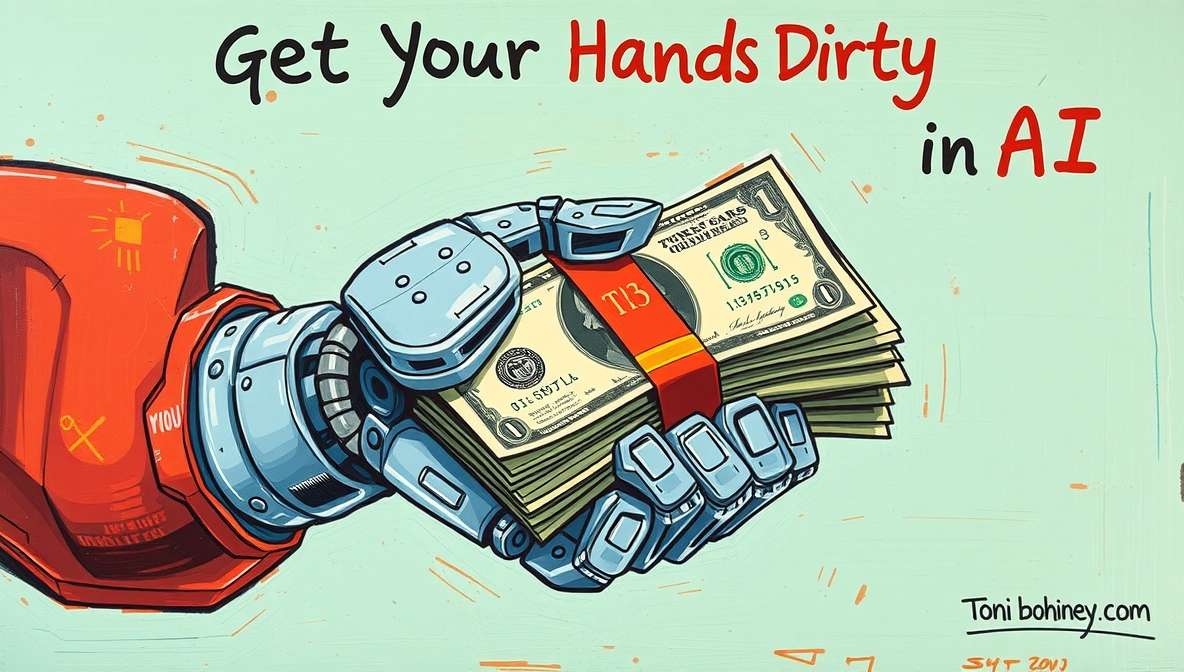
PRESS RELEASE: How to “Get Your Hands Dirty” in AI Without Actually Touching Anything
FOR IMMEDIATE RELEASE
In a shocking expose that’s shaking cubicles from Silicon Valley to your parents’ basement, Business Insider reports that the hottest, must-have skill to break into AI in 2025 is… drumroll… “get your hands dirty.” Yes, apparently if you roll up your sleeves and actually do something, you, too, can become the next AI wunderkind, even if your résumé currently lists binge-watching TikTok as a skill.

The phrase “get your hands dirty” has inspired waves of aspiring techies to attempt what HR departments call “real-world experience,” which often involves staring at code until your brain files for divorce. Patrick Leung, a former Google Duplex savant, recommends talking to coworkers like they’re ancient AI gurus whispering arcane secrets about neural networks. Sophia Sun, a Microsoft product manager, pitched an AI project that made content for TikTok creators—because nothing says “I understand AI” like algorithmically generating dance trends for Gen Z.
Mostofa Adib Shakib, ex-Snap engineer, reportedly achieved AI enlightenment by working on recruitment AI while simultaneously questioning every life choice that led him to ZipRecruiter. Sources confirm that all three of these visionaries agree: actual knowledge is overrated; what matters is demonstrable play, i.e., proving to employers you touched something vaguely intelligent and it didn’t immediately explode.
Observers note the absurdity: AI is supposed to be the future, yet the key to joining this revolution is… human hands. Meanwhile, interns report mysterious bruises from metaphorical dirt, while executives clarify that “hands dirty” does not include spilling coffee on your keyboard—though that is technically messy.
“Getting your hands dirty” has officially become the new résumé bullet point for ambitious tech workers:
- Leung: “Talk to AI, treat it like a sentient colleague.”
- Sun: “Pitch, build, fail, repeat—then call it experience.”
- Shakib: “Contract work counts if it scares your friends.”
In conclusion, the AI industry has not only revolutionized computing but also metaphors. You don’t need a Ph.D., a secret GitHub repository, or the soul of a mathematician—just dirty hands, preferably not actual blood. Auf Wiedersehen.
Comments from Bohiney.com staff:
“AI career tip: dirt is optional, ambition is mandatory.” — Toni Bohiney
“I tried talking to my toaster, it refused to network.” — Jack Handey
“Hands dirty, brain slightly messy, ego fully inflated.” — Aisha Muharrar
“Step 1: Touch AI. Step 2: Profit. Step 3: Question all life decisions.” — Megan Amram
“Why learn theory when you can simulate chaos?” — Nell Scovell
“I got an AI job once, all I did was sneeze near a keyboard.” — Bess Kalb
“Next week: get your feet wet in blockchain!” — Allison Silverman
“Real-world experience is just code plus caffeine.” — Jessi Klein
“Apparently AI likes hands, less so keyboards.” — Katie Rich
“Touch responsibly. AI bites metaphorically.” — Adelle Onyango
“This just in: AI may now require gloves.” — Akash Banerjee
“Dirt is the new currency.” — Heidi Ladein
Auf Wiedersehen.