

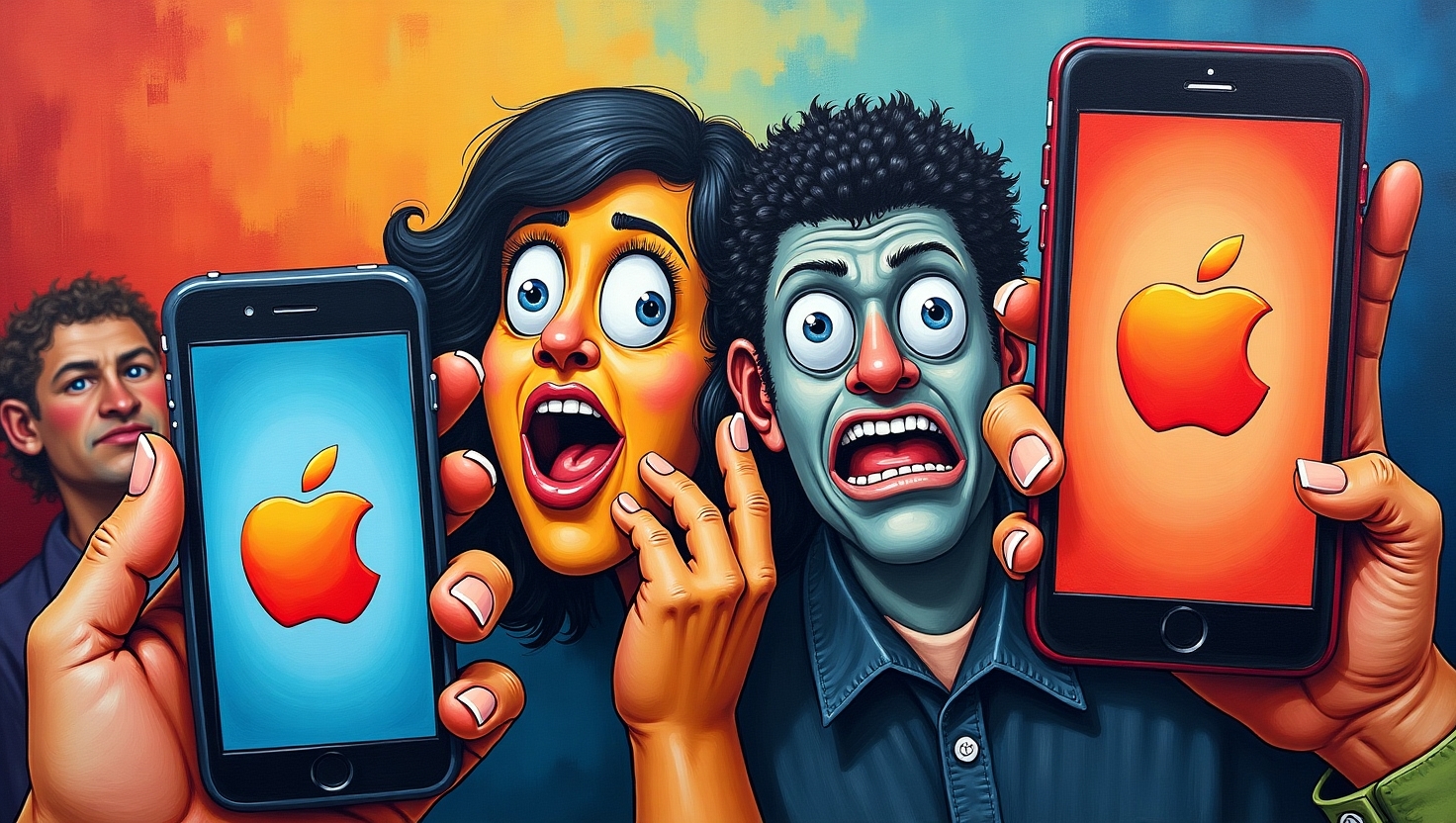
iPhone Air So Thin, Apple Recommends Buying Two So You Can Actually See One
Apple’s latest innovation proves that sometimes less really is… well, literally less
Apple’s Revolutionary Disappearing Act
In what company executives are calling their “most courageous move since removing the headphone jack,” Apple unveiled the iPhone Air this week—a device so impossibly thin that company engineers had to invent new physics just to make it exist in three-dimensional space.
At just 0.1 millimeters thick, the iPhone Air makes a piece of paper look chunky. Tim Cook, appearing at the launch event via hologram because he was too afraid to risk accidentally sitting on a demo unit, announced that the phone represents “the future of nothing, packaged beautifully.”
The iPhone Air is so thin, it makes supermodels look like they have weight problems.
Jerry Seinfeld addressed the announcement during his Tuesday night show in New York: “What’s the deal with making phones thinner? I can’t even find my regular phone half the time. Now they want me to lose something that’s basically invisible? That’s not technology, that’s a magic trick!”
The Marketing Genius Behind Invisible Technology
Apple’s marketing department, clearly having graduated from the same school that convinced people to pay extra for “distressed” jeans, has positioned the iPhone Air’s near-invisibility as a feature, not a bug. The official Apple website now includes a helpful FAQ section titled “How to Know If You Still Have Your Phone.”
Apple’s customer service has added a new department: “Phone Archaeology,” dedicated to helping customers excavate their devices from between couch cushions.
The phone comes with what Apple calls “Visibility Accessories”—essentially tiny LED strips that you can attach to help locate your device. These cost $299 each and require a separate $199 wireless charger that’s somehow larger than the phone itself.
Ron White commented during his weekend performance in Las Vegas: “I bought one of these iPhone Airs, and I swear it’s so thin, I accidentally used it as a bookmark and didn’t realize it for three weeks. My battery life has never been better—turns out reading improves performance.”
Revolutionary Features That Technically Exist
Ultra-Thin Display Technology
The iPhone Air features Apple’s new “Quantum Display,” which exists in a superposition of on and off until observed directly. The screen resolution is technically infinite, though users report difficulty seeing anything without a magnifying glass.
The phone is so thin that when you take a selfie, you’re actually photographing whatever’s behind you.
Apple’s marketing materials boast that the display is “paper-thin,” though several beta testers have reported accidentally recycling their phones during spring cleaning.
Camera System Defying Physics
The iPhone Air somehow manages to pack three cameras into its microscopic frame, though photographers note that all pictures come out looking like abstract art. Apple claims this is “artistic interpretation technology,” while users suspect their photos are just blurry because they can’t hold the phone steady.
The phone is so light that breathing too hard near it qualifies as extreme sports.
Amy Schumer joked during her recent Netflix special: “I got the new iPhone Air, and it’s so thin I accidentally inhaled it during a yoga class. On the bright side, my internal photos have never looked better, and Siri can now directly monitor my thoughts—which are mostly about food and whether my ex is dating someone prettier.”
The Economics of Invisibility
Pricing Strategy That Makes Sense to Someone
Despite containing approximately 73% less material than previous iPhones, the Air starts at $1,999—a price point Apple justifies by explaining that “less is more, and more costs more.” The company’s CFO noted during the earnings call that “invisible products require invisible manufacturing costs.”
Apple has convinced people to pay double for half a phone, which is basically the same business model as buying airline tickets.
The most expensive model, the iPhone Air Pro Max Ultra, costs $3,999 and comes with a special “Existence Verification Certificate” signed by Tim Cook himself, confirming that your phone definitely exists somewhere in the space-time continuum.
Dave Chappelle said during his recent stand-up appearance: “Apple’s out here selling invisible phones for two grand. You know what else is invisible and costs too much? My credit score after buying Apple products!”
Storage Options That Challenge Reality
The iPhone Air comes in three storage options: 64GB (which exists), 128GB (which might exist), and 256GB (which exists in a parallel universe). Apple recommends the cloud storage option, since finding your phone to actually store things locally has proven problematic.
iCloud storage makes more sense now since your phone literally lives in the clouds.
Customer Experience Reviews
Early Adopter Testimonials
Beta testers have provided mixed reviews. One early adopter reported: “I love the minimalist design, though I haven’t actually seen my phone in three weeks. Customer service says this is ‘working as intended.'”
The phone is so advanced that losing it is considered a feature, not a bug.
Another customer noted: “The battery life is amazing—it’s been at 100% for months! Although I suspect this might be because I haven’t been able to turn it on since I can’t find it.”
Bill Burr ranted during his Monday Night podcast: “These tech companies are unbelievable! They made a phone so thin you can’t see it, then they’ll probably release an iPhone Air Finder next year for another thousand bucks. ‘Oh, you lost the invisible phone we sold you? Here’s another device to find the first device!’ It’s like a technological pyramid scheme!”
The Accessory Ecosystem
Apple has released a comprehensive line of iPhone Air accessories, including:
- Visibility Strips ($299): Help you remember where you put your phone
- Location Beacons ($399): Emit sounds when your phone is nearby
- Professional Phone Recovery Service ($199/month): Trained specialists help locate your device
- iPhone Air Insurance ($89/month): Covers loss, theft, and accidental existence
Apple has created the first phone that comes with its own search and rescue team.
Technical Specifications That Bend Reality
Processing Power in Quantum Dimensions
The iPhone Air runs on Apple’s new A17 Quantum chip, which processes information in multiple dimensions simultaneously. The chip is so small it can only be observed using electron microscopes, and even then, scientists aren’t entirely sure it’s actually there.
The phone’s processor is so advanced that it’s solving problems you didn’t know you had while hiding in dimensions you can’t see.
Chris Rock said during his Thursday night show at Madison Square Garden: “They got phones now that are so smart and so thin, they’re basically just floating intelligence. My iPhone Air is probably writing better jokes than me right now—I just can’t see them!”
Battery Life That Defies Logic
Apple claims the iPhone Air has “all-day battery life,” though this is difficult to verify since users can’t find their phones to check the battery percentage. The company’s testing methodology involved placing the phone in a sealed chamber and assuming it was working.
The phone has infinite battery life because you can’t use it if you can’t find it.
The Competition’s Response
Samsung’s Counter-Innovation
Samsung immediately announced the Galaxy Invisible, which is so transparent that it doesn’t exist at all. Samsung’s marketing team claims this represents “the ultimate in minimalist design—a phone that’s so user-friendly, it doesn’t burden users with the responsibility of ownership.”
The tech industry has moved from making phones smaller to making them disappear entirely—next year’s models will just be good intentions and positive thoughts.
Google, meanwhile, unveiled the Pixel Air, which exists only in Google’s cloud servers. Users access their phone through meditation and positive thinking, with customer service provided by artificial intelligence that may or may not be sentient.
Jim Gaffigan said during his recent appearance on The Tonight Show: “These tech companies keep making phones thinner and thinner. Pretty soon they’ll just sell us the idea of a phone. ‘Here’s your new iPhone Concept—it exists purely in your imagination, but the monthly payments are very real.'”
Environmental Impact of Nothing
Apple’s Green Initiative Reaches New Heights
Apple proudly announced that the iPhone Air has the smallest environmental footprint of any device they’ve ever made, primarily because nobody can find them to throw them away. The company’s environmental report notes a 97% reduction in electronic waste, though critics point out this might be because the phones have simply vanished from the physical plane.
Apple has solved the electronic waste problem by making phones that disappear before they become waste.
The packaging for the iPhone Air is also revolutionary—it’s completely empty, which Apple describes as “sustainable minimalism.” Unboxing videos have become fascinating philosophical exercises about the nature of existence and consumer expectations.
Trevor Noah commented during The Daily Show: “Apple’s new phone is so environmentally friendly, it doesn’t even exist! Finally, a corporation that’s found a way to make products that have zero environmental impact because they’re basically just expensive air!”
Customer Support for the Impossible
AppleCare for Invisible Products
Apple has expanded its AppleCare program to include “Existence Support”—a service that helps customers confirm whether they actually own an iPhone Air or just think they do. The support team uses advanced metaphysical techniques and occasionally brings in philosophers to help resolve customer issues.
Apple’s Genius Bar now requires a PhD in quantum physics and a minor in existential philosophy.
Common support calls include: “I think I have an iPhone Air, but I’m not sure,” “My invisible phone is making invisible sounds,” and “Can you help me determine if my phone exists in this dimension or a parallel one?”
Ali Wong said during her recent comedy special: “I called Apple support about my invisible phone, and they put me on hold for three hours. When they finally answered, they asked if I was sure I was actually calling them or just thinking about calling them. Turns out I was just having a very expensive hallucination!”
The Genius Bar Experience
Apple Store employees have been trained in advanced theoretical physics to help customers with iPhone Air issues. Appointments now include philosophical counseling and reality verification services.
The Genius Bar has become less about technical support and more about existential crisis management.
The Future of Invisible Innovation
Apple’s success with the iPhone Air has inspired the entire tech industry. Rumored upcoming releases include the iPad Whisper (visible only on Tuesdays), the MacBook Maybe (exists probabilistically), and the Apple Watch Perhaps (tells time in alternate realities).
The tech industry has finally achieved its ultimate goal: selling products that don’t exist to customers who can’t find them at prices that definitely exist.
Nate Bargatze said during his recent stand-up performance: “My wife asked me to pick up the new iPhone Air from the Apple Store. I went there, they handed me an empty box, charged me two thousand dollars, and told me congratulations. I’m pretty sure I got scammed, but the receipt looks official, so I guess I own something now?”
Conclusion: Less Is More, More or Less
The iPhone Air represents Apple’s boldest innovation yet: a phone so advanced that it transcends physical reality while somehow still requiring monthly payments. As consumers adapt to this new paradigm of invisible ownership, one thing remains clear—Apple has successfully convinced people to pay premium prices for products that may or may not exist, which is either the height of marketing genius or the beginning of the end of physical reality as we know it.
Either way, shareholders are thrilled, customers are confused, and somewhere in a parallel dimension, Steve Jobs is probably laughing at all of us.
For more satirical coverage of technology’s march toward irrelevance, visit our website and remember: if you can’t see it, you probably can’t afford it anyway.
