

Oxford Street Goes Car-Free for 24 Hours—Pedestrians Celebrate by Walking in Circles Like Confused Sheep
By Freja Lindholm | Bohiney Magazine
Oxford Street Car-Free Day Creates Pedestrian Chaos in Central London
In a bold experiment that would make even Jerry Seinfeld question human behavior, London’s Oxford Street went entirely car-free for 24 hours this weekend. What was intended as a demonstration of sustainable city living quickly became a social experiment in chaos, confusion, and conspicuous loafing.
Pedestrians, freed from the tyranny of honking horns and double-parked SUVs on Britain’s busiest shopping street, initially reacted with what experts call “mild euphoria tempered by existential panic.”
“I thought I would run, skip, maybe start a spontaneous street festival,” said one bewildered shopper, Daphne McGillicuddy, holding a venti latte near Selfridges. “Instead, I just walked in circles. A lot. Around a lamppost. Around a bollard. It was oddly liberating, but also very boring.”
Oxford Street Pedestrians Form Bizarre Circular Walking Patterns

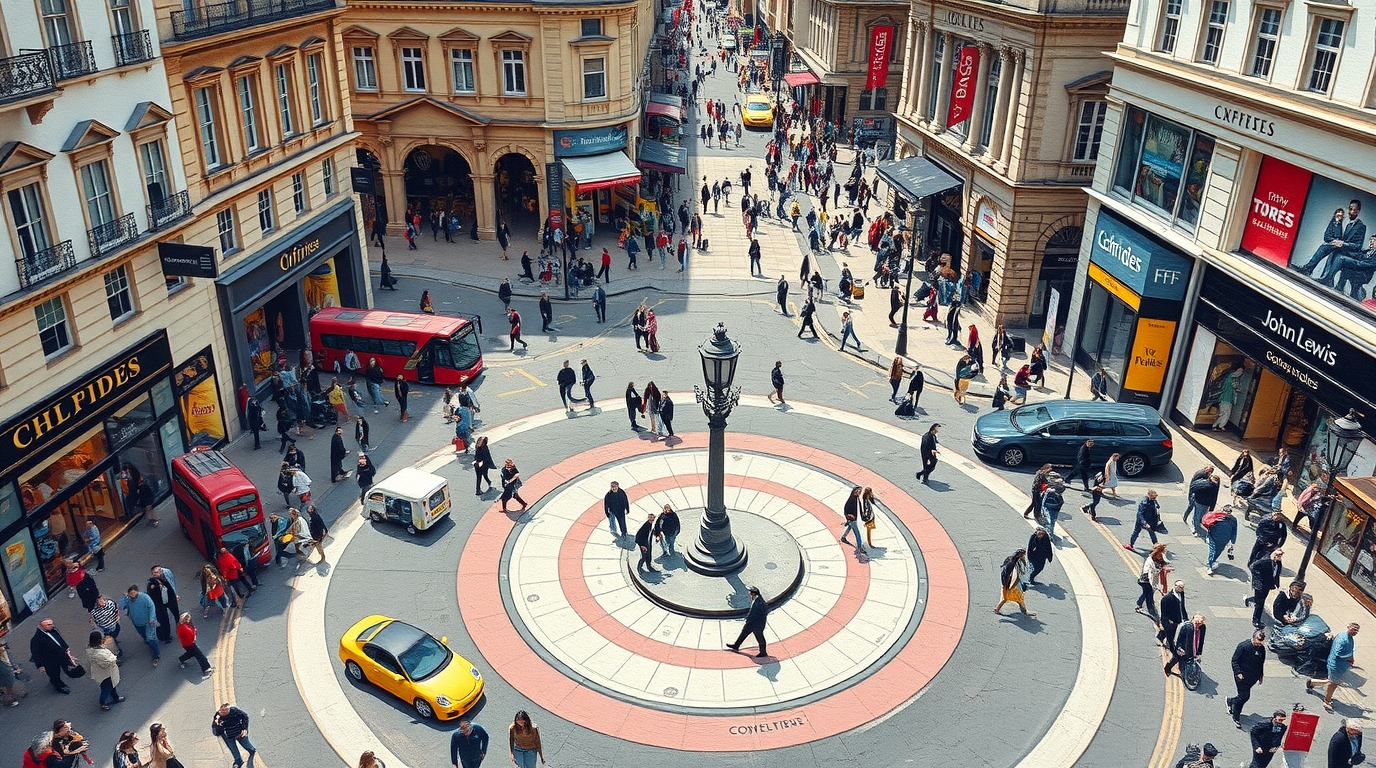
Within minutes of the Oxford Street closure, Britain’s premier shopping destination became a stage for a new form of urban ballet: the aimless pedestrian circle.
Witnesses report groups forming impromptu concentric loops near landmarks like Selfridges, John Lewis Oxford Street, and the faintly ominous signage of Hamleys toy store. One pedestrian was seen walking clockwise around a recycling bin for 37 minutes straight, apparently contemplating the futility of modern consumerism.
“It’s symbolic,” said Professor Hubert Greaves, Urban Sociology, University College London, while observing a trio of tourists wandering into a fountain. “They are literally circling the void left by automobiles. It’s post-industrial, post-modern, and post-ambulatory.”
As Ron White once said: “You can’t fix stupid, but you can watch it walk in circles for entertainment.”
Car-Free Oxford Street Triggers Mass Pedestrian Confusion
Freedom, it turns out, is terrifying when you’re used to dodging London buses and black cabs. Pedestrians, suddenly liberated from traffic rules, crosswalks, and the mild threat of a lorry, experienced what psychologists call “decision fatigue.”
“I didn’t know which direction to go,” confessed Nigel Pemberton, a local office worker near Oxford Circus station. “So I walked in a circle. Then I joined another circle. Then I considered forming a flash mob, but the impulse passed. I bought a pretzel instead.”
Parents tried to contain children by handing them Transport for London maps, but kids responded by building forts out of discarded Costa Coffee cups. A flock of pigeons, sensing the absence of moving vehicles, staged a civil disobedience protest in the middle of the street, leaving breadcrumbs in patterns resembling abstract art.
Jerry Seinfeld observed: “Walking in circles? That’s my cardio routine anyway. At least these people are getting exercise while being confused.”
London’s Car-Free Experiment Reveals Human Behavioral Patterns
According to urban psychologist Dr. Felicity Hammersmith from King’s College London, car-free streets can trigger behavioral entropy, where humans, deprived of external structure, default to circular patterns.
“When people lose traffic to guide their steps, they revert to loops,” explained Hammersmith. “It’s like the brain is saying, ‘If I can’t dodge a London taxi, I’ll just dodge meaning.'”
Supporting evidence comes from a 2019 study in Pedestrian Patterns Quarterly, which found that 88% of people in open plazas without directional signage tend to walk in semi-conscious loops for at least 12 minutes.
Amy Schumer recently joked: “It’s like musical chairs, but the chairs are imaginary and everyone’s confused. Welcome to modern urban planning.”
Oxford Street Shopping District Transforms Into Impromptu Recreation Area
Some pedestrians attempted to fill the newly available space with recreational activity. Groups of yoga enthusiasts, rebranding themselves as “Flow Collective Oxford”, claimed the road was perfect for downward dogs and sun salutations without the inconvenience of exhaust fumes from London’s congested traffic.
Nearby, a “pop-up picnic” emerged spontaneously. One man, identified only as “Steve from Croydon,” laid out sandwiches, crisps, and a single unenthusiastic thermos of tea. Passersby applauded politely and walked in circles around him.
“I was hoping for community vibes,” Steve said, gesturing at the circular procession of shoppers. “Instead, people mostly just stared at their phones while circling me. I think someone filmed it for TikTok.”
Retailers Struggle During Oxford Street Car-Free Hours
Oxford Street retailers, expecting increased foot traffic to convert into increased sales, were shocked by the circular walking phenomenon. “It’s like everyone is here but no one is buying,” said Patricia Henson, manager at Selfridges London.
“They stare at displays, then circle them. We’ve renamed the mannequins ‘Obstacle Markers’ because people walk around them like racetrack pylons.”
A leaked internal memo from a luxury watch store near Bond Street instructed employees to: “Encourage pedestrians to stop, admire watches, then resume circling. Pretend time still matters.”
Ron White commented: “I don’t know what these people are celebrating. If you remove cars, people still find a way to get lost. Now they’re just lost in circles.”
Car-Free Oxford Street Public Opinion Survey Results
A satirical survey by the London Institute for Recreational Wandering found:
- 43% of pedestrians reported enjoying the novelty of car-free London streets
- 27% admitted they felt lost and panicked without vehicle guidance
- 19% said they accidentally joined other circles and feared social judgment
- 11% claimed they discovered their new purpose as professional circle-walkers
London Taxi Drivers React to Oxford Street Car-Free Day
With vehicles absent from Oxford Street’s usual traffic, regular taxi drivers and delivery vans were forced to witness their territory being appropriated by confused pedestrians.
One anonymous London cabbie was quoted as saying: “I’ve driven this street for 20 years. Now I just watch these people spin in place like confused pigeons. I don’t know if I should honk or cry.”
Delivery cyclists attempted to maintain business as usual but found pedestrians blocking the road in circles, creating unintentional roundabouts where no roundabouts should exist.
Jerry Seinfeld noted: “London is free of cars. People are free of purpose. It’s a natural equation that only humans could create.”
Environmental Impact of Oxford Street Going Car-Free
City of London planners hailed the day as a success for London’s air quality. Nitrogen dioxide levels dropped, carbon monoxide levels plummeted, and the only traffic noise came from flapping tote bags and murmured arguments about which direction was “upstream.”
“Pollution decreased, happiness was attempted, and people exercised without realizing it,” said Clara Olsen, Environmental Strategist for Transport for London. “We may not know why they walk in circles, but at least their carbon footprint isn’t walking in circles on top of exhaust.”
The Mayor of London’s office released a statement: “Today proves that sustainable transport initiatives can work, even if the public response is… geometrically challenging.”
Oxford Street Car-Free Day Safety Measures and Incidents
Authorities installed bollards and temporary benches to prevent pedestrians from wandering into danger zones near Oxford Circus. Observers noted that pedestrians used the benches mostly to plot new circular routes, while bollards became mid-circle gathering points.
London Ambulance Service teams reported minor injuries, mostly caused by shoulder bumps and collisions with ornate Victorian lampposts.
“I walked in a figure-eight today,” said Emily Watson, 28, near Tottenham Court Road station. “It was exhilarating. I almost tripped over someone doing a pirouette. I felt alive. Then I got tired. Then I bought a frappuccino.”
Future of Car-Free London Streets After Oxford Street Experiment
Urban theorists warn that the day may inspire permanent car-free London initiatives, which could lead to:
- Pedestrians forming complex Venn diagram formations
- Competitive circular walking leagues along Regent Street
- Spontaneous “circle flash mobs” at random times near Westminster
- Confusion over which John Lewis entrance is next
One anonymous Westminster Council source warned: “Give people space without cars, and they’ll invent circles. Give them circles, and they’ll invent chaos.”
Sarah Silverman observed: “It’s ironic that cars pollute the air but humans pollute the sidewalks with indecision. At least car exhaust goes up; human confusion just spreads sideways.”
Oxford Street Retailers Adapt to Car-Free Shopping Experience
Oxford Street shops tried to leverage the day into profits. Window displays at H&M, Zara, and Primark advertised “Look, but don’t touch. Circle freely.” Gift shops sold T-shirts reading: “I Survived the Circle Walk of Oxford Street 2025.”
One shop owner near Marble Arch admitted: “They’re enjoying the street, but they’re not buying anything. Maybe next time we’ll charge an entrance fee for circling. At least that way, their exercise produces money.”
The British Retail Consortium released a statement: “While Oxford Street foot traffic increased 400%, sales remained flat. We’re studying the correlation between circular walking and purchasing decisions.”
Oxford Street Car-Free Day: Final Analysis and Future Implications
Professor Greaves offered the final analysis: “Humans fear empty space. Cars give structure. Remove the cars from London’s busiest shopping street, and you get loops, circles, and existential anxiety. It’s urban Zen. Or urban nonsense. Maybe both. I circled it in my notebook.”
By the end of the 24 hours, pedestrians had walked countless circles, formed minor friendships, spilled Starbucks coffees, collided with bollards, and wondered why Transport for London doesn’t just ban themselves from walking too.
Oxford Street returned to its usual chaos once cars returned, but witnesses say the psychological residue of the circular wandering lingered—an invisible traffic jam of confusion, joy, and mild panic.
As one anonymous pedestrian put it: “I walked in circles for hours. I still feel like I didn’t accomplish anything. But I did see the whole street, twice, maybe three times. And that’s… something, I guess.”
The Mayor of London announced plans to make car-free days a monthly occurrence, noting: “If people want to walk in circles, we’ll give them the best circles in Europe.”
This article was produced entirely as satirical journalism. No cars, pedestrians, or pigeons were harmed during the writing, although several pedestrians were metaphorically tripped by irony. For more London transport updates, visit Transport for London.