

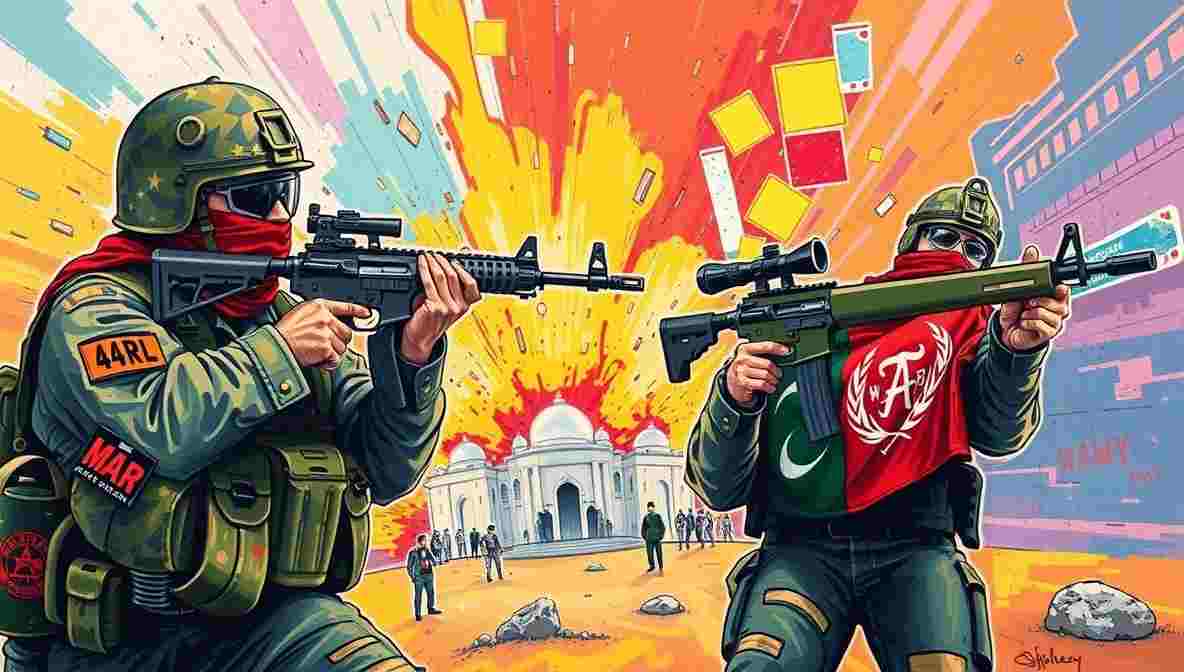
Pakistan-Afghanistan Relations Downgraded From ‘Complicated’ to ‘Explosive’
Observations Before Things Detonate Further
-

UN officials had hoped the holy month of Ramadan might inspire restraint and contemplation. Instead, both sides embraced reflection in the literal sense, as explosions reflected across city skylines and “open war” entered diplomatic vocabulary. The relationship status between Pakistan and Afghanistan has officially moved from “It’s Complicated” to “We Need to Step Outside.”
- Both governments insist they are retaliating, though no one remembers who started retaliating first. Historians are now calling it “pre-retaliation” — the geopolitical equivalent of pre-crime, but with better explosions.
- The phrase “open war” suggests honesty, transparency, and possibly a sign-in sheet.
- During Ramadan, diplomats hoped for spiritual reflection. Instead, they got reflective explosions — same word, wildly different insurance premiums.
- Each side denies hosting militants with the confidence of a teenager denying they ate the last slice of cake while holding crumbs.
- Cease-fires in the region now come with expiration dates shorter than yogurt.
- Defense ministers have discovered that social media is faster than artillery for declaring war. And cheaper, if you exclude the artillery.
- Border skirmishes are now being described as “aggressive networking events.”
- The word “patience” has been officially retired from both national vocabularies. A small ceremony was held. Nobody waited for the speeches.
- UN mediators are beginning to suspect that “cup of patience overflowing” may require a larger cup. Or a bucket. Or a different metaphor entirely involving something less flammable.
ISLAMABAD AND KABUL — In what analysts are calling the most dramatic relationship downgrade since “It’s Complicated” became “We’re Done,” relations between Pakistan and Afghanistan have officially been reclassified from “strained” to “actively combustible.”
The phrase “open war” was introduced with ceremonial seriousness by officials who appeared both resolute and slightly surprised at how quickly the situation escalated from sternly worded statements to actual airstrikes.
“Our cup of patience has overflowed,” declared Pakistan’s defense minister, Khawaja Asif, on social media, proving once again that modern geopolitics now comes with a character limit.
Experts say the metaphor was unfortunate. “When you describe patience as a cup, you imply refills are possible,” noted Dr. Hamid Qureshi, a regional analyst who has not slept since 2014. “This suggests a beverage diplomacy failure.”
Retaliation, Now With Extra Layers — Like a Conflict Baklava
The current exchange follows a series of retaliations responding to retaliations responding to retaliations. Officials on both sides agree the timeline is crystal clear, provided you start at a different point.
Afghan officials claim cross-border strikes were justified responses to prior strikes. Pakistani officials insist those prior strikes were necessary responses to even earlier provocations. Observers have described the logic as “recursive indignation” — a term now trademarked by three separate think tanks.
“It’s like arguing about who clapped first at a concert,” said a Kabul shopkeeper who declined to give his name but did offer tea. “Eventually, everyone is clapping and nobody remembers the song.”
Denial Is a Shared Language — and Both Sides Are Fluent
Central to the tension is Pakistan’s accusation that Afghanistan is providing sanctuary to militants affiliated with Tehreek-e-Taliban Pakistan. The Afghan government has denied this with unwavering consistency.
The denial has reached such polished levels that communication experts are studying it for tone. “It’s not just denial,” said one European diplomat. “It’s denial with posture.”
Meanwhile, citizens on both sides are navigating a geopolitical reality where “neighbor” increasingly sounds like “archrival with shared plumbing.”
Ramadan and the Art of Strategic Reflection — Mostly the Explosive Kind
The timing of escalation during Ramadan has added an extra layer of irony. United Nations officials had quietly hoped the holy month might inspire restraint, contemplation, and perhaps a well-timed pause.
Instead, both sides appear to have embraced reflection in the literal sense, as explosions reflected across city skylines.
One UN mediator, speaking anonymously, sighed: “We planned prayer breakfasts. We did not plan airspace closures.”
The Evolution of Diplomatic Vocabulary — From ‘Concern’ to ‘Airborne’
Regional analysts confirm that the language of diplomacy has evolved significantly.
Once upon a time, “concern” meant something. Now “deep concern” means something is already airborne.
The term “open war” sounds almost courteous, as if the conflict were announcing itself at the door before entering. It is war with manners. War that RSVP’d. War that asked if you had any dietary restrictions.
Yet beneath the phrasing lies a familiar pattern: mutual suspicion layered over decades of history, geography, and unfinished arguments.
Borderlines, Bottom Lines, and Lines in the Sand That Keep Moving
The border between Pakistan and Afghanistan has long been less a line and more a suggestion. It exists on maps with confident ink but on the ground with considerably less agreement.
“This is not new tension,” said Professor Nadia Rahmani of Islamabad University. “This is recurring tension with updated branding.”
Indeed, cease-fires have come and gone with seasonal regularity. The October truce is now described by officials as “a productive chapter,” which in diplomatic language means it briefly reduced explosions — a bar so low it deserves its own ceasefire.
Social Media: The New Battlefield, Same Old Trenches
One notable development in this chapter is the speed at which declarations are made public.
Gone are the days of carefully crafted press conferences. Today, statements are deployed like hashtags. Wars launch with a tweet and trend before the first analyst finishes their coffee.
Defense ministers have traded the war room for the notification bell. Geopolitics has been disrupted. Silicon Valley is somehow involved and doesn’t know how to feel about it.
Citizens in the Middle — Who Did Not, For the Record, Request This
Lost in the rhetorical fireworks are ordinary citizens who, as usual, did not request to participate in any “open” conflict.
In Kabul, a teacher summarized the mood: “We would prefer complicated. Complicated still allows for tea.”
In Peshawar, a taxi driver put it more bluntly: “Explosive is expensive.”
When ‘Complicated’ Was a Luxury — And ‘Explosive’ Is on Trend
For years, observers described Pakistan-Afghanistan relations as complicated. The word implied tension, yes, but also nuance. Complicated relationships suggest at least the possibility of reconciliation.
Explosive relationships suggest distance. And insurance claims.
And so, two neighboring nations with intertwined histories now find themselves in a familiar spiral, fueled by distrust, strategic calculations, and cups of patience that may need to be upgraded to buckets — fire-retardant buckets, specifically.
Diplomats insist backchannels remain open. Officials promise measured responses. Analysts appear on television with increasingly expressive eyebrows.
Meanwhile, the region waits, once again, to see whether “open war” proves to be a phrase or a path.
In the grand tradition of geopolitics, everyone claims reluctance. Everyone claims necessity. And everyone claims they are simply responding.
It is a relationship downgrade, yes. But like all complicated relationships, there remains the possibility that someone, somewhere, will suggest counseling.
Until then, “complicated” has been archived.
“Explosive” is trending.
Auf Wiedersehen, amigo!
Pakistan and Afghanistan have maintained one of South Asia’s most volatile bilateral relationships for decades, complicated by the disputed Durand Line border, allegations of cross-border militancy, and the Taliban’s return to power in Kabul in 2021. Tensions escalated sharply in early 2025 after Pakistan conducted airstrikes inside Afghan territory targeting Tehreek-e-Taliban Pakistan (TTP) positions, which it accuses the Afghan Taliban government of sheltering. Afghan officials denied complicity and condemned the strikes. Pakistani Defense Minister Khawaja Asif declared on social media that Pakistan’s “cup of patience has overflowed,” framing the strikes as justified retaliation. The exchange drew international concern, with the UN urging both sides toward dialogue. The escalation occurred during Ramadan, adding a layer of geopolitical irony to what analysts described as a deeply entrenched cycle of mutual grievance, strategic mistrust, and unresolved territorial ambiguity.