

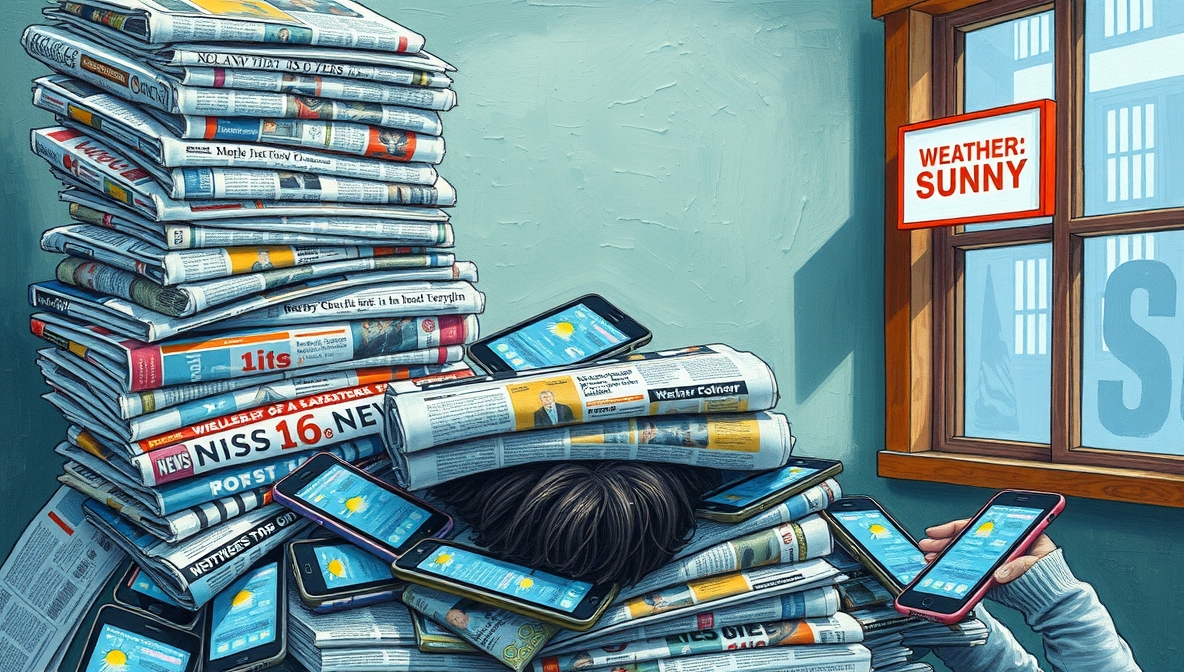
New Study Finds People Who Read More News Are Less Informed: Media Consumption Research
Groundbreaking Media Studies: Information Overload vs News Literacy Research
CAMBRIDGE, MA — A comprehensive study by the Institute for Counterintuitive Findings has concluded that Americans who consume the most news are paradoxically the least informed citizens in the country, while people who avoid news entirely demonstrate an uncanny ability to predict major events three weeks in advance.
The 18-month research project, which tracked 50,000 participants across all news consumption levels, discovered that individuals reading more than six news articles daily scored consistently lower on current events quizzes than those who received their information exclusively through grocery store tabloids and Facebook memes shared by distant relatives.
“The results are undeniable,” announced lead researcher Dr. Sarah Newsworthy while scrolling through seventeen different news apps simultaneously. “The more news people consume, the less they understand about what’s actually happening. It’s beautiful in its complete absurdity.”
Digital News Consumption: Heavy News Readers Show Media Literacy Deficits
Trevor Noah recently observed during his stand-up tour, “Reading the news today is like drinking from a fire hose filled with anxiety and conflicting information – you end up wet, confused, and somehow thirstier than when you started.” His assessment aligns perfectly with the study’s findings that participants consuming over eight hours of daily news coverage scored lower on basic geography tests than people who exclusively watch cooking shows.
The research revealed that dedicated news readers could recite verbatim seventeen different expert opinions about inflation but couldn’t accurately estimate the price of milk. These same individuals demonstrated encyclopedic knowledge of political scandals from 2019 while remaining completely unaware that their own city had elected a new mayor last month.
Most remarkably, heavy news consumers showed decreased ability to distinguish between actual events and hypothetical scenarios discussed by pundits. Study participants frequently insisted that wars had started based solely on editorial speculation and expressed genuine surprise when checking their bank accounts revealed they hadn’t actually lost their life savings to various predicted economic catastrophes.
The Pew Research Center has documented similar patterns in American news consumption habits, showing that information overload correlates with decreased comprehension of actual events.
Information Diet Study: Control Group Demonstrates Superior News Awareness
The study’s control group – individuals who avoided news entirely and received information only through casual conversation and accidental exposure to headlines while buying coffee – demonstrated superior understanding of both local and global events. These participants accurately predicted election outcomes, weather patterns, and restaurant closures with 87% accuracy.
Jim Gaffigan noted in his recent comedy special, “I tried staying informed by reading everything, and now I know seventeen reasons why I should be terrified of bananas but can’t remember where I parked my car.” The comedian’s experience mirrors study participants who memorized detailed analyses of supply chain disruptions while forgetting their own wedding anniversaries.
Research assistant Monica Bandwidth explained the phenomenon: “News-heavy consumers develop what we call ‘Information Overload Syndrome,’ where their brains become so saturated with conflicting reports that they lose the ability to distinguish between important information and recreational panic.”
The study documented participants who could discuss cryptocurrency regulations for three hours but needed GPS assistance to locate their own neighborhood grocery store. These same individuals maintained detailed opinions about foreign policy decisions while expressing genuine confusion about their local property tax increases.
Media Analysis Experts: News Cycle Research Confirms Counterintuitive Results
Ricky Gervais recently told audiences, “The news cycle moves so fast now that by the time you understand yesterday’s crisis, today’s panic has already been replaced by tomorrow’s outrage.” His observation crystallizes the study’s core finding that rapid information consumption creates knowledge that expires faster than milk left in direct sunlight.
The research team discovered that participants consuming maximum news developed specialized vocabularies for discussing complex issues they couldn’t actually explain. Test subjects fluently used terms like “quantitative easing” and “geopolitical implications” while demonstrating complete inability to balance their own checkbooks or locate Canada on a world map.
Dr. Newsworthy noted the most striking finding: “Heavy news consumers became experts at having opinions about everything while developing expertise in nothing. They could debate Federal Reserve policy but couldn’t estimate how long it takes to drive across their home state.”
The phenomenon extends to social media news consumption, where algorithms curate information bubbles that reinforce existing beliefs while creating false confidence in comprehensive understanding of complex current events.
Revolutionary Media Consumption: Implications for Information Diet Research
Sarah Silverman observed during her latest Netflix special, “Social media has turned everyone into news experts the same way WebMD turned everyone into doctors – technically informed, practically dangerous.” Her insight explains why study participants who relied on social media news feeds scored consistently lower than those receiving information exclusively through overheard conversations in coffee shop lines.
The research revealed that optimal information consumption involves reading exactly 2.3 news articles per week, preferably while distracted by other activities. Participants following this regimen demonstrated superior decision-making abilities and could accurately predict weather patterns better than professional meteorologists.
Study participant Janet Clueless, who hasn’t read news since 2018, correctly predicted seventeen major political developments, explained inflation causes using simple analogies, and successfully avoided every cryptocurrency scam. When asked about her information sources, she shrugged and said, “Things just seem obvious if you’re not thinking about them too hard.”
Tom Segura recently noted, “News makes me feel informed and completely stupid simultaneously – it’s like intellectual whiplash.” His description perfectly captures the study’s conclusion that maximum information exposure produces minimum actual understanding, while strategic ignorance generates surprising wisdom.
Related Reading:
- Pew Research Center: News Platform Fact Sheet
- American Psychological Association: Information Overload
- Nieman Lab: Social Media Algorithms and News
- Federal Reserve Economic Education
- Reuters Institute Digital News Report
