

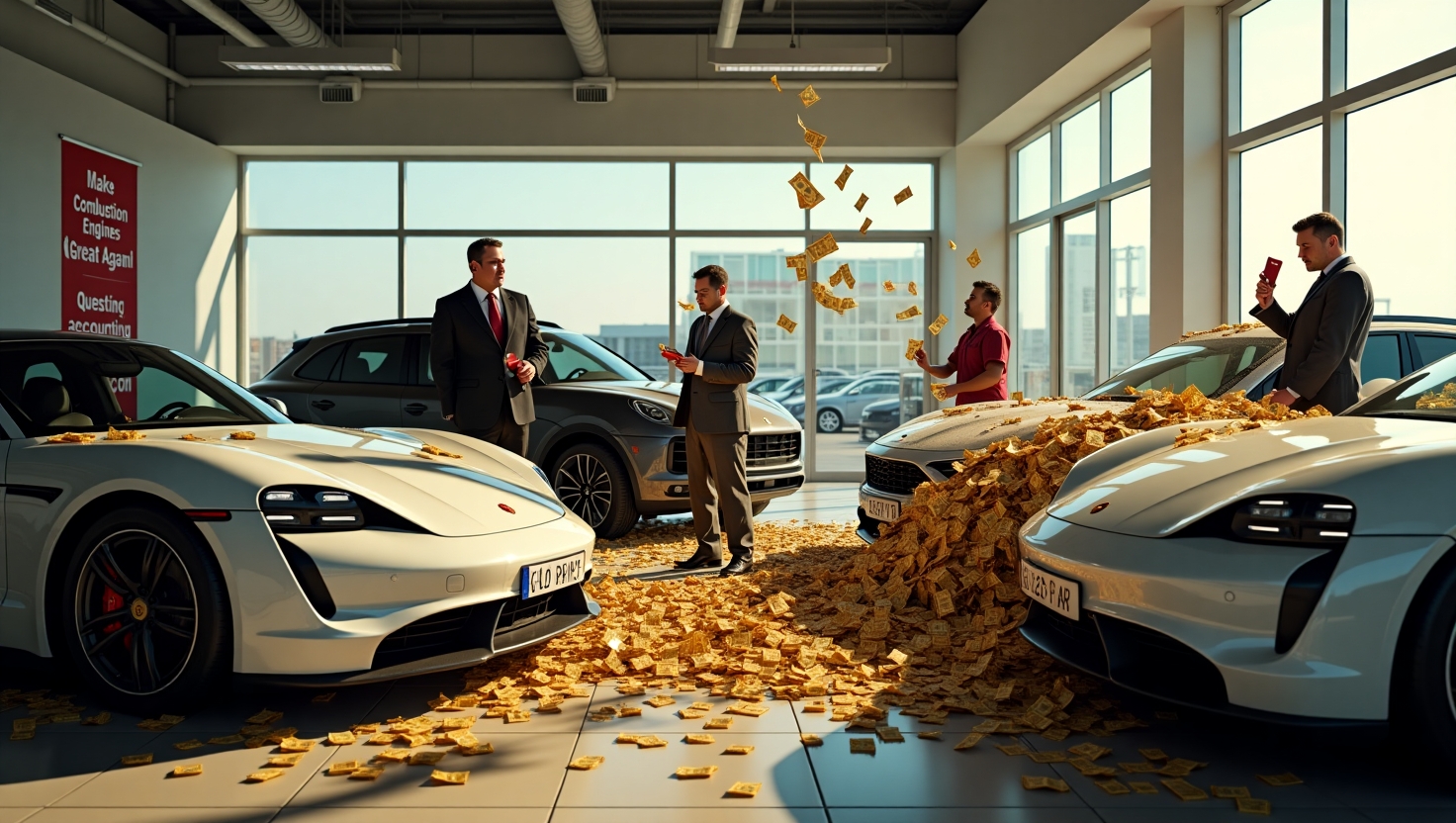
Porsche Admits Its Business Model No Longer Works—And That’s Hilariously Inevitable
Porsche, the crown prince of European auto elitism, has finally confessed what every valet in America already knew: the business model “no longer works.” That’s right—after decades of charging hedge fund managers $130,000 for a two-seater that fits less luggage than a toddler’s backpack, the German carmaker is now clutching its designer pearls and wondering where it all went wrong.
The short answer? Everywhere. The long answer? Well, it’s the kind of corporate midlife crisis that even Ron White wouldn’t try to drive through Texas without a 30-pack and a buddy named Cletus.
From “Precision Engineering” to “Who’s Still Buying This?”
Porsche used to print money. Their whole brand was built on scarcity and speed—a kind of high-performance gas-powered aristocracy on wheels. But now, with EVs flooding the market and millennials Googling “is it cheaper to own a goat than a car,” suddenly selling a glorified golf cart for six figures doesn’t hit like it used to.
China—Porsche’s former cash cow—is ghosting them harder than a Tinder date after seeing your crypto portfolio. Sales in the region are down a whopping 42%. Turns out, Porsche’s assumption that Chinese buyers would line up forever for status symbols was about as sustainable as a Hummer doing yoga.
Meanwhile, the U.S. market isn’t faring much better. The company raised prices 3.6% during an inflationary panic while simultaneously introducing electric models nobody asked for. The Taycan, their flagship EV, dropped in sales by 49% last year, then another 6% in 2025—basically, the car version of getting ghosted twice by the same person.
The Death of the “Dude Car”
One big problem? Porsche still sells like it’s 1996. Their marketing playbook reads like: “Target men between 45 and 60 who just got divorced and are trying to convince their chiropractor they’re emotionally available.”
But Gen Z doesn’t care about torque or tailpipes—they want cars that sync with their emotional support apps and tell them they’re valid.
Porsche’s signature masculinity doesn’t work in a world where climate guilt is a feature, not a bug. Driving a Porsche Taycan into a Whole Foods parking lot is like showing up to a dog funeral wearing fur.
EV Dreams and Existential Screams
Porsche once boasted that by 2030, 80% of its cars would be electric. Now it’s backpedaling so fast you can hear the combustion engines firing up just to escape that target.
Ironically, the company’s most expensive venture—electrifying the brand—has become its biggest existential crisis. The EV market is flooded, competitive, and—worst of all—affordable. You can now get a decent EV for under $40K. Meanwhile, Porsche still wants you to spend $120,000 for a car that doesn’t even come with Apple CarPlay.
They’ve announced cost-cutting measures. Translation: layoffs are coming. About 1,900 jobs will vanish by 2029 in Germany. For a company that once built cars with the efficiency of a Swiss watch, it’s now running like an overpromised Kickstarter campaign—great design, no delivery.
When Skoda Beats Porsche at Its Own Game
Let’s talk about the biggest insult in this tragic opera: Skoda—Volkswagen’s budget cousin, the Timex to Porsche’s Rolex—is now delivering better profit margins.
That’s right. While Porsche obsesses over handcrafted steering wheels stitched by monks on alpacas, Skoda’s out here slinging practical family SUVs like they’re fresh-baked pretzels.
This is like discovering that the guy who used to cheat off your math homework now runs NASA.
From IPO Glory to “Please Buy Our Cars”
In 2022, Porsche’s IPO valued it higher than Volkswagen itself. But what goes up like a Carrera often comes down like a mid-engine belly flop.
CEO Oliver Blume now says the company will “rethink the business model.” That’s German for “We’re gonna panic in an orderly fashion.”
Reports say Porsche may re-add combustion engines to electric-only models. You heard right: they’re literally reversing the future. That’s like unplugging your smart TV to make it dumber—just to feel something.
Final Lap: Who’s Left in the Driver’s Seat?
If Porsche wants to survive, it’ll need more than soft leather seats and “sustainable exclusivity.” It’ll need self-awareness, humility, and possibly a Groupon.
As comedian Sarah Silverman might say, “You can’t sell middle-aged insecurity in an EV chassis and expect Gen Z to care.” And as Ron White would probably shout from a speeding Boxster, “You can’t fix the steering if you keep driving into the ditch.”
Porsche’s business model didn’t fail because the cars stopped being good. It failed because the world stopped worshipping the same gods.
Auf Wiedersehen, amigos. 👋🏻
