

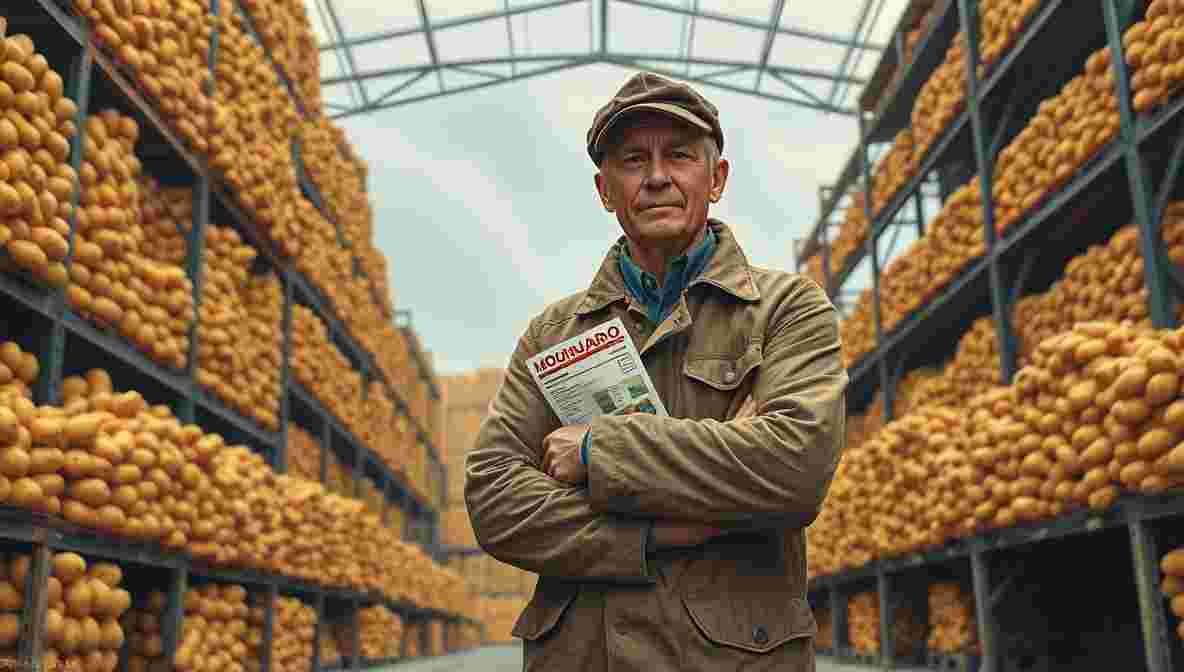
American Potato Farmers Declare War on Ozempic: “We Didn’t Grow 600 Tons of Regret”
Somewhere in the vast flatlands of Idaho, a potato is staring into the abyss. And the abyss is staring back… wearing athleisure, holding a weekly Ozempic injection, and declining a second helping for the first time in its adult life.
Welcome to 2026, where the humble American spud — cornerstone of the Fourth of July cookout, backbone of the drive-through, and the only vegetable that ever made it onto a Super Bowl commercial — has been dethroned by a syringe and a sudden national outbreak of portion control.
Nobody saw this coming. Least of all the potato.
The Great American Carb Collapse: How Ozempic Declared War on the French Fry
Farmers across the United States are sitting on what agricultural economists are now calling “Mount Starchmore” — vast, glistening silos of unsold potatoes that nobody is coming to eat. Weight-loss drugs like Ozempic and Mounjaro are slashing potato demand from coast to coast, leaving growers staring at spreadsheets that make no mathematical sense.
For generations, the American potato was this country’s most democratic food. Rich, poor, red state, blue state — everybody ate fries. McDonald’s built an empire on them. Idaho built an identity. And then, in the span of about eighteen months, America collectively looked at a basket of fries and said, “You know what? I’m good.”
And just like that, the potato went from “comfort food” to “agricultural liability.”
The numbers are staggering. Cornell University research found that spending on savory snacks dropped roughly 10% among GLP-1 users, with similarly large decreases in sweets, baked goods, and cookies — and the potato, which had a finger in every one of those categories, is taking the hit from all directions simultaneously.
What the Experts Are Saying (Mostly in Disbelief)

Dr. Dale Butterfield, a food economist at a land-grant university that would prefer not to be associated with this article, issued the following statement from his office in a building named after a corn subsidy:
“We are witnessing the first agricultural crisis in American history caused not by drought, blight, or a trade war — but by people stopping halfway through their meal and meaning it.”
Meanwhile, an anonymous pharmaceutical executive reportedly sent a company-wide email celebrating the trend:
“Every skipped order of fries is a shareholder dividend.”
That email was described by insiders as “the most honest thing Wall Street has produced since the invention of the earnings call.”
For context: the US GLP-1 market generated $47.98 billion in revenue in 2025 and is projected to hit $130.6 billion by 2033. The potato generated considerably less. The potato does not have a CAGR. The potato has feelings, and right now those feelings are complicated.
The Half-Fry Economy: What Ozempic Did to the Drive-Through
According to fast food industry insiders, customers who once supersized without hesitation are now treating a medium order of fries like it’s a finite natural resource.
Restaurant operators are baffled.
One franchise owner in Ohio — who asked not to be named, for fear of being sued by a company whose name is three letters and two golden arches — told us:
“People are leaving fries behind now. Full fries. Hot fries. I got a customer last Tuesday who ordered fries, ate four of them, and pushed the rest away like they’d made their peace with something. That’s not a diet. That’s a spiritual experience I wasn’t trained for.”
The major chains have responded with the kind of menu innovation usually reserved for a PR crisis. Chipotle rolled out a “High Protein Cup,” Subway launched “Protein Pockets,” Olive Garden introduced a “lighter portion” menu, and Smoothie King debuted an entire GLP-1 support menu — which sounds less like a restaurant offering and more like a co-pay you eat with a straw.
The potato watched all of this from a temperature-controlled storage facility in Burley, Idaho. The potato had thoughts. The potato kept them to itself.
What the Funny People Are Saying
“I saw a guy at a diner order a baked potato, stare at it for ten minutes, and leave. The waitress said it happens twice a week now. She’s started naming them.” — Jerry Seinfeld
“My buddy got on Ozempic and now he looks at a plate of fries like they owe him money. He used to eat two baskets before the appetizers arrived. Now he’s ‘full from smelling the menu.’ I don’t know this man anymore.” — Ron White
“We spent fifty years trying to get Americans to eat less. Didn’t work. Spent two years on a drug. Now Idaho’s in crisis. I feel like there’s a lesson here about government nutrition guidelines, but I can’t eat enough to think straight.” — Amy Schumer
“The potato is the most American vegetable there is. It doesn’t complain, it works in any situation, and now the whole country has decided it’s the problem. I’ve never related to a root vegetable more in my life.” — Jim Gaffigan
The Potato Identity Crisis: Rebranding America’s Favorite Side Dish
Potatoes are now in full rebranding emergency mode — the kind of desperate pivot usually reserved for airlines after a bad quarter and politicians after a worse headline.
Focus groups have tested new slogans, with results that can only be described as increasingly unhinged:
- “Potatoes: Still Better Than Feelings”
- “Try Carbs Again… Just Once… For Closure”
- “We Were There For You During Every Breakup Since 1953”
- “We Survived the Low-Fat Era. We Can Survive Semaglutide.”
- “French Fries: A Constitutional Right”
None tested well with GLP-1 users, who responded to each concept with a slow head tilt and the phrase: “I appreciate that, but I’m just not hungry.”
US household data shows grocery spending falls by roughly five percent when someone in the household starts taking a GLP-1 drug. That means every new Ozempic prescription is also, functionally, a restraining order served on the potato aisle. No hearing. No appeal. Just a cold warehouse full of evidence.
A New American Food Hierarchy: Protein Is King, Carbs Are on Parole
As GLP-1 adoption spreads, a new and deeply un-American culinary order is emerging.
Protein is now king. Carbohydrates are treated with the kind of suspicion previously reserved for the fine print on a cell phone contract.
The restaurant industry is adapting — or at least attempting to, between rounds of emergency board meetings:
- Smaller portions, presented on larger plates to suggest abundance without delivering it
- “Protein-forward” menus that read like a CrossFit newsletter written by a dietitian
- Meal kits designed around the GLP-1 lifestyle, because apparently that’s a lifestyle now
Even the USDA food pyramid is under pressure to shift further away from starchy carbohydrates. The potato has been watching the food pyramid get revised its entire life. The potato is tired.
Historians confirm this is the first time in recorded American history that the french fry lost a popularity contest. The hot dog issued a statement of solidarity. The hot dog is also nervous.
The Farmer’s Lament: From the Heartland to the Storage Heap
Back on the farm — in Idaho, in Washington State, in the Red River Valley of North Dakota where half the country’s potatoes are grown — the mood is somewhere between stoic and genuinely confused.
The GLP-1 revolution is reshaping the entire American food economy, and farmers who have spent decades supplying a nation of legendary appetites are now discovering that the nation has quietly changed the terms of the agreement without telling anyone in agriculture.
Alternative uses currently under active consideration include:
- Biofuel conversion — giving the potato a second career it did not audition for
- Livestock feed — a demotion the potato considers beneath its dignity
- A direct-to-consumer subscription box called “Spuds Across America,” targeted at people who remember eating
- Rebranding surplus potatoes as “heritage starch” and selling them at farmers markets for $11 a pound
One farmer in Twin Falls, Idaho, was reportedly seen standing in front of a 40,000-square-foot storage facility whispering, “We grew these for you.”
He was later seen Googling “how to pivot to quinoa.”
Supply, Demand, and the Economics of a Nation That Stopped Snacking
The economic logic, as one agriculture professor at Iowa State explained to a room full of increasingly uncomfortable students, is brutally straightforward:
- GLP-1 drugs suppress appetite across tens of millions of American households
- Suppressed appetite means less food purchased at grocery stores and restaurants
- Less food purchased means farmers sitting on product with nowhere to go
- Farmers sitting on product with nowhere to go means a very bad year in a profession that already specializes in very bad years
The share of US households reporting at least one GLP-1 user rose from about 11% in late 2023 to more than 16% by mid-2024 — and that number is still climbing. The potato did the math. The potato needed a moment.
The Global Snack Panic: From Chips to Contemplation
This crisis extends well beyond the potato aisle at your local Walmart.
Industries currently in various stages of demand-related panic include:
- Chip manufacturers, several of whom have reportedly hired consultants to explain what “volume headwinds” means to their shareholders without using the word Ozempic
- Fast food chains, who are discovering that “eat less, charge more” is both a business model and a form of grief
- The inventor of the loaded baked potato, who cannot be reached and is probably fine
Even chocolate is defying expectations. GLP-1 users are actually spending more on premium chocolate — because if you’re only eating one thing today, it had better arrive in foil wrapping with a percentage on the label and a story about a cacao cooperative in Ecuador.
So instead of a family-size bag of Lay’s, Americans are buying a single dark chocolate square and holding it up to the kitchen light like they’re assessing a gemstone. The potato watches this from a storage bin in Nampa. The potato is not impressed.
The Future of American Food: Smaller, Sadder, and Suspiciously Artisanal
Industry forecasters — who get paid handsomely to describe things everyone can already see — predict the American food landscape of the late 2020s will feature:
- Smaller portions on bigger plates, to maintain the psychological illusion of a full meal
- Higher protein content in everything, including things that have no business containing protein
- A great deal of mindful eating, which is just regular eating with worse vibes
Restaurants are reportedly considering concepts including:
- “Memory portions” — full-sized servings offered as a nostalgic novelty, priced like a therapy session
- “Aroma-only tasting menus” — you smell the food, you discuss your relationship with hunger, you go home lighter in the wallet
- “GLP-1 compliant comfort food” — a sentence that should not exist but does
And somewhere, in a processing facility off I-84 in southern Idaho, someone will look at a conveyor belt of potatoes moving toward an uncertain future and think: “We built this country on carbs.”
The Revenge of the Potato: Patient, Starchy, and Not Done Yet
Do not, however, count the American potato out.
The potato survived the low-fat craze of the 1990s, when butter was the villain and everyone was eating rice cakes that tasted like packing material. It survived Atkins. It survived keto. It survived the sweet potato’s inexplicable rise to trendy status, which the regular potato has never forgiven and will never forget.
The potato is patient.
The potato is starchy.
The potato has been feeding this country through wars, recessions, droughts, and at least six dietary revolutions, and it is not especially worried about a Danish pharmaceutical company’s quarterly earnings report.
Because one day — probably a Sunday, probably after someone has spent forty minutes on a Peloton and feels they’ve earned something — a person will look at a plate of fries and think: I deserve this.
And when that day comes, the potatoes will be ready.
Ozempic’s patent won’t last forever, and the day generic semaglutide hits the bargain bin at Costco, the entire pharmaceutical appetite suppression calculation changes. The potato knows this. The potato is playing the long game.
The real story behind this satire: American potato farmers are facing a genuine demand crisis driven by the mass adoption of GLP-1 weight-loss medications including Ozempic, Wegovy, Mounjaro, and Zepbound. Cornell University research published in the Journal of Marketing Research found meaningful reductions in grocery and restaurant spending among US households with GLP-1 users, with savory snacks seeing roughly a 10% decline. The US GLP-1 market generated $47.98 billion in 2025 and is projected to reach $130.6 billion by 2033. Fast food chains including Chipotle, Subway, and Olive Garden have already redesigned menus around smaller, higher-protein offerings. Idaho, Washington State, and the Red River Valley — which together produce the majority of America’s potatoes — are all watching the numbers with concern. This piece was produced by the world’s oldest tenured professor and a philosophy major turned dairy farmer, neither of whom has ever left a fry uneaten and neither of whom intends to start.
Auf Wiedersehen, amigo! 🥔