

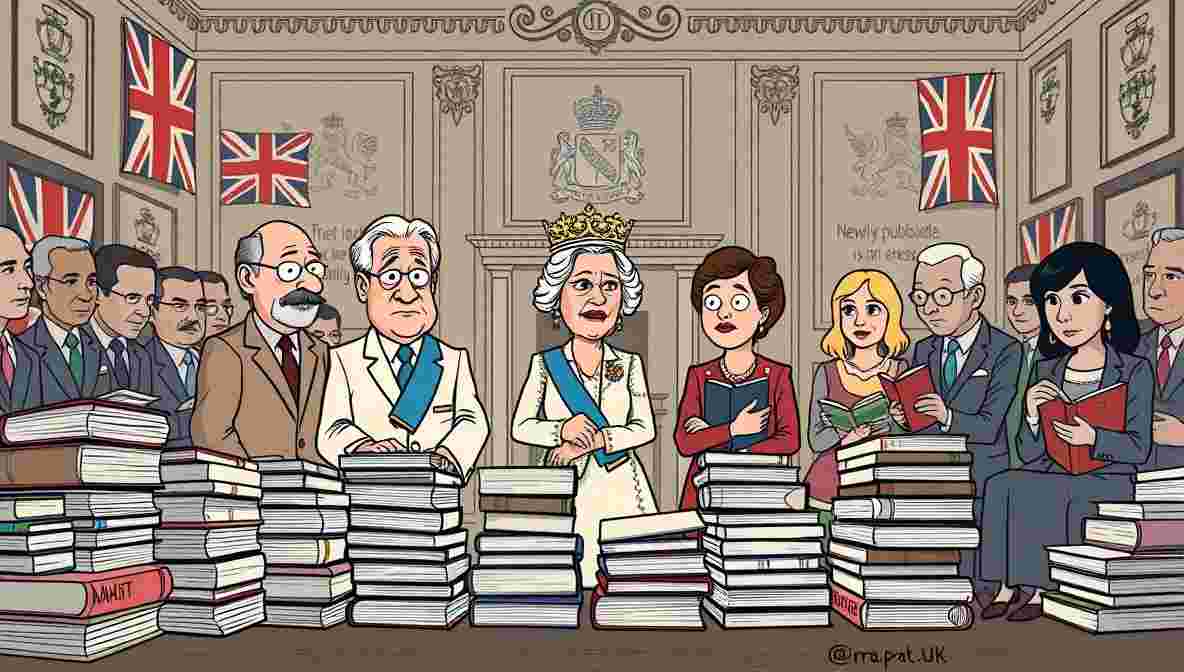
Royal Family Publishes New Book, Immediately Regrets the Whole Literacy Thing
The Monarchy Has Survived Revolution, Plague, and Bad Hats — But the Paperback May Finally Finish Them
Somewhere between a palace balcony wave and a Netflix production meeting, the British monarchy has discovered its greatest enemy is no longer revolution, scandal, or even poor tailoring. It’s the written word. Which is ironic, given that the written word is currently their primary source of income.
The latest literary grenade, Betrayal: Power, Deceit and the Fight for the Future of the Royal Family by Tom Bower, has landed with the elegance of a corgi tripping over a Fabergé egg. And much like that corgi, everyone involved insists they meant to do that.

According to reports, the book paints Prince Harry and Meghan Markle as somewhere between misunderstood visionaries and a couple who turned a thousand-year-old institution into what one aide memorably described as “a very expensive podcast about feelings.” The couple has responded by calling the book a “deranged conspiracy” — which, in royal terms, is the equivalent of underlining every page.
Palace Insiders Confirm the Firm Is Now Running on Competing Narratives and Low-Grade Panic
Royal insiders say the biggest shock is not the content itself, but the dawning realisation that every member of the royal family is now effectively a competing author in what experts are calling “the most passive-aggressive book club in human history.” The Crown, once a symbol of unassailable authority, has become a symbol — full stop. It just now comes with an author bio.
A leaked palace memo, written in calligraphy on crested notepaper because some habits die harder than others, reportedly states: “If this continues, we may need to issue the Crown with a publishing schedule.” Which would make it the first monarchy in history to govern by editorial calendar.
One historian from the University of Buckinghamshire Online (which exists mostly in spirit and entirely on Wi-Fi) observed: “Historically, monarchies relied on secrecy. Now they rely on pre-orders.” The divine right of kings has been replaced by the right of first serialisation.
Every Royal Event Is Now Content — Including, Apparently, the Handshakes
The book alleges that even charitable events have acquired a suspiciously cinematic quality, with critics suggesting appearances feel less like goodwill and more like good lighting. An eyewitness at a recent charity polo match reported: “They didn’t just arrive. They entered. Like emotionally. Like Act Two. With better horses.”
Meanwhile, an anonymous staffer confessed: “We used to plan events. Now we storyboard them. Last week we spent 45 minutes debating whether a handshake felt ‘authentic enough for streaming.'” In fairness, it’s the first time in British history that a handshake has required a second take.
A Nation Asks: Is This Still a Monarchy, or Did We Accidentally Subscribe to Something?
A YouGov-style poll conducted outside a Starbucks in Columbus, Ohio — admittedly not the most scientific deployment of clipboard-based research — found that 63% of Americans believe the royal feud has “gone on longer than most of their mortgages.” A further 21% thought the book was about the TV show. The remaining 16% asked if Harry was the one who dated Taylor Swift, which suggests the feud has successfully penetrated demographics that cannot locate the United Kingdom on a map.
One man in a Kansas City Chiefs hoodie delivered what may stand as the definitive American assessment: “I don’t mind the drama. I just wish it came with a fantasy league.”
What the Funny People Are Saying
“I love how the royals wanted privacy and responded by writing enough books to open a franchise.” — Jerry Seinfeld
“This ain’t a monarchy anymore. It’s a family reunion where everybody brought receipts — and a literary agent.” — Ron White
“You ever notice rich people never argue quietly? They argue with a publicist, a dust jacket, and a 12-city book tour.” — Ali Wong
The Deeper Problem: Everyone Has an Heir to Their Own Version of Events
At the heart of the situation is a deeply modern problem: everyone involved has their own version of events, and all of them have an ISBN. The book reportedly claims tensions existed well before the wedding, with clashes between Meghan and senior royals running like a subplot that the editors kept trying to cut and the principals kept reinstating.
A behavioural psychologist — who absolutely billed for this quote at his standard hourly rate — explains: “When every disagreement becomes content, resolution becomes financially irresponsible.” In other words, making up is bad for the bottom line. The feud, at this point, is the product. The monarchy is just the packaging.
Silicon Valley Wants to Put the Crown on a Subscription Model and Nobody Can Stop Them
Sources confirm several tech companies have approached the royal family with what they are calling a “disruptive solution to narrative fragmentation”: Royal+, a streaming platform where viewers choose which version of events they believe and pay monthly for the privilege.
Proposed tiers include “William’s Cut” (more stoic, fewer emotions, no crying in 4K), “Harry’s Cut” (same events, narrated like a therapy breakthrough with better production values), “Meghan’s Cut” (cinematic lighting, stronger personal branding, the handshake gets its own episode), and “Anonymous Staffer DLC” (passive-aggressive emails sold separately). Early beta testers described the experience as: “Confusing, emotionally exhausting, and somehow impossible to cancel.” So: exactly like the monarchy itself.
The Spare, the Heir, and the Streaming Deal — A Modern Succession Story
Despite everything, the royal family continues its core mission: appearing in public while internally functioning like a Thanksgiving dinner where someone brought a book proposal. The book suggests deeper structural issues, including the long-standing problem of the “spare” — a title that has never, in the history of titles, made anyone feel better about themselves.
Which raises the philosophical question at the centre of all of this: if your entire purpose is symbolic, what happens when the symbol stops symbolising? Answer: you get a Netflix deal, a Spotify deal, a memoir, a rebuttal memoir, and a docuseries in which you explain, at length, that you never wanted any of this.
Final Verdict: The Crown Is Now a Cinematic Universe and We’re All Trapped in It
At this point, the British monarchy is less an institution and more a franchise. There are origin stories. There are spin-offs. There are conflicting timelines and unreliable narrators and at least two characters who insist they’re the protagonist. Somewhere in Buckingham Palace, a very tired equerry is whispering into the wainscoting: “Please. Just one scandal that doesn’t require a sequel. Or a prequel. Or a companion volume.”
He will not get his wish. The audiobook rights have already been sold.
This article is a work of satire and should be read as such, preferably with a large coffee and the quiet resignation of someone who has been following this story since the Spice Girls were still a going concern. It is the product of a deeply serious collaboration between the world’s oldest tenured professor and a philosophy major turned dairy farmer, both of whom agree the royal family would benefit enormously from a group chat titled “Maybe Don’t Publish That.”
Auf Wiedersehen, amigo!