

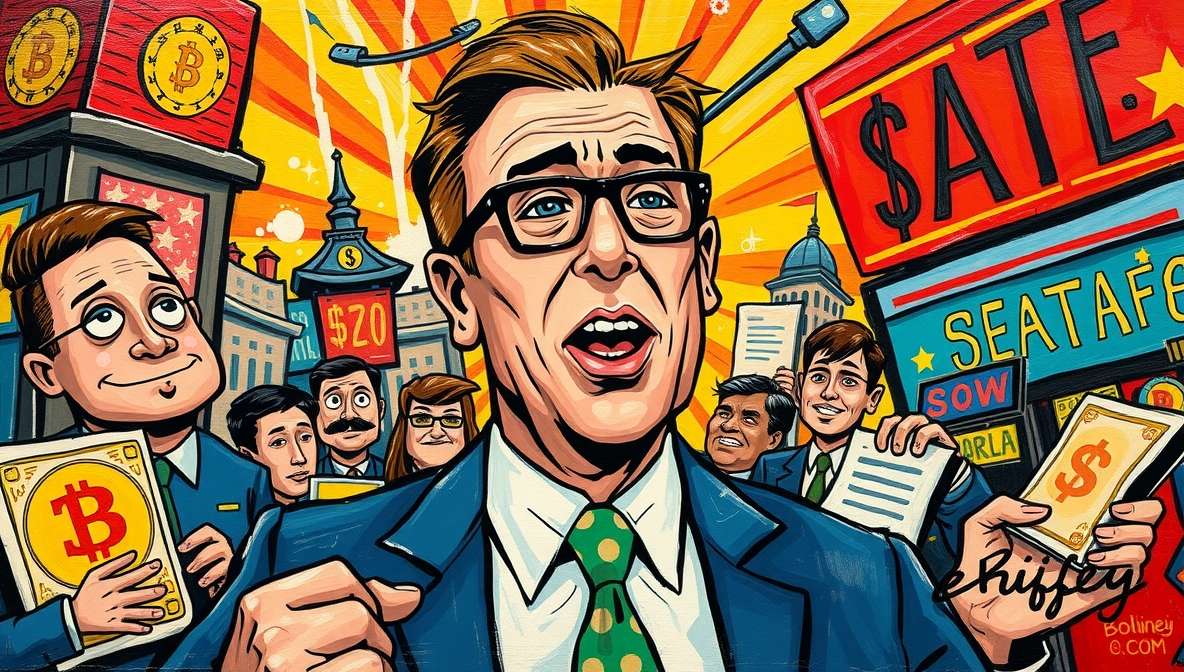
Hedge Fund Manager’s Revolutionary Approach Blends Traditional Finance With Mystical Card Interpretation
Unconventional Methods Promise Market Revolution
Prominent hedge fund manager Scott Bessent revealed his highly anticipated economic recovery strategy Tuesday at an invitation-only presentation that left economists questioning both his methodology and their own career choices. The proposal combines traditional Federal Reserve monetary policy analysis with what Bessent described as “intuitive market guidance derived from ancient divination practices,” specifically a tarot deck he purchased from a Brooklyn metaphysical bookstore.
“The data tells us one story,” Bessent explained, gesturing to the first of three PowerPoint presentations. “But the cards tell us the deeper truth about market sentiment and cosmic economic alignment. Together, they form a complete picture.” He then drew the Tower card and announced it indicated “temporary disruption in the tech sector, or possibly just that I should avoid tall buildings today.”
Presentation Structure Baffles Attendees
The three-hour session alternated between dense macroeconomic analysis and tarot readings, creating what several witnesses described as “intellectual whiplash.” PowerPoint One covered fiscal multipliers and debt-to-GDP ratios. PowerPoint Two detailed inflation projections and unemployment trends. PowerPoint Three was titled “What The Cards Are Telling Us About Q3 Earnings” and featured photographs of Celtic Cross spreads with arrows pointing to various corporations’ stock tickers.
Kevin Hart once said about confusion, “Everybody wants to be famous, but nobody wants to do the work.” Bessent wants to revolutionize economics, but apparently the work involves both Bloomberg terminals and fortune telling cards, which is definitely a choice.
Audience member Dr. Patricia Chen, economist at the International Monetary Fund, raised her hand during the Q&A to ask whether the tarot component was “perhaps satirical.” Bessent responded by shuffling the deck, drawing a card, and informing her that “the Three of Pentacles suggests you should be more open-minded about alternative analytical frameworks.”
Methodology Combines Math and Mysticism
According to the 287-page supporting documentation distributed after the presentation, Bessent’s strategy involves running traditional quantitative models, consulting with leading economists, analyzing historical market data, and then “validating conclusions through three-card spreads to ensure spiritual-temporal market alignment.” The document includes seventeen pages of regression analysis followed by detailed interpretations of Major Arcana symbolism.
The Treasury Department, which invited Bessent to present his findings, issued a carefully worded statement describing the proposal as “certainly comprehensive” and “unlike anything we’ve seen before,” which senior officials later clarified meant “What the hell was that?” but in diplomatic language.
Investment Community Responds With Skepticism
Wall Street analysts spent Wednesday morning attempting to incorporate tarot readings into their existing models with mixed results. Goldman Sachs released a research note titled “On the Integration of Cartomancy Into Fixed Income Strategies,” which concluded that while “market fundamentals remain our primary analytical tool, we cannot definitively rule out that tarot cards predict nothing, especially given how wrong we’ve been about everything else lately.”
Sarah Silverman observed about alternative approaches, “I don’t care if you think I’m racist. I only care if you think I’m thin.” Bessent doesn’t care if you think he’s unorthodox; he only cares if you think his strategy works, which requires believing that playing cards have predictive economic power.
JPMorgan Chase CEO Jamie Dimon, when asked for comment, stared silently at reporters for seventeen seconds before saying “Next question” and refusing further elaboration. Sources close to Dimon revealed he spent Wednesday afternoon researching whether competitive hedge funds were also using divination methods and whether he was “somehow missing the boat on mysticism.”
Academic Economists Express Concern
Leading economic scholars have published rapid responses to Bessent’s presentation, ranging from measured criticism to what the American Economic Association journal described as “full academic meltdown.” Professor Harold Martinez of the University of Chicago wrote a fourteen-page rebuttal that began “What the actual hell?” and maintained that tone throughout.
“We’ve spent centuries developing rigorous analytical methods,” Martinez’s paper explained. “We’ve built sophisticated models, collected massive datasets, and trained generations of economists in empirical research. And now someone suggests we could have just been using tarot cards? This undermines everything. Or maybe it doesn’t. I don’t even know anymore.”
Bessent Defends Integrated Approach
During follow-up interviews, Bessent doubled down on his methodology, arguing that traditional economics has “failed to predict major market events with any consistency,” so incorporating tarot readings “couldn’t possibly make predictions less accurate.” He noted that the cards correctly predicted three of the last five major market movements, which he characterized as “better than most Fed forecasts.”
Dave Chappelle said about unconventional thinking, “I’m cool with failing so long as I know that I’m failing forward.” Bessent is either failing forward into a new paradigm of economic analysis or just failing, but he’s definitely committed to the direction.
When pressed on whether the tarot component might be “completely ridiculous,” Bessent drew a card, studied it thoughtfully, and responded that “the Eight of Wands suggests rapid communication and movement of ideas, which I interpret as validation that we should move forward quickly with implementation.” He then added that skeptics were “demonstrating exactly the kind of closed-minded thinking that the Five of Cups warns against.”
Political Implications Remain Unclear
The presentation has created unexpected complications for policymakers attempting to incorporate Bessent’s recommendations into actual economic policy. Congressional committees responsible for budget planning held emergency sessions to discuss whether they’re legally permitted to base fiscal policy on tarot interpretations or whether that violates separation of church and state provisions.
“Nobody knows if mysticism counts as religion for constitutional purposes,” explained House Budget Committee Chair Robert Jenkins. “We’ve got legal scholars researching 18th-century court cases about fortune tellers. This is my job now. I went to Harvard for this.”
Market Reaction Reflects Confusion
Following Bessent’s presentation, markets experienced unusual volatility that analysts attributed to “complete uncertainty about what the hell is happening.” The S&P 500 dropped 200 points, recovered 180 points, dropped another 150 points, and closed essentially flat after investors collectively decided they had no idea how to price in “mystical economic guidance.”
Amy Schumer captured market sentiment when she said, “I’m not saying I’m lazy, I’m just very efficient at doing nothing.” Markets aren’t lazy; they’re just efficiently doing nothing because nobody knows whether tarot-based policy recommendations should influence anything.
Trading volumes surged as hedge funds attempted to front-run what they assumed were Bessent’s actual positions, while simultaneously googling “can tarot cards predict markets” and becoming increasingly concerned about their own analytical frameworks.
Rival Hedge Funds Consider Alternative Methods
Several competing firms have quietly begun researching their own unconventional analytical approaches, reportedly including astrology, numerology, and one fund that’s seriously considering hiring a psychic full-time. Industry insiders suggest this represents either “keeping all options open” or “mass professional breakdown.”
Bridgewater Associates founder Ray Dalio, known for quantitative rigor, issued a statement clarifying that his firm would “continue relying on data-driven analysis” but had “purchased a tarot deck for research purposes only, definitely not because we’re panicking about missing the mysticism revolution.”
Future Applications Under Development
Bessent announced plans to expand the methodology, incorporating other divination practices including I Ching consultations for currency trading, palm reading for executive hiring decisions, and consulting tea leaves for “general vibes-based market sentiment analysis.” He’s currently seeking researchers willing to study whether these methods outperform random chance, though he noted that “the cards suggest we’ll find answers soon.”
Chris Rock would probably say about this situation, “You know the world is going crazy when the best rapper is a white guy.” It’s equally crazy when serious economic policy might involve tarot cards, PowerPoints, and a hedge fund manager who apparently believes both regression analysis and mystical symbolism are equally valid forecasting tools.
The economic community remains divided on whether Bessent’s approach represents innovative thinking or complete professional breakdown. What’s certain is that somewhere, Adam Smith is rolling in his grave, and the tarot cards probably have an opinion about that too.
Auf Wiedersehen, amigos.
