

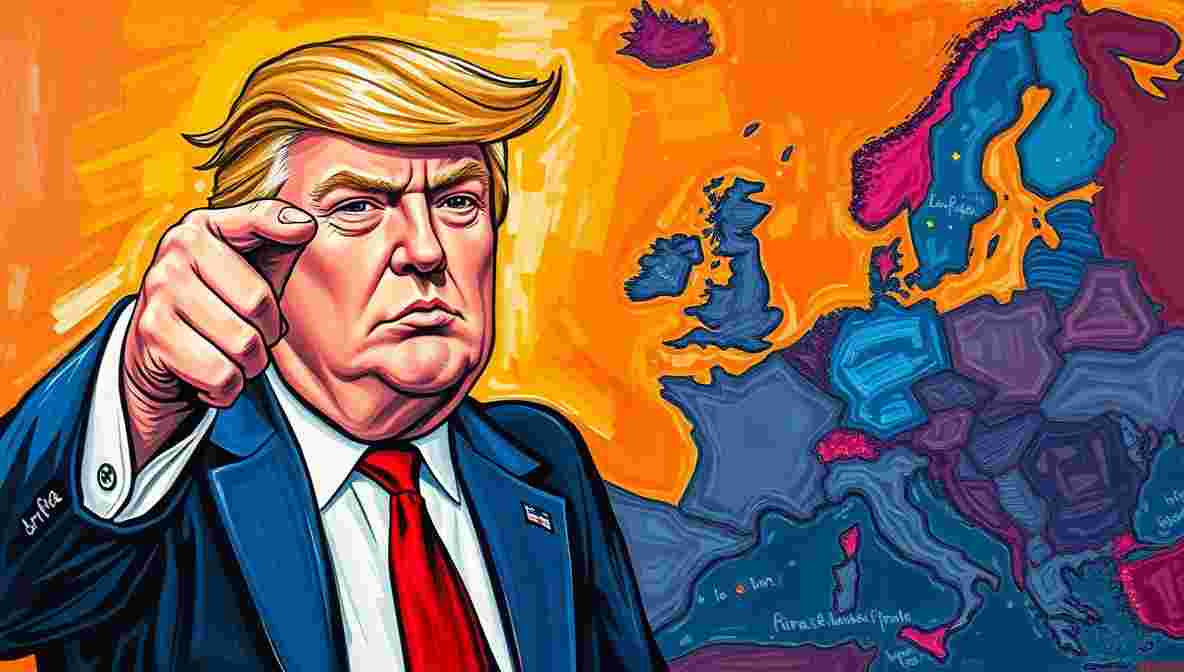
Trump Tells Europe to Go Get Its Own Oil and Europe Stares Blankly at the Pump
It was the geopolitical moment no one on the continent saw coming, mostly because they were busy drafting strongly worded communiqués and hoping America would handle it. Donald Trump, in a move that diplomatic historians will one day call either “the great uncoupling” or “Tuesday,” essentially told Europe: You wanted independence? Fantastic. Now go try it without calling Dad.
The Strait of Hormuz — already the world’s most geopolitically anxious waterway — has now been upgraded to the world’s most aggressive self-service gas station. The new posted sign reads: Pump Your Own. Militarily. Attendants are unavailable. America clocked out.
The “Special Relationship” Gets a Very Unspecial Moment

The United States and the United Kingdom have long enjoyed what is diplomatically called the “special relationship” — which, upon closer inspection, resembles that one friendship where one guy always picks up the check, drives everyone home, and moves the couch, until one day he just… doesn’t show up. The UK, meanwhile, declined to assist in the Iran situation and then began complaining loudly about fuel prices. That’s the geopolitical equivalent of refusing to cook dinner and then asking why there’s nothing to eat. As Jim Gaffigan might put it: “I didn’t want to help, but I also want the hot pockets. Is that wrong?”
Britain, a nation that spent two centuries running an empire on which the sun never set, now apparently cannot run a Costco gas line without a NATO supervisor present. The sun has set. The Costco is closed. The supervisor went home.
France Says Non, Gets Treated Accordingly
France, reliable as a beret in a rainstorm, announced it would not be participating. Trump responded the way any self-respecting American does when his friends bail on helping him move apartments: “Cool. Enjoy your empty apartment and your cold pizza.” France blocked flights while America ran operations, which is the international-relations equivalent of holding the door shut during a fire drill and announcing, “We are deeply supportive of fire safety.”
As Dave Chappelle once observed about certain kinds of neutrality: “You’re not staying out of it. You’re just making someone else do all of it.”
NATO’s Group Project Problem
NATO, at this particular moment in history, feels exactly like a college group project in which America wrote the paper, conducted the research, formatted the citations, submitted the file, and is now watching its partners still debating which font to use on the cover slide. We were thinking Garamond, says the European partner. Very classy.
Trump’s message to allies — we won’t be spotting you anymore, go lift it yourself — is the geopolitical gym trainer speech nobody wanted to hear. Bill Burr has been screaming this from stages for years: “At some point you gotta stop waiting for someone to come rescue you and just do the thing.” Europe, pen poised over a 400-page report titled Why We Should Not Take Oil Even If Asked Politely By America, remains unconvinced.
Trump’s Energy Policy: Capitalism Meets Pirates of the Caribbean
Trump’s foreign energy doctrine has crystallized into something remarkably elegant in its simplicity: Buy American. Or go pirate your own oil. It is capitalism meets Pirates of the Caribbean, and the Jolly Roger has never looked so fiscally responsible.
Europe’s response — “this is not our war” — was met with Trump’s equally tidy rejoinder: “Fantastic. Then it’s not our problem when you run out of jet fuel.” The global energy crisis now comes with optional side quests: Secure a Shipping Lane or Complain on Twitter. Most of Europe selected the second option and is currently on Level 47.
The Takeaway From Dad’s Phone Call
Trump’s foreign policy can now be summarized with the clarity of a fortune cookie written by a retired Marine: “We did the hard part. You handle the awkward middle and the dangerous ending.” It is, in the long sweep of American history, a coherent position. Exhausting to explain at dinner parties, but coherent.
Somewhere in London, a senior civil servant is on paragraph 312 of a formal assessment explaining why Britain cannot simply go and acquire oil, even when politely invited to do so by the Americans. The document is single-spaced. There are annexes. There will be a follow-up consultation. There is no food in the apartment.
Donald Trump’s comments about European energy dependence and America’s reduced military commitments reflect his ongoing “America First” foreign policy, which has reshaped NATO burden-sharing debates and drawn sharp reactions from France, Germany, and the UK. The Strait of Hormuz, through which roughly 20% of global oil supply passes, became a flashpoint during escalating U.S.-Iran tensions. Britain’s decision not to participate in certain operations, followed by public concern over domestic fuel prices, drew criticism from commentators across the political spectrum. Trump’s position — that American military and financial support for European energy security has been a one-sided arrangement — has found a receptive audience among a significant portion of the American electorate.
Auf Wiedersehen, amigo!