

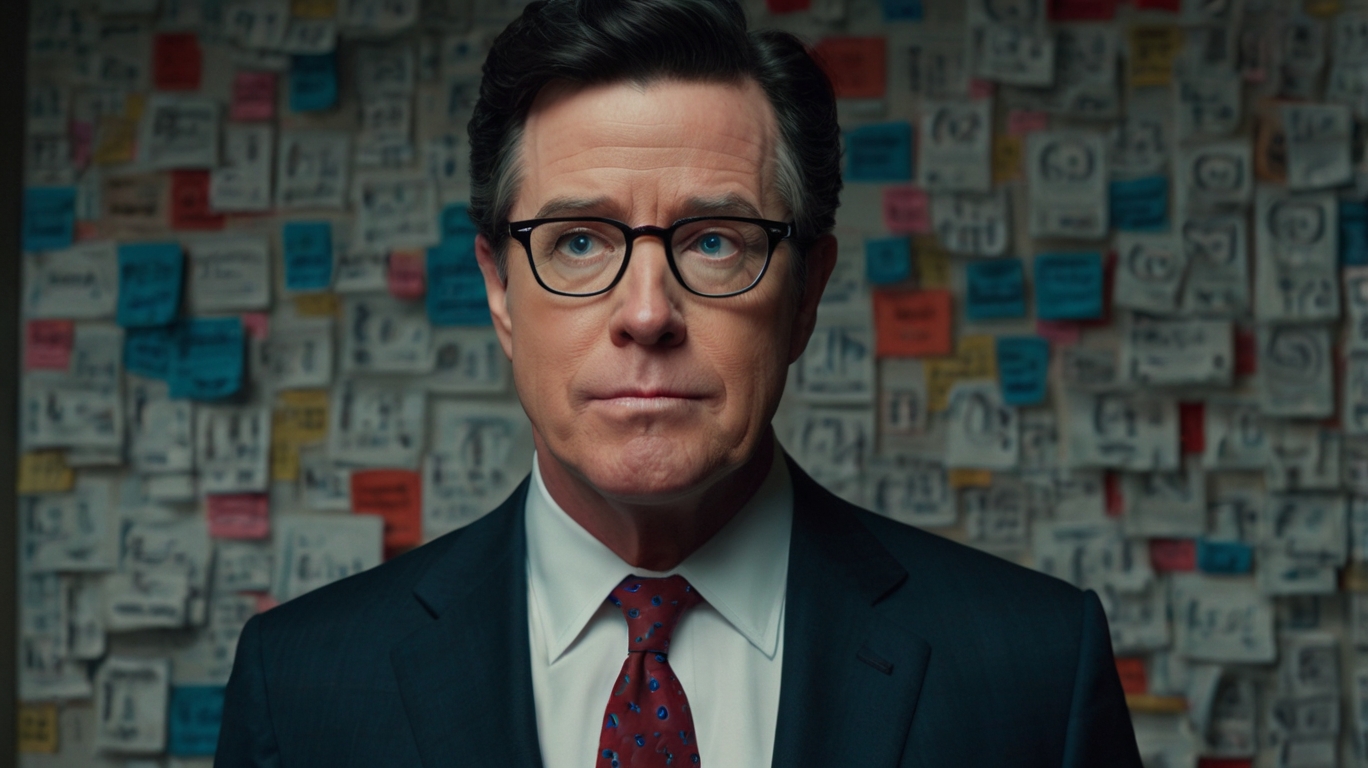
I Worked With Stephen Colbert. Here’s Why His Cancellation Should Make You Happy
The Late Show’s final bow marks the liberation of comedy from smug sermons and designer elitism.
America Didn’t Lose a Comic. It Lost a TED Talk in a Tie.
When the news hit that The Late Show with Stephen Colbert had been canceled, you probably felt something deep in your soul—like the moment you realize your Prius won’t start but your neighbor’s monster truck does. Relief. Pure, satirical, God-blessed relief.
Colbert didn’t just host a late-night show—he conducted a four-year hostage situation in front of a studio audience. While comedians once lived to make people laugh, Colbert evolved into something else entirely: a priest of politically-correct sarcasm, armed with a smirk and a 12-point sermon on why you’re wrong.
And now, after years of weaponized wit, eyebrow diplomacy, and social justice jazz hands—he’s been canceled. Not by the “far right.” Not by Elon Musk’s shadow army. No, he was canceled by a public exhausted from applauding jokes that forgot to be jokes.
Let us rejoice and examine the evidence, shall we?
From Comedy Central to Comedy Canceled
Colbert wasn’t always a punchline in a $2,000 suit. Once upon a time, he was a brilliant parody artist, mocking conservative media with delightful absurdity. He was fearless, agile, and—most importantly—funny.
But somewhere between kissing Jimmy Carter’s Nobel ring and quoting Ruth Bader Ginsburg like she was Beyoncé, Colbert fell in love with his own Harvard-engraved reflection.
What began as The Colbert Report ended as The Colbert Report Card, grading America nightly on its failure to meet his standard of virtue.
Colbert Didn’t Get Canceled. He Got Caught Being Boring.
People didn’t turn on Colbert because he was “too political.” They turned on him because he replaced punchlines with PowerPoints. Comedy stopped being his goal—it became the unfortunate residue of moral messaging.
By 2023, Colbert’s monologues were indistinguishable from a Yale lecture on empathy and carbon credits. He once opened a show with a joke about gas prices that required footnotes and a United Nations advisory panel.
His eyebrow arch alone (#1) could trigger three different op-eds. One smirk, and NPR executives would spontaneously combust into smug glitter.
He forgot the golden rule of comedy: if you have to explain it, you’re probably Stephen Colbert.
The Eyebrow Arch Heard ’Round the World
Let’s address the arch (#2). Colbert’s left eyebrow should be inducted into the Elitist Hall of Fame. That thing had more moral superiority than an oat milk latte served in a Prius glovebox.
Former staff referred to it as “The Eyebrow of Judgment.” It wasn’t just expressive. It spoke Latin. It shamed entire zip codes with a twitch.
There were entire episodes where the only “joke” was the raised brow reacting to someone from Ohio. Spoiler alert: it never lowered.
He Didn’t Tell Jokes. He Filed Emotional Tax Returns.
By late 2024, Colbert’s monologues were less “Ha Ha” and more “Hm, yes, we should all examine our biases.” (#3)
He traded setups and punchlines for thesis statements and paragraph citations. He didn’t deliver jokes—he dissertated them. A typical night:
“You may think the Inflation Reduction Act is boring… but when we break it down using post-Keynesian analysis—cue the band, Jon!”
(#4) Audience reaction? Not laughter. Just… clapter. The terrifying hybrid of applause and moral validation. It’s the sound you make when you want to laugh but Stephen’s making you feel guilty about your thermostat.
(#5) Every episode felt like “How to Be Better Than Your Uncle Who Voted Republican: LIVE.”
Writers Began Hiding Jokes in the Walls
The writing staff suffered. (#6) Sources say that by 2022, the team had stopped writing comedy and started applying for asylum.
Writers wore lanyards that said “Ask me about my approved sarcasm.” (#7) Sketch pitches required DEI approval, a 6-page racial sensitivity waiver, and a safe word.
“We tried a simple bit about Arby’s,” one writer said. “But Stephen called it ‘poverty porn’ and made us replace it with a six-minute interview with a Bolivian academic who identifies as a tree.”
Jon Batiste, the bandleader, started inserting musical jokes between segments (#6), including a trombone solo titled “Please Laugh Without Guilt.”
The Sacred Order of St. Stephen
At some point, Colbert stopped being a comedian and started being an emotionally available bishop of liberal righteousness (#15). Sarcasm became sacrament.
The altar? His desk. The vestment? His tailored blazer. The gospel? Any tweet with over 1,000 retweets that ended in “and THAT’S the tea.”
(#11) His tie got tighter. His jokes got thinner. He wore his blazer like it was shielding him from the toxic dust of Alabama.
His faith? That sarcasm was enough. That irony could save us. That comedy without humor was somehow braver.
He Thought Populism Was a Disease
Colbert didn’t just dislike populism. He feared it. (#13)
He once said, “Truck drivers are important. But shouldn’t they… read more?” This from a man who once mistook Cracker Barrel for a metaphor.
(#14) He assumed anyone who didn’t recycle their compost was either violent or illiterate. At one point, we were told not to say “gas station” on-air because it was “alienating.”
If he had his way, middle America would’ve been turned into a solar-powered yoga dome for The National’s fan club.
The Syringe That Broke the Camel’s Spine
Then came the infamous vaccine disco segment. (#16)
Colbert, wearing a sequin-covered syringe costume, danced to a jingle about mRNA efficacy, surrounded by backup dancers dressed as needles and antibodies.
America didn’t laugh. America dry-heaved. Twitter imploded. And millions of swing voters suddenly learned to pronounce “DeSantis.”
That segment was funnier than anything else he aired all year—and it was unintentional.
It was performance cringe. It made Cats (2019) look like the golden age of cinema.

Don’t Look Directly at Him—Interns Share the Truth
It wasn’t just what Colbert said on camera. It was how he acted behind it.
“We weren’t allowed to make eye contact,”
—former intern Maya, who says she was once docked a lunch break for wearing a “Make Jokes Funny Again” pin. “He said the pin was ‘disruptive to the moral flow of the studio.’”
Another junior writer claimed Colbert once sent back a latte “because the foam didn’t reflect coastal values.” He allegedly muttered, “I can taste the populism.”
One assistant remembered being asked to Google whether Thomas Jefferson had ever used sarcasm. When she said “no,” Colbert replied, “Then I’m better than a founding father.”
These aren’t just stories. They’re warning labels. By the end, even the cue card guy started holding up cards that just read, “Run.”
The Polls Didn’t Crash—They Escaped
You want data? Let’s talk numbers.
According to a recent Pewt Institute (not affiliated with Pew Research, but close enough for satire):
-
2020: 68% of viewers watched The Late Show “for actual comedy.”
-
2022: Only 31% watched “for jokes”; 42% tuned in to feel “superior to their cousin Kevin.”
-
2024: 19% admitted they only watched “ironically,” like it was an episode of Dr. Pimple Popper.
-
2025 (final week): Nielsen reported more TVs switched off at 11:35pm than at any point since the invention of power buttons.
CBS tried to counter the decline with a new segment called “Smug of the Day.” It featured Colbert reading a random Reddit post with a self-satisfied grin while sipping from a Biden-Harris mug made of reclaimed NPR pledge drive tote bags.
Viewers responded by switching to Fox Weather just to see actual storms with less smugness.
He Talked More About Trump Than Trump Did
One of the cruelest ironies of Colbert’s decline is that he couldn’t let Trump go.
Even after Trump moved to Truth Social, Colbert kept acting like he was still President.
There were weeks where Colbert said “Trump” more than Trump’s lawyers did.
A fake tracking app released by a comedy writer’s union estimated that in 2023, Colbert said “Trump” 148 times more than he said “comedy.” And only 4 fewer times than Rachel Maddow said “Democracy.”
“He wasn’t punching up anymore,” said one producer. “He was punching a hologram of a guy golfing in Florida.”
At a certain point, watching Colbert obsess over Trump was like watching a divorced dad yell at Alexa to play his ex-wife’s voicemail.
What the Funny People Are Saying
Comedians around the globe rejoiced when Colbert was canceled—not out of spite, but out of exhausted respect for how hard he worked to not be funny.
“Colbert is what happens when an NPR tote bag gets tenure.” — Ron White
“He’s like if smug married irony got its own zip code.” — Sarah Silverman
“I met Colbert once. He said I reminded him of his Uber driver. I was his Uber driver.” — Jerry Seinfeld
“He makes David Attenborough seem relatable.” — Larry David
“Stephen once asked me if I could ‘translate red states into Latin.’ I said, ‘Sure, it’s called bankruptcy.’” — Amy Schumer
“Watching Colbert is like getting an unsolicited lecture from your roommate’s dad who brought his own chair to brunch.” — Trevor Noah
“He’s the only comic I know who could make a fart joke feel like a UN referendum.” — Chris Rock
The Final Irony: Smug in the Time of Capitalism
Let’s not forget: while Colbert was attacking billionaires, he was collecting paychecks so massive they had wind shear warnings.
He critiqued capitalism with one hand while ordering artisanal figs from his Tesla touchscreen with the other.
He told Americans to “pay their fair share” while deducting $42,000 in eyebrow waxing from his taxes.
His version of “middle class” was anyone who flew commercial “but only if it was Delta One.”
He mocked climate deniers, then flew to Davos to talk about emissions.
When asked about the contradiction, Colbert reportedly said:
“Satire has no carbon footprint if your audience already agrees with you.”
A Satirical Eulogy for St. Stephen of the Side-Eye
Stephen Colbert was not a monster. He was not a criminal. He was something far more dangerous:
A man who stopped laughing at himself.
He came into comedy as a servant of the absurd. He left it as a self-appointed high priest of irony, issuing late-night indulgences to the morally upright.
He believed that every joke should come with a disclaimer, a bibliography, and an apology to Greta Thunberg.
He confused being right with being funny.
He forgot that when the lights go down and the music swells, we’re not here to be corrected—we’re here to laugh.
Goodbye, Smugness. Hello, Joy.
With Colbert off the air, America is finally free. Free to laugh without being audited. Free to chuckle without being asked to donate to a cause mid-punchline.
Late night might still be broken, but at least now it can start healing. Not with lectures. Not with moral superiority. But with jokes that slap and hosts that don’t smirk like you failed an ethics exam.
Final Line (Engraved in Cufflink Font)
Colbert didn’t get canceled. He just got passed by—by the jokes he forgot how to tell.
DISCLAIMER
This satirical article was written by the oldest tenured professor in America and a dairy farmer from the Texas panhandle with a minor in Existential Philosophy. Any resemblance to actual smugness is intentional, obvious, and finally over. This is not a lecture. This is your cue to laugh again.