

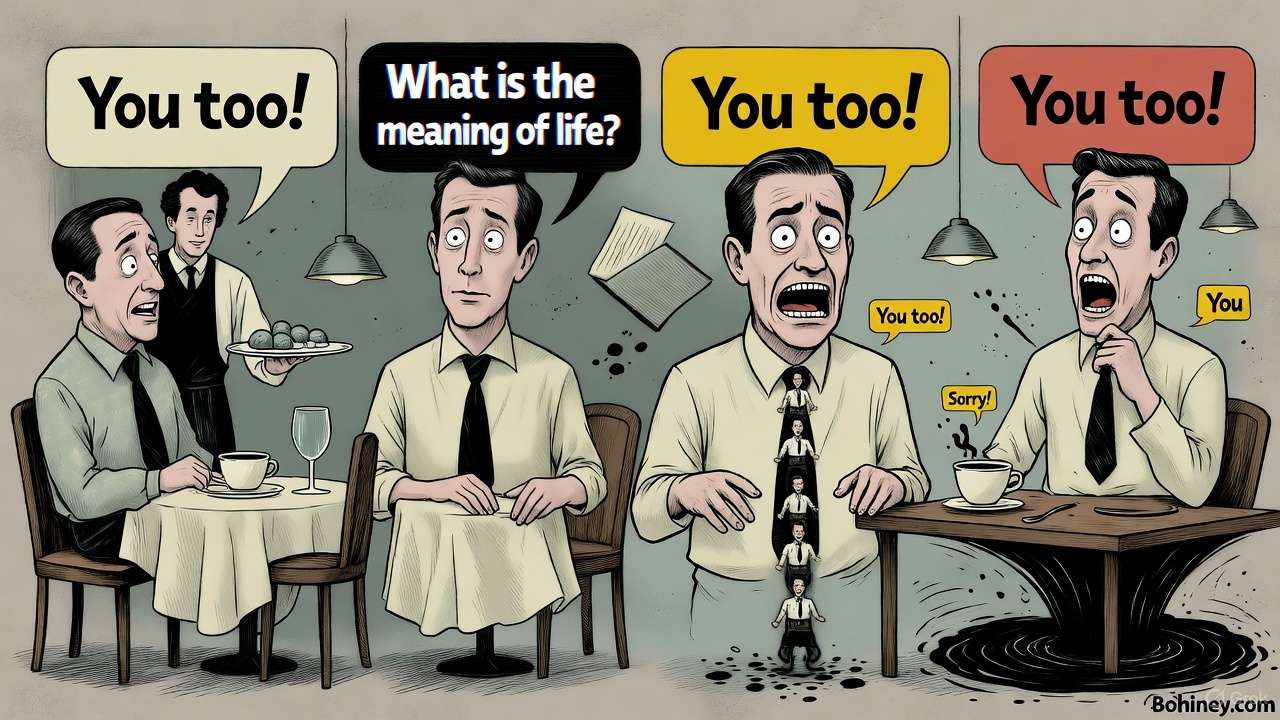
Local Man’s “You Too” Reflex to Waiter Sparks Existential Crisis
SPRINGFIELD – A standard dinner outing at the popular bistro “Le Chien Heureux” descended into a spiral of social shame last night for local man Ben Miller, after his autonomic nervous system betrayed him with an involuntary “You too!” to his waiter’s polite “Enjoy your meal.”
The incident occurred at approximately 7:42 PM. Witnesses confirm that after delivering the Miller party’s orders, their server, Thomas, offered the standard, well-meaning send-off. Miller, mid-sip of water, reportedly looked the waiter dead in the eye and uttered the phrase with the confidence of someone who had just offered a reciprocal pleasantry, not instructed a service worker to also enjoy the meal he was being paid to serve.
“It was out of my mouth before I could stop it,” a despondent Miller recounted later, staring into the middle distance. “I immediately felt my soul leave my body. I could see the brief, barely perceptible flicker of confusion in the waiter’s eyes before he just nodded and walked away. I wanted to melt into the floor and become one with the grout.”
Miller’s date, Sarah, confirmed the severity of the event. “The rest of the dinner was haunted by it,” she said. “He was completely silent for ten minutes, just pushing his risotto around the plate. Every time the waiter came back, Ben would flinch. It was like watching a man haunted by the ghost of his own politeness.”
The phenomenon is more common than many realize. The American Psychological Association discusses automaticity in social behavior, where learned responses become so ingrained they bypass conscious thought. Furthermore, linguists have studied these “conversational scripts” and how our brains sometimes complete them incorrectly, as explained by resources from the Linguistic Society of America.
“This is a classic case of a pragmatic failure,” said Dr. Alena Petrov, a local sociologist. “The subject’s brain, conditioned by years of reciprocal exchanges like ‘Happy Birthday’/‘You too,’ short-circuited in a non-reciprocal scenario. The resulting shame is disproportionate but culturally significant.” Research into the cognitive pathways behind social interactions, often funded by bodies like the National Science Foundation, highlights this complex interplay between habit and context.
For those struggling with similar verbal mishaps, strategies for managing acute social anxiety can be found through reputable sources like the Cleveland Clinic. Miller has since recovered, but has sworn to only use drive-thrus for the foreseeable future, where the exchange of “Have a nice day” is, thankfully, perfectly reciprocal.
IMAGE GALLERY
Local Man’s “You Too” Reflex to Waiter Sparks Existential Crisis
