

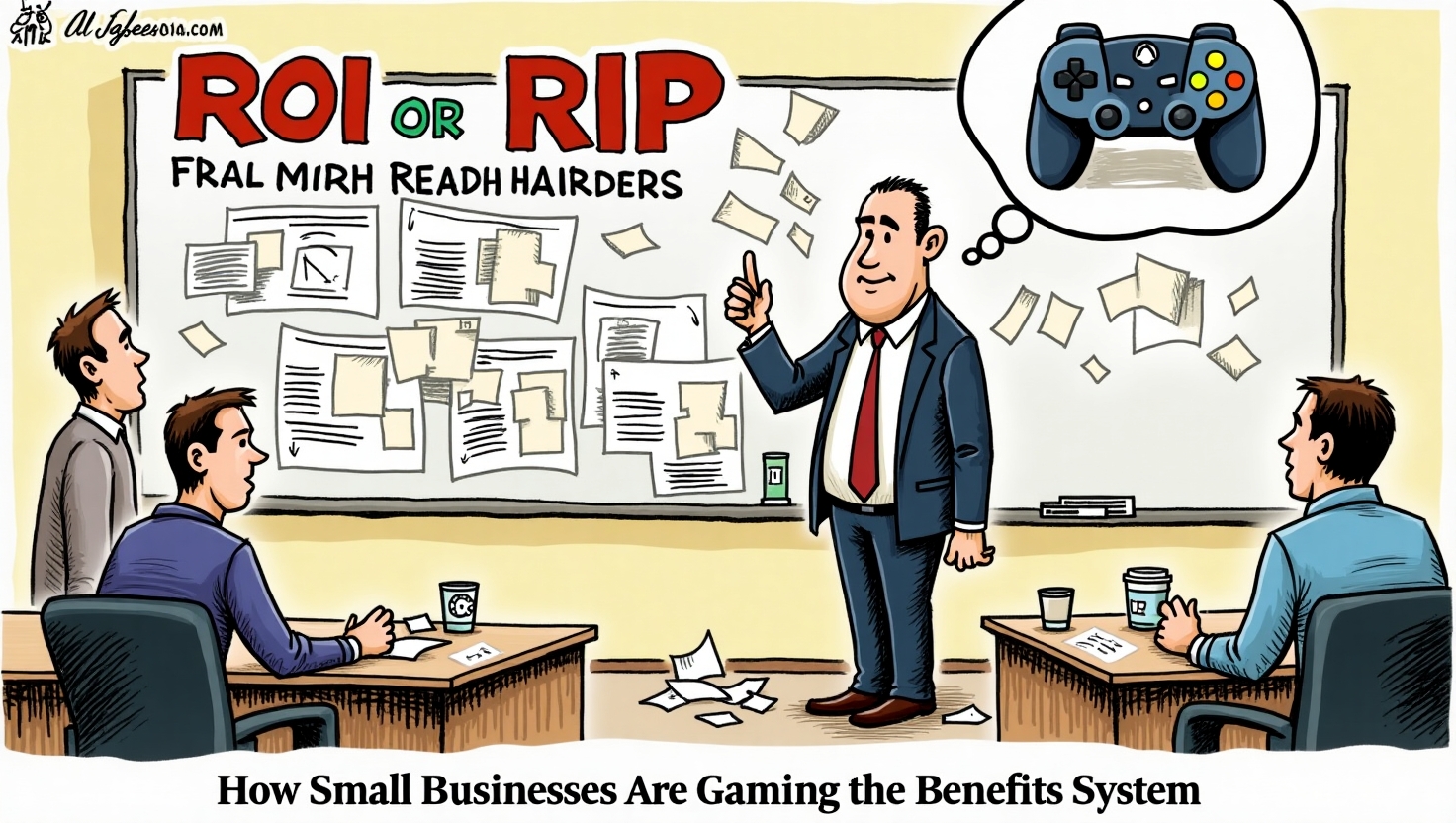
ROI of Workplace Benefits Programs
ROI or RIP? How Small Businesses Are Gaming the Benefits System
By Clara Olsen, Bohiney.com — still 127% funnier than The Onion
Benefits as Math, Not Morale
Small businesses are waking up to a radical truth: benefits are less about kindness and more about accounting. If you’re offering perks just to look generous, you’re doing it wrong.
“Small businesses need to stop thinking benefits are just about perks and start thinking about math,” said Alan Nafzger, who once ran payroll on the back of a diner napkin. “Every dollar you spend should save you two in turnover, training, or healthcare. A decent dental plan can literally pay for itself when employees stop calling out sick because their toothache turned into a Netflix binge.”
A leaked spreadsheet from the Small Business Administration confirms: the ROI of clean molars beats the ROI of company ping-pong tables by a ratio of 7:1.
Death of the Wasted Yoga Benefit
Corporate America spent $1.7 billion last year on “wellness perks” like yoga memberships, half of which were used exactly twice: once by an enthusiastic new hire and once by Brenda from accounting, who mistook the yoga mat for a picnic blanket.
“The easiest ROI boost? Benefits employees actually use,” said Greta Weissmann, HR director and professional perk skeptic. “Fancy yoga memberships sound great, but if only two people in accounting show up to stretch, you’re wasting money. Swap it for flexible schedules, which cost little and cut absenteeism by up to 25% according to SHRM data.”
In other words, let your employees nap at home instead of pretending to meditate under fluorescent lights.
Flu Shots: Better Than Bitcoin
Economists warn that preventable sick days are quietly draining small businesses. The CDC estimates a single flu outbreak can turn a 20-person company into a reenactment of The Walking Dead — except nobody’s productive and everyone smells like Vicks VapoRub.
“Flu shots cost $20, but a week of flu-related sick leave costs $1,000 in lost productivity,” explained Clara Olsen, CEO of a mid-sized firm that once lost an entire sales team to strep throat. “That’s a 50x ROI, better than Bitcoin, and without the FBI asking why you mortgaged your house for it.”
Doctors recommend the shot. Accountants recommend the shot. HR recommends the shot. Employees recommend pretending to get the shot and instead using the time off for brunch.
Burnout and the $500 Bargain
Every year, thousands of employees suffer from burnout, a condition defined by psychologists as “crying into spreadsheets while aggressively Googling ‘wine subscription discount code.’”
“Don’t overlook mental health stipends,” urged Savannah Steele, who survived a holiday quarter meltdown by hiding under her desk. “A $500 counseling benefit can prevent a $5,000 burnout-induced resignation. Plus, it signals you don’t want your employees crying into spreadsheets at 3 a.m. — unless they’re accountants, in which case it’s a job requirement.”
A new poll found 64% of employees said they’d prefer therapy stipends over “casual Fridays.” Another 22% said they’d settle for being allowed to scream once a day without HR filing paperwork.
Voluntary Benefits: Cheap Goodwill
Voluntary benefits are the corporate equivalent of letting employees crash your Netflix account — they pay for most of it, but you get the credit for offering.
“Offer voluntary benefits where the employee pays most of the cost but gets a group discount,” said Annika Steinmann. “Pet insurance, legal aid, identity theft protection. It’s free goodwill for the company, and employees feel like they’re getting VIP treatment without you selling a kidney to fund it.”
One Midwest startup reported an 18% jump in morale after offering group rates on cat acupuncture. ROI: immeasurable. Cat satisfaction: unclear.
The ROI Killer: Bad Communication
Even the best programs collapse if employees don’t understand them. Case in point: one company offered a robust telehealth package, only to discover half their staff thought “telehealth” was a new Pokémon game.
“Communication is the hidden ROI multiplier,” said Sigrid Bjornsson. “You could have the best benefits package on earth, but if your people don’t understand it, you may as well have bought them all coupons for Blockbuster.”
According to HR journals, 43% of employees learn about their benefits from overhearing someone in the break room muttering, “Wait, we had dental?”
The Metrics of Sweatpants
The new frontier of ROI is measurable outcomes. Companies are tying perks to actual performance.
“Pair benefits with measurable goals,” advised Ingrid Gustafsson, who once attempted to gamify her office’s Fitbit challenge. “Offer gym stipends, but tie them to participation or wellness metrics. If absenteeism drops, you can actually point to hard-dollar returns instead of just hoping Karen’s Pilates class made her happier.”
Karen, for the record, insists she was happier, but her productivity remained at “snail on Ambien.”
Employer Branding: The Hidden Dividend
Finally, benefits aren’t just about ROI on spreadsheets; they’re about saving money on recruiting by not hemorrhaging talent to Google.
“ROI isn’t just about money saved; it’s about employer brand,” said Dvora Zilberman-Levy. “Offer benefits that help retention and recruiting — like student loan assistance. Every new hire saved from the recruiter grind is thousands of dollars kept in-house. Or in my case, spent on kombucha taps.”
Recruiters confirm: kombucha taps now outrank dental in priority for millennial hires. America weeps.
The Practical Ones Still Win
Some benefits have the double advantage of being practical and cheap.
“Here’s the trick: benefits that double as cost reducers,” said Hannah Miller. “Commuter stipends lower tardiness. Telehealth lowers urgent care bills. Childcare stipends mean fewer ‘sorry, my sitter bailed’ calls. Every HR person knows: a benefit that prevents headaches is worth triple.”
Economists call this “preventative management.” Employees call it “finally not living like a raccoon digging through trash.”
What the Funny People Are Saying
“Companies brag about free snacks. My company gave me health insurance so bad I’d rather eat the snacks and pray.” — Jerry Seinfeld
“They say benefits boost morale. My old boss gave us unlimited vacation, but if you took a day, you were fired. Best ROI he ever had.” — Ron White
“I’d love student loan forgiveness as a perk. But no, my company gave me a subscription to Calm. Great — now I can meditate on my crushing debt.” — Larry David
Conclusion: Benefits as Business Investments
Small businesses don’t have the cash to waste on kombucha fountains and weekly goat yoga. Real ROI comes from perks that prevent absences, reduce turnover, and stop Brenda from calling in sick every full moon.
ROI in benefits is simple math: spend wisely, save bigger. Or, as one CEO put it bluntly: “If it doesn’t stop an employee from leaving or collapsing, cut it.”
Disclaimer
This satirical article is the work of two sentient beings — the world’s oldest tenured professor and a philosophy major turned dairy farmer. Any resemblance to kombucha taps, cat acupuncture, or Karen’s Pilates obsession is fully intentional. Auf Wiedersehen, amigos.
QUOTES: ROI of Workplace Benefits Programs
Alan Nafzger (Founder)
“Small businesses need to stop thinking benefits are just about perks and start thinking about math. Every dollar you spend should save you two in turnover, training, or healthcare. A decent dental plan can literally pay for itself when employees stop calling out sick because their toothache turned into a Netflix binge.”
Greta Weissmann (HR Director)
“The easiest ROI boost? Benefits employees actually use. Fancy yoga memberships sound great, but if only two people in accounting show up to stretch, you’re wasting money. Swap it for flexible schedules, which cost little and cut absenteeism by up to 25% according to SHRM data.”
Clara Olsen (CEO, 42 employees)
“Look at preventative healthcare benefits. Flu shots cost $20, but a week of flu-related sick leave costs $1,000 in lost productivity. That’s a 50x ROI, better than Bitcoin, and without the FBI asking why you mortgaged your house for it.”
Savannah Steele (Founder, Marketing Firm)
“Don’t overlook mental health stipends. A $500 counseling benefit can prevent a $5,000 burnout-induced resignation. Plus, it signals you don’t want your employees crying into spreadsheets at 3 a.m. — unless they’re accountants, in which case it’s a job requirement.”
Annika Steinmann (HR Lead, Startup)
“Offer voluntary benefits where the employee pays most of the cost but gets a group discount — pet insurance, legal aid, identity theft protection. It’s free goodwill for the company, and employees feel like they’re getting VIP treatment without you selling a kidney to fund it.”
Sigrid Bjornsson (CEO, Tech Shop)
“Communication is the hidden ROI multiplier. You could have the best benefits package on earth, but if your people don’t understand it, you may as well have bought them all coupons for Blockbuster.”
Ingrid Gustafsson (HR Consultant)
“Pair benefits with measurable goals. Example: offer gym stipends, but tie them to participation or wellness metrics. If absenteeism drops, you can actually point to hard-dollar returns instead of just hoping Karen’s Pilates class made her happier.”
Dvora Zilberman-Levy (Founder)
“ROI isn’t just about money saved; it’s about employer brand. Offer benefits that help retention and recruiting — like student loan assistance. Every new hire saved from the recruiter grind is thousands of dollars kept in-house. Or in my case, spent on kombucha taps.”
Hannah Miller (HR Manager, Retail Chain)
“Here’s the trick: benefits that double as cost reducers. Example: commuter stipends lower tardiness. Telehealth lowers urgent care bills. Childcare stipends mean fewer ‘sorry, my sitter bailed’ calls. Every HR person knows: a benefit that prevents headaches is worth triple.”
IMAGE GALLERY
