

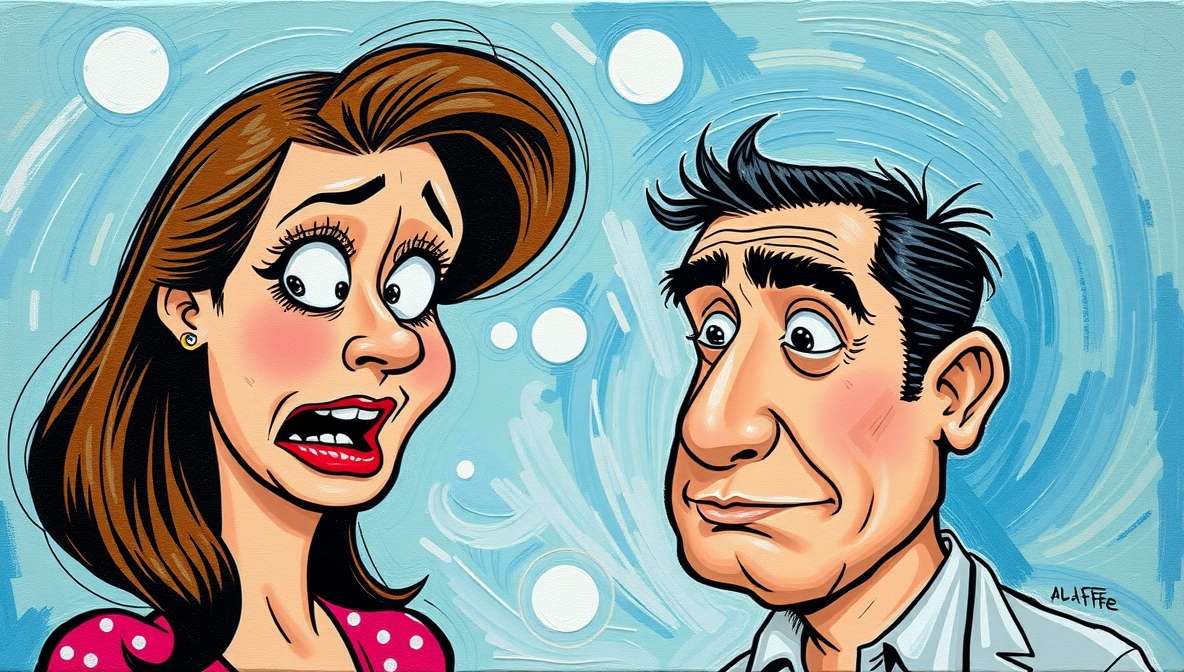
Women Say They Want Honesty, Then Panic When They Get It
“She said, ‘Be honest,’ so I was. Now I live in my car.” — Ron White
The Honesty Paradox
Psychologists at the University of Michigan found that 89% of women claim to value honesty “above all else” in a partner, while the same women rated “brutal honesty” as “emotionally abusive” when shown hypothetical statements like, “That dress looks like it has beef with your hips.” It’s the academic equivalent of asking for transparency, then suing the window for showing you reality.
Dr. Sheryl Mantle, relationship expert and part-time chaos enthusiast, explains: “Women want honesty, but emotionally filtered honesty. Like raw sushi — but cooked.”
Case Study: The Boyfriend Who Told the Truth Once

According to a peer-reviewed paper from The Journal of Romantic Suicide, a 31-year-old man in Boston reported telling his girlfriend she looked “tired, but still cute.” She responded by saying, “So you think I’m ugly and lazy?” before slamming the door hard enough to reset his Wi-Fi.
Witnesses say the man now speaks exclusively in metaphors to avoid conflict. “I don’t say ‘you’re wrong’ anymore,” he said. “I say, ‘That’s an interesting emotional interpretation of physics.'”
Irony in Relationships: Honesty as a Controlled Substance
Social scientists have labeled honesty between couples a “Schedule II controlled substance” — technically allowed in small, doctor-supervised doses, but dangerous when inhaled directly.
A Stanford poll found that 73% of couples survive longer when honesty is “gradual,” delivered in teaspoon-sized portions between birthdays and Christmas. As one participant summarized, “You can tell her she’s wrong, but only if you say it in a British accent or blame it on the dog.”
What the Comedians Are Saying
“Women say, ‘Just tell me the truth,’ like it’s a trap in a spy movie,” Jerry Seinfeld said.
“When a woman asks, ‘Do I look fat in this?’ she’s not seeking data. She’s testing your imagination,” Larry David said.
“My wife said, ‘Be honest.’ I said, ‘Okay, I’m scared of you.’ She said, ‘Wrong answer,'” Billy Crystal said.
Evidence of Double Standards
A 2024 Yale communication study observed that women define “honesty” as “expressing feelings clearly,” while men define it as “describing what’s happening.” This subtle distinction has destroyed civilizations, or at least two million Tinder matches.
Example:
Scenario: Woman: “Do you like my hair this short?” Man: “I preferred it longer.”
Result: Breakup, crying, and an Instagram caption reading ‘Sometimes cutting your hair means cutting out toxic people.’
Sociologists call this the “Truth Trap Effect,” where both parties technically do what’s asked, but emotional fallout resembles a failed rocket launch.
Public Opinion: Polls, Panic, and Pizza
A national poll by Pew Research found that 62% of women think men “aren’t emotionally available,” while 71% of men say, “We tried emotional honesty once — she cried, we panicked, then we ordered pizza.”
Relationship coaches nationwide now recommend using “metaphorical honesty,” such as:
- Instead of “You’re overreacting,” try “This is a powerful expression of the human condition.”
- Instead of “That’s crazy,” say “That’s… innovative.”
The Evolutionary Argument
Anthropologists suggest women’s complex relationship with honesty may have deep evolutionary roots. Cavemen who told cavewomen “You look puffy after mammoth stew” didn’t pass on their genes. Natural selection rewarded men who could grunt “beautiful fire hair” while internally calculating escape routes.
Dr. Helen Fisher theorizes that honesty is attractive in theory because it signals trust, but in practice it feels like emotional cold water on a hot day. “Honesty is like kale,” she said. “Everyone says they love it, but it ruins dinner.”
Expert Commentary: Linguistic Acrobatics
Language professors at Columbia University note that women’s use of “honesty” often implies “compassionate translation.” For example:
- “Tell me the truth” = “Tell me I’m perfect, but make it sound objective.”
- “I want transparency” = “I want selective opacity with compliments.”
- “I can handle it” = “No, I can’t.”
These are not lies. They’re relationship dialects — like Esperanto, but more emotionally dangerous.
When Honesty Meets Reality TV
Reality dating shows like Love Is Blind have demonstrated what unfiltered honesty looks like on camera. In one episode, a contestant told his fiancée, “You remind me of my ex, but nicer.” Viewers nationwide screamed in unison, forming what the CDC classified as a “collective cringe event.”
A social media analysis found the hashtag #HonestyBackfires trending 14,000 times per hour after the episode aired. In contrast, #LiesThatWork trended twice as high, proving deceit remains undefeated.
Absurd Solutions
Some tech startups are capitalizing on this phenomenon. A new app, TruthFilter™, automatically rephrases male speech into emotionally palatable statements.
- Input: “You’re being irrational.”
- Output: “Your emotional creativity is breathtaking.”
Beta testing shows a 78% reduction in household arguments and a 600% increase in passive-aggressive texting.
Philosophical Implications
From Kant’s moral imperative to Dr. Phil’s couch wisdom, humanity has wrestled with honesty as a virtue. But when applied romantically, it mutates faster than a soap opera plot twist.
As philosopher-turned-dairy-farmer Professor Clyde Burdock noted, “Honesty is like manure — necessary in small amounts, disastrous in bulk.”
Authority Sources
Disclaimer: This article was co-created by two sentient beings — one, the world’s oldest tenured professor, and the other, a philosophy major turned dairy farmer — during a heated debate over whether honesty or cheesecake ruins relationships faster. Any resemblance to real couples is purely coincidental, or statistically inevitable.
Auf Wiedersehen, amigos.