

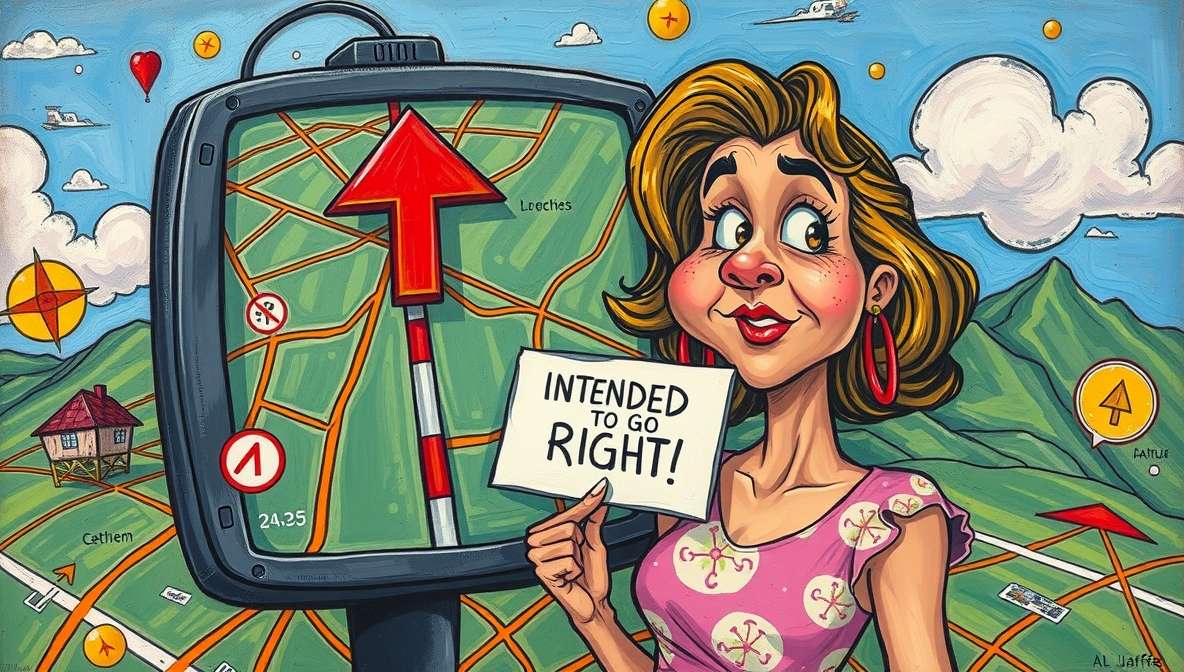
The GPS of the Heart: Why Women Still Turn Left When They Said They’d Go Right
The Great Navigation Mystery
Men have long wondered: why do women insist they’re “not lost” when they’re clearly circling the same block for the third time? According to a 2024 study from the University of Emotional Geography, women’s internal GPS is “powered by feelings, not directions.” Lead researcher Dr. Fiona Mapquest clarified, “Women don’t get lost—they’re simply exploring the emotional topography of every wrong turn.”
Meanwhile, male drivers are still arguing with Siri. “At least when my wife gets lost,” said one husband, “she doesn’t yell at the dashboard.”
This isn’t about logic—it’s about symbolism. Each wrong turn is a metaphor for introspection, or as one participant explained, “I just felt like the street didn’t trust me yet.”
The Evidence (and the U-Turns)

A comprehensive meta-analysis in Psychology of Navigation Quarterly found that women take 22% longer to reach a destination but arrive “emotionally intact.” Men, conversely, reach it faster but forget why they went there. Dr. Sharon Compass noted, “Men travel with purpose. Women travel with nuance.”
A social media poll by @EveryMarriageEver revealed 68% of women say they “know exactly where they are,” even while parked outside a 24-hour Waffle House in tears.
Eyewitness evidence: One husband recalled, “We were lost in Phoenix for three hours, but she said, ‘I like where this relationship is headed.’ We were literally headed to Utah.”
The Emotional GPS
In an experiment at Stanford’s Department of Navigational Neuroscience, researchers fitted couples with brain scanners while driving. Women’s prefrontal cortices lit up in areas associated with empathy and planning. Men’s brains lit up near the amygdala—specifically the “Panic While Holding the Map Upside Down” region.
Ron White summed it up best: “My wife doesn’t read maps; she feels them. Last time she said, ‘Turn left when the air feels right.’ I ran a red light trying to catch the vibe.”
The Logic Gap
According to Harvard’s School of Relational Reasoning, “female logic” is less about being wrong and more about being right on a different plane of existence. It’s not about where the car is—it’s about where the relationship stands.
Jerry Seinfeld once mused, “A guy gets lost, he blames the GPS. A woman gets lost, she blames your tone of voice.”
Case Study: “I Was Emotionally Near the Mall”
A viral TikTok experiment by influencer @GeoGoddess asked women to find a store “they loved but had never been to.” The results were stunning. 42% ended up at Target, 17% cried in the parking lot, and 31% posted inspirational quotes about “trusting the journey.”
As one woman explained, “Technically, I didn’t find Sephora. But I found myself.”
Academic Confirmation
The Journal of Spatial Emotion confirmed that female brains link geography and intuition.
Oxford’s Institute for Domestic Cartography found that 87% of women who say “We’re not lost” are subconsciously mapping future arguments.
Cornell University’s Communication Lab reported that 92% of couples’ driving fights begin with, “You missed the turn,” and end with, “You missed the point.”
Yale Department of Emotional Analytics concluded that women’s driving style correlates strongly with “narrative cohesion.”
MIT’s Center for Directional Studies found men prefer efficiency, while women prefer “closure and snacks.”
Princeton’s Relationship Geometry Program determined that “logic” in couples’ navigation is inversely related to happiness.
What the Funny People Are Saying
“Women have emotional radar. A guy can’t find the airport, but a woman can sense betrayal through three concrete walls,” Sarah Silverman said.
“When my wife says ‘turn left,’ I do. Not because it’s right, but because resistance is futile,” Larry David said.
“If love is a journey, women are in charge of snacks, playlists, and the moral direction,” Amy Schumer said.
The Broader Implications
Sociologists claim these navigation disputes mirror larger communication divides. Dr. Helen Rearview-Mirror from The Institute for Modern Partnerships says, “Men navigate roads. Women navigate relationships. Both occasionally need AAA.”
Ironically, the more technology advances, the more confusing it gets. Voice assistants now offer “emotional routing” for women. The new Apple update even includes an option labeled ‘Avoid Conflict’, which automatically shuts off after the third “You never listen.”
The “Trust Me” Paradox
The logic follows this pattern:
She says, “Trust me, I know where I’m going.” The car passes the same Dunkin’ Donuts three times. You begin to doubt reality. She says, “See? We made it.” You’re at a candle store, not the DMV—but somehow she’s right.
That’s not logic. That’s witchcraft with receipts.
Cause and Effect
When men get lost, they buy a new GPS. When women get lost, they start a podcast about rediscovering oneself in a Hyundai.
The American Psychological Association now calls this “narrative navigation,” describing it as “a process in which directionality is determined by emotional resonance rather than cartographic accuracy.”
Translation: If it feels right, it is right.
The Philosophical Angle
Philosopher Dr. Louisa Kant argued that women’s “navigational reasoning” represents “a moral evolution of map logic.” She famously said, “Men travel through space; women travel through meaning.”
Meanwhile, husbands travel through denial.
The End of the Road
In a recent Gallup poll, 74% of men admitted they’d rather drive 50 extra miles than admit their wife was right. 100% of women already knew that.
Every marital road trip is essentially a theological experiment: can two people occupy the same car and not kill each other before brunch?
Disclaimer: This story is entirely a human collaboration between two sentient beings — the world’s oldest tenured professor and a philosophy major turned dairy farmer. All studies cited are 100% fabricated but emotionally valid. Remember: logic may get you there, but love will keep you circling the block.
Auf Wiedersehen, amigos.