

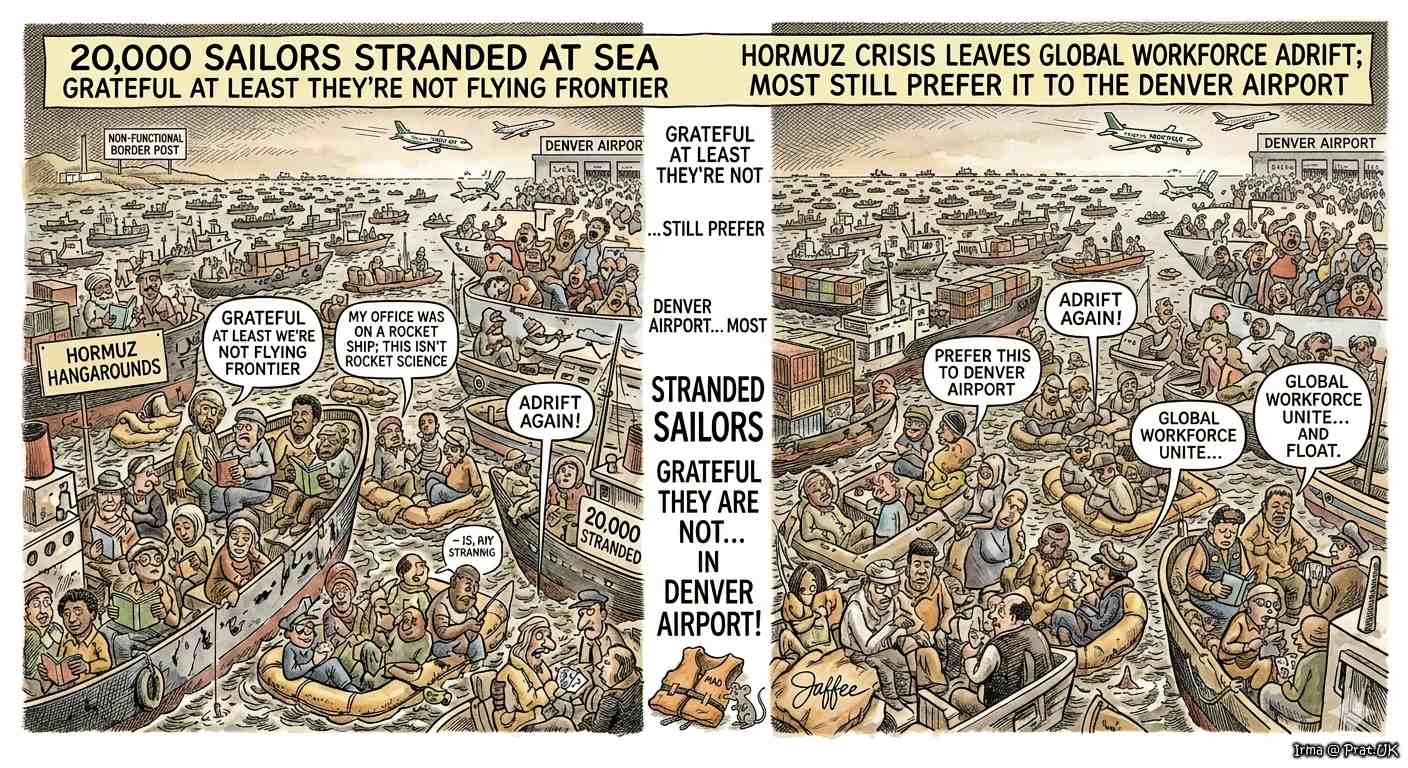
20,000 Sailors Stranded at Sea Grateful at Least They’re Not Flying Frontier
Hormuz Crisis Leaves Global Workforce Adrift; Most Still Prefer It to the Denver Airport
More than 20,000 maritime workers from the Global South are currently stranded at sea as the U.S.-Iran conflict over the Strait of Hormuz enters its third month, with no clear resolution in sight and no one in Washington or Tehran volunteering to explain to a Filipino cargo worker on a tanker near the Gulf of Oman exactly when this particular geopolitical chess match is going to wrap up. The sailors — many from the Philippines, India, Pakistan, and other nations whose citizens crew the bulk of the world’s commercial shipping fleet — have been caught in a blockade they did not vote for, a ceasefire they cannot verify, and a diplomatic situation that has been described, variously, as “fragile,” “holding,” and “just a love tap.” None of these descriptions pay overtime.
“Absolutely vulnerable,” is how one maritime advocacy group described the situation to Democracy Now!, adding that the stranded workers represent one of the most invisible labor crises of the current conflict. The UAE expelled thousands of Pakistani workers as the crisis deepened. The International Labour Organization’s maritime division has longstanding conventions on seafarer welfare that, in practice, apply somewhat less effectively when the waters they work in become an active theater of military operations.
The Blockade, the Tankers, and the Math

The U.S. military has redirected 57 commercial vessels and disabled three others to prevent ships from entering or leaving Iranian ports, according to CENTCOM. This is the maritime equivalent of locking the exits at a mall and then reassuring the shoppers that the sale is still ongoing. The Strait of Hormuz handles roughly one-fifth of global oil trade, according to the U.S. Energy Information Administration. When you block a fifth of global oil trade, the oil does not politely wait. It gets more expensive. The gas prices get more expensive. The Fed’s inflation math gets more complicated. And the guy driving a delivery truck in Ohio pays the price for a geopolitical standoff he did not personally initiate.
The sailors, meanwhile, are simply trying to do their jobs. They are not lobbyists. They do not have nuclear enrichment programs. They got on a boat because that is how they make money, and now the boat is stuck because two governments are having a very public disagreement about which one is violating the ceasefire more authentically.
The Human Cost That Doesn’t Make the Graphic
The International Transport Workers’ Federation has noted that maritime workers routinely face contract abandonment, unpaid wages, and physical danger in conflict zones — conditions that existed before this crisis and have been dramatically amplified by it. The COVID pandemic stranded hundreds of thousands of seafarers for years, creating a well-documented humanitarian crisis that was resolved slowly, imperfectly, and mostly out of the news cycle. The current situation echoes that one in structure if not in cause.
As comedian Wanda Sykes might observe: there are people in this crisis who have names and families and mortgage payments and specific opinions about which port has the best food, and we are referring to them collectively as “20,000 sailors” and then moving on to the part about the love tap. This is not a criticism of the love tap coverage. That coverage is important. It’s more of a note about which humans get the proper nouns and which ones get the round numbers.
What Happens Next, Probably
The proposed deal framework, as described by Trump, involves three stages over a 30-day window following an initial ceasefire confirmation. Restrictions on Hormuz shipping would be lifted in stage two. That means the sailors — the ones who are already on the water, who have already been stranded, who are already not flying Frontier and thus can only dream of the relative comfort of deplaning on a runway in Denver — don’t get relief until stage two of a deal that hasn’t been signed and that both parties appear to be interpreting differently on alternating days.
The United Nations Convention on the Law of the Sea guarantees freedom of navigation through international straits. This is also technically in effect. Everyone agrees it is in effect. The missiles disagree.
In the meantime, 20,000 people float. The oil floats with them, only in the wrong direction. The price of everything goes up. And somewhere in the Arabian Sea, a man from Cebu checks his contract end date and does the math again, hoping the geopolitics resolve before his family does.
Auf Wiedersehen, amigo!
As of early May 2026, the U.S.-Iran conflict over the Strait of Hormuz has left more than 20,000 maritime workers from developing nations stranded aboard commercial vessels caught in or near the U.S. naval blockade. The UAE expelled Pakistani workers amid the crisis, and multiple commercial ships have been redirected or disabled by U.S. forces. The Strait of Hormuz handles approximately 20% of global oil trade. The proposed peace framework includes lifting Hormuz shipping restrictions in a second phase, contingent on a signed agreement. This is American satirical journalism. The sailors are real. Their vulnerability is real. The love tap remains metaphorical.