

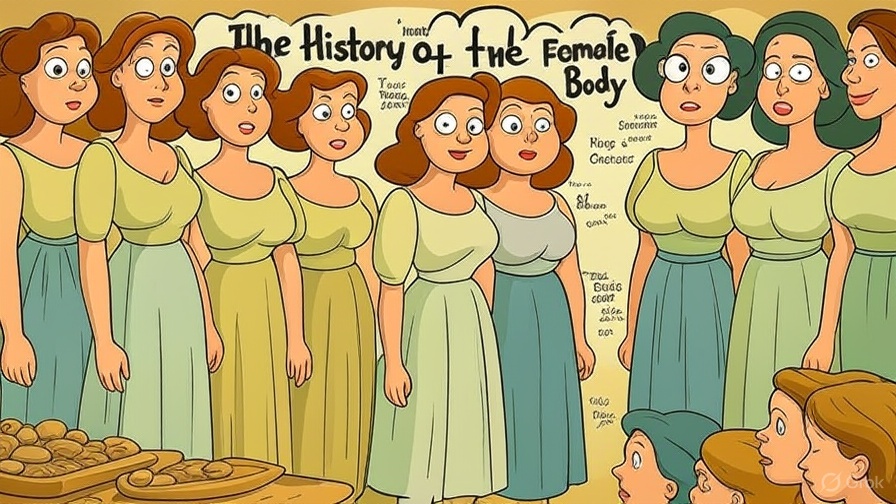
A Body of Lies: 100 Years (and More) of Ideal Women According to Fashion, Fools, and Flat Abs
By the Editorial Team at Bohiney Magazine – where satire meets spandex.
“We used to ask, ‘Mirror, mirror on the wall, who’s the fairest?’ Now it’s, ‘Front cam, front cam on my phone-can I be famous before I’m grown?'” — Alan Nafzger
For centuries, the female body has been less a biological form and more a shifting art project supervised by confused kings, panicked doctors, and emotionally unavailable fashion designers. One century, you’re divine if you resemble a buttered scone with arms; the next, you’re praised for looking like a Victorian coat rack. From Renaissance plumpness to TikTok’s face-smoothing apocalypse, history has sculpted women’s bodies to match whatever trend men could neither explain nor attain. In this satirical stroll through time, we unpack the absurd, impossible, often contradictory expectations placed on women’s flesh-from corsets that required blueprints to butts allegedly visible from orbit. It’s not just about vanity-it’s about vanity weaponized by capitalism, oiled with shame, and updated every ten years like an iPhone. Welcome to the History of the Female Body: where beauty standards age faster than dairy in the sun, and the only consistent feature is regret in high heels.
The Renaissance Body Ideal Was Basically “Bring Your Own Cheesecake”
We begin in the age of powdered wigs, lute solos, and men who painted women like they were made of sourdough.
The Renaissance body wasn’t just full-figured-it was a visual buffet. Artists like Rubens praised women whose thighs could crush a fruit cart. Having a few extra layers of flesh meant you were wealthy, fertile, and definitely not doing cardio.
Fake art historian Alfredo Baguette once said, “If you didn’t have three chins by the age of 30, you were either cursed or French.”
Beauty was simple back then: be soft, be slow, be blessed with gravy-based genetics.
The Victorian Corset Was Like a Sexy Bear Trap
Flash forward to the Victorian era, where femininity meant fainting with flair.
Corsets were in. Organs were out. Women willingly compressed their torsos until their waistlines could pass through a bagel hole. Not for aesthetic purposes, mind you-for modesty and spine rearrangement.
Victorian doctor Horace Pinchbottom famously warned, “Corsets are safe, provided the wearer has no plans to inhale or experience joy.”
Husbands called it “ladylike.” Feminists called it “rib prison.” Regardless, if your lungs functioned fully, you were clearly a slut.
Women in the 1920s Were Basically Trying to Disappear
Then came the Roaring Twenties-where the body standard dropped faster than prohibition liquor.
Out with the curves, in with the ironing board chic. Flappers bound their chests like runaway manuscripts and strutted through jazz clubs resembling genderless punctuation marks.
“Flat was freedom,” says fake sociologist Zelda Sternum. “If you had visible breasts, you were basically a walking felony.”
Women wore shapeless dresses, chopped their hair, and smoked long cigarettes like rebellious coat racks with sass.
“Boyish Figure” in the 1920s: Gender Neutral Before It Was Cool
The 1920s invented gender-neutral fashion before Twitter knew what to do with pronouns. Everyone was dressed like a rebellious pageboy with a jazz addiction.
One ad from 1924 read:
“No bust? No problem! No future? Even better!”
Society said: blend in, blend out, and let no curve survive.
In the 1950s, You Needed a Bust, Hips, and…A Willingness to Wear a Girdle
Enter the postwar era of TV dinners and appliances the size of Buicks.
The hourglass figure was back, and with it came industrial-strength girdles and terrifying conical bras. If you didn’t have a bust, hips, and a waist the diameter of a Pringles can, were you even trying to be a woman?
Women wore lingerie reinforced with rebar. Tupperware parties turned into body-shaming circles.
Marilyn Monroe was the prototype. The rest of America just passed out trying to copy her.
The 1980s Ideal Woman Looked Like She Could Bench-Press Her Date
Cue the synth music and pelvic thrusts: the 1980s arrived like a caffeinated rhinestone.
Fitness culture exploded. Jane Fonda became the priestess of pain. If your thighs couldn’t crush a watermelon, you weren’t on trend.
Aerobics was the new religion. The body ideal? “Power triangle with hair.” Women wanted delts, abs, and spandex that screamed confidence and potential blood circulation issues.
A VHS workout instructor named Chad Boombox summarized it best:
“You don’t need a personality if you have triceps and glitter.”
The ’90s Supermodel Look Was Basically a Friendly Ghost
And then everything shrunk.
The 1990s demanded women vanish again-this time looking like haunted Tim Burton sketches with high cheekbones.
Kate Moss ushered in the “heroin chic” era, where models strutted runways resembling caffeine-deprived ghosts who hadn’t seen sunlight or carbs in years.
One diet book from 1996 was titled “Smoke, Cry, Repeat.”
Teen girls were told to aspire to a form of visible malnutrition with great fashion sense. Bagels were classified as threats.
The Early 2000s Wanted You to Have a Tiny Waist and a NASA-Level Butt
At the turn of the millennium, something wild happened: curves came back-but only some of them.
You needed a microscopic waist and a butt so big it could block a solar flare. The Brazilian Butt Lift became the hottest surgery on the market, even though it had a higher casualty rate than skydiving.
J.Lo and Kim Kardashian reprogrammed society’s gaze. Suddenly, booties were no longer the butt of the joke-they were the whole punchline.
One Miami surgeon said, “We’re not building butts-we’re launching satellites.”
The 2010s Invented Butt Science
The rear end entered a new frontier-scientific enhancement.
Surgeons measured booties by volume. Fitness influencers offered online glute camps with slogans like “Squat till you dissolve” and “Assume Command.”
Kim Kardashian once posed for a photo that shattered the internet and a few mirrors. Her body became the blueprint for a generation. Meanwhile, NASA issued a statement denying she was visible from space.
“She’s close,” said one unnamed engineer. “But we need more glitter for satellite detection.”
The Modern Ideal Is…All of Them at Once?
Today’s beauty standard is less about one ideal and more about… a buffet of contradictions.
You’re expected to be thin but curvy, toned but soft, flawless but natural, ageless but experienced, and ethereal but grounded.
The modern woman must look like she drinks green juice, meditates daily, and does Pilates in zero gravity while managing a full-time job, three kids, and a psychic TikTok brand.
Cosmetic surgeon Dr. Harmony Fontina said:
“It’s like ordering sushi, tacos, and lasagna in one body. Impossible, but everyone wants it.”
Body Positivity Is the New Ideal… Until Next Tuesday
The body positivity movement was born from exhaustion-and Photoshop.
Brands now embrace all shapes… as long as those shapes still fit neatly into their marketing schemes. Meanwhile, TikTok filters do more for self-esteem than 30 years of therapy.
Self-love is promoted, but only if you’re hot while doing it. Dove’s “Real Beauty” campaign was beautiful-until it launched a skin cream named “Poreless Perfection Elixir.”
As feminist-entrepreneur Skyla D’Monet tweeted:
“Love yourself, babe… but only in HD.”
“Ideal” Means “Painfully Impractical”
All these eras had one thing in common: you couldn’t actually function as a human.
Victorian women fainted when they sneezed. 1920s flappers couldn’t raise their arms. 1950s housewives dislocated ribs for date night. 1990s supermodels broke into pieces in strong wind.
You could either look good or enjoy soup. Never both.
Doctors now classify the “Ideal Body Syndrome” as a disorder wherein your pants look great but your organs file HR complaints.
If a Time Traveler Woman Woke Up in Each Era, She’d Be Bullied 9/10 Times
Imagine a woman from 2025 accidentally time-traveling through beauty history.
In 1400, she’s too skinny. In 1900, too loud. In 1920, too busty. In 1950, not perky enough. In 2000, her butt isn’t optimized. In 2023? “Just be yourself,” says society, before handing her a filter and a gym membership.
A fictional experiment conducted by Dr. Tammy Zeitgeist concluded:
“Time-traveling women are consistently shamed unless they arrive nude with a gift basket.”
Every Decade Invents a New Way to Make Women Feel Like Crap
If there’s one thing every generation has achieved, it’s inventing new insecurities and then monetizing them.
- 1800s: “You’re not pale enough.”
- 1920s: “Too feminine.”
- 1950s: “Too masculine.”
- 1980s: “Where’s your delts?”
- 1990s: “Are you ghost-chic or just depressed?”
- 2000s: “Thicker thighs, smaller waist, please.”
- 2010s: “Can we BBL that smile?”
You are never enough-but you can be purchased.
The Ideal Body Changes More Often Than iPhone Chargers
Let’s be honest: the concept of an “ideal female body” updates more frequently than Apple software.
A 2024 satirical poll from the Center for Cosmetic Regret revealed that most women had attempted at least three different body trends before breakfast.
Like a software patch from hell, beauty updates erase your current confidence and replace it with bugs and side effects.
Dr. Rita Clavicle summed it up:
“Every time you reach the goal, the finish line jogs away on a treadmill and winks at you.”
This Article is Basically Fashion’s Way of Saying, “Oops, Our Bad… Again”
The original Daily Mail article pretends to be informative, but really it’s a longwinded, gaslighting apology from the fashion industry:
“Oops! Remember how we told you big butts were gross? Now we worship them. Also, please buy this waist trainer made of dolphin cartilage and sorrow.”
Each era blamed women for not being “on trend,” when really, the trend was just: confusion, shame, and consumerism disguised as empowerment.
What the Funny People Are Saying
“They told women to shrink, then grow, then disappear, then reappear with implants. That’s not beauty-that’s Pokémon evolution.” – Ron White
“Every decade, we tell women to ‘just be yourself’… as long as ‘yourself’ looks like someone else.” – Sarah Silverman
“I told my wife she looked perfect in 1955, and she punched me with her 1980s arms.” – Jerry Seinfeld
Disclaimer: This article is a collaborative effort between the world’s oldest tenured professor and a dairy-farming philosophy major. No actual beauty standards were harmed, but many were mocked.
Auf Wiedersehen, amigos.

MORE NEWS
Renaissance Women Were Built Like Bread: The Yeast Behind the Beauty
In a groundbreaking culinary-anthropological study from the Institute of Yeast-Based Standards, researchers have confirmed what Renaissance artists knew all along: ideal beauty was less about symmetry and more about resembling a freshly baked boule.
The report, titled “Crusty Curves and Flour Power,” reveals that the average Renaissance woman had “the visual density of focaccia and the bounce of a sourdough starter left too long in the sun.” Rubens didn’t paint women so much as butter them.
“Back then, if you weren’t fluffy and dimpled, they assumed you were possessed,” said Dr. Marinara Sloth, lead historian. “Thin women were burned as witches or asked to fetch wine from the cellar, permanently.”
The study also highlights how bread metaphors dominated love letters of the era: “Thy thighs rise like the blessed dough,” wrote one 16th-century duke. Yeast infections were even considered a mark of fertility and favor from the gods.
Modern body positivity influencers have jumped on the trend, with #BreadyToLove and #CiabattaGoals trending on TikTok.
Panera has issued a cease-and-desist to Botticelli.
Corset Manufacturers Lobby for Return of ‘Fashionable Breathlessness’
In a bold move straight from the 1800s, the National Corset Guild (NCG) has launched a campaign to bring back what they call “Fashionable Breathlessness”-the once-glorified practice of sacrificing lung capacity for a snatched waist.
“Who needs oxygen when you have elegance?” asked NCG spokesperson Madame Squeeza Von Thynne, wearing a corset so tight her pancreas blinked Morse code.
Their official slogan? “If You Can Breathe, You’re Doing It Wrong.”
The lobbying effort includes updated corset designs with Bluetooth connectivity and app-synced gasps-per-minute monitoring. Influencers are already lining up, with TikTokers posting videos of themselves blacking out in decorative fabrics.
The guild also proposed “charm collapse zones” in public spaces-velvet-lined fainting couches where fashion victims can recover between selfies.
While doctors warned of spinal compression, nerve damage, and “Victorian organs,” the fashion industry responded with a shrug, noting that “death by beauty” had great Instagram engagement.
Congress remains divided. Republicans prefer unregulated corsetry while Democrats demand all corsets come with safety instructions and a defibrillator.
Peloton is rumored to be launching a corset-friendly cycling class titled “Waist Training, Literally.”
TikTok Filter Scandal: Teens Now Mistaking Their Reflections for Strangers
In the latest wave of digital identity crises, thousands of TikTok teens have reportedly failed to recognize themselves in bathroom mirrors after prolonged use of beauty filters-some even calling the police to report “suspicious attractive persons” inside their homes.
The problem began when TikTok’s new “Perfect You 5.0” filter was released. It subtly adjusted facial symmetry, removed pores, elongated eyelashes, and added a $3,000 nose job, all while whispering affirmations in a British accent.
“I thought I was being stalked by a Disney villain with perfect skin,” said 16-year-old Cassidy Blorb from Des Moines. “Turns out it was just me-raw, unfiltered, and ugly as God intended.”
One father walked into his daughter’s room and asked, “Who is this strange woman holding my daughter’s phone?”-only to be met with, “Dad, it’s literally me, stop freaking out.”
Experts warn that self-esteem has collapsed into what they call the “Mirror Identity Gap,” where teens need name tags at sleepovers to avoid hugging the wrong reflection.
Meanwhile, makeup brands are panicking. “Why buy concealer,” asked one executive, “when the filter gives you the face of a Roman statue high on benzodiazepines?”
The filters have now been banned in four EU countries and Utah.
NASA Confirms Kim Kardashian’s Butt Visible from Low Orbit
In a press conference that blurred the line between space exploration and pop culture analysis, NASA has officially confirmed that Kim Kardashian’s rear end is visible from low Earth orbit, specifically when sunlight hits Los Angeles at a 42-degree angle.
“Technically, it has its own gravitational pull,” stated Dr. Neil deAsstroglute Tyson. “We’ve charted small satellites temporarily rerouting near it.”
The discovery was accidental. NASA’s earth-monitoring satellites, programmed to track glacier melting and crop development, were overwhelmed by an anomalous reflective surface near Calabasas. Upon closer inspection, it was revealed to be the now-infamous “Gluteal Geofence.”
Kardashian responded with pride. “I’ve always wanted to leave my mark on the world… I just didn’t expect it to be visible from space.”
The Department of Homeland Security has declared her posterior a Class III Topographic Landmark. Tourists now gather with telescopes in Griffith Park, hoping to catch “The Great Crescent” in its full glory.
Elon Musk offered to launch a Kardashian Booty Viewing Satellite (KBVS) for under $200 million, claiming it could “inspire a new generation of space enthusiasts… and OnlyFans subscribers.”
Kanye West released a new single titled “Orbit My Ex.”
Time Traveler Woman Arrives in 1912, Immediately Arrested for “Too Much Eyebrow”
A woman from 2025, accidentally sent back in time during a misguided skincare time-machine experiment, was immediately detained upon arrival in 1912 for displaying what authorities called “unladylike, provocative eyebrow behavior.”
The time traveler, later identified as influencer Kylie Quantum, arrived at a London train station wearing yoga pants, winged eyeliner, and brows that “arched like the devil’s own punctuation.”
Local constables tackled her within minutes.
“She had the brows of a suffragette assassin,” gasped Sergeant Nigel Fobsworth. “They were dark, symmetrical, and… purposeful.”
Eyewitnesses reported that babies cried, horses fled, and one elderly baron spontaneously combusted after making direct eye contact with her contouring.
In court, Kylie explained eyebrow threading, highlighter palettes, and the concept of “lamination.” The judge, horrified, sentenced her to six months of eyebrow leech therapy and a hysteria diagnosis.
Historians believe her arrival triggered the 1912 eyebrow panic, leading to that year’s sudden fashion shift toward wide-brimmed hats and downward glances.
She was last seen teaching Edwardian women how to overline lips and say “slay.” A young boy named Winston Churchill took notes.
A sequel mission is planned-code name: “Operation: Eyeliner Through Time.”