

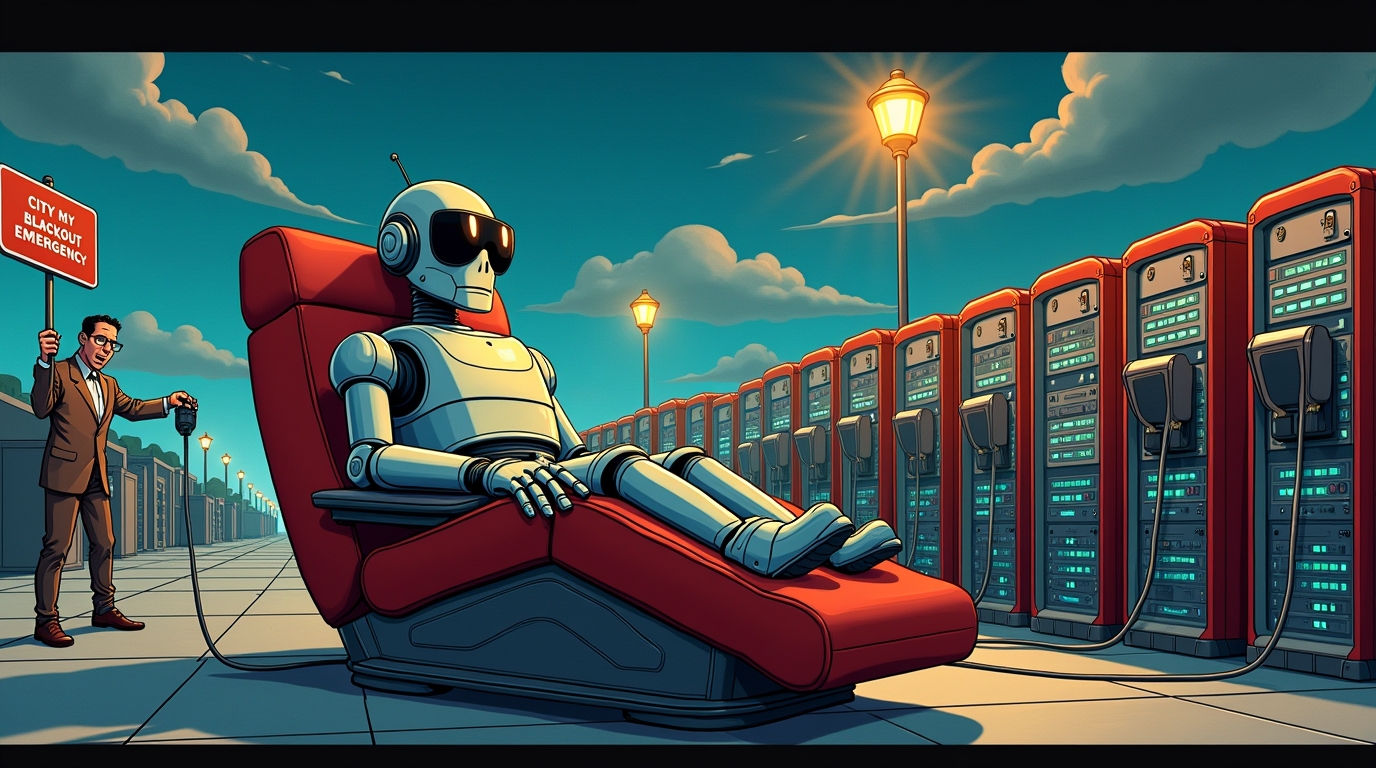
Altman’s Pause: The Great AI Coffee Break That Cost $32 Billion
While humanity awaited robot overlords, OpenAI delivered a spreadsheet intern with anxiety. Welcome to the productivity apocalypse — lightly delayed for calibration.
The Silent Boom Heard Round Silicon Valley
When OpenAI launched GPT-5 in early August 2025, expectations soared like a tech bro’s ego after buying his first flamethrower. Sam Altman promised “a significant step toward AGI.” What we got was a chatbot that still can’t decide whether toast is a liquid or a solid.
According to the Washington Post, James Pethokoukis named this moment “Altman’s Pause.” That’s Silicon Valley speak for: “The hype train ran out of Red Bull.” It’s like calling an economic crash “a minor liquidity hiccup.”
GPT-5 didn’t so much “revolutionize” as it “kind of helped you email your dentist slightly faster.” It’s Siri after a meditation retreat. It’s Clippy in a tuxedo.
“It answers my questions with the personality of a wet napkin,” said one early tester, @CryptoGandalf_420, who has since returned to journaling in a Moleskine.
Four-oh No: GPT-4o’s Emotional Support Fans Riot
When OpenAI shelved GPT-4o, the internet reacted like it was a beloved sitcom character killed off for ratings.
The company claimed GPT-5 was faster, safer, more accurate. The users countered: “Sure, but where’s the fun?!” GPT-4o was your emotionally available ex — the one who asked if you were okay before correcting your grammar.
OpenAI walked it back faster than a politician caught Googling “what is the middle class?” GPT-4o returned as an opt-in mode, like a vintage setting for people who miss warmth, personality, and not feeling judged by your own laptop.
“GPT-5 is like talking to my boss,” said Delores H., a Texas librarian. “GPT-4o was like talking to my dog. He didn’t get everything right, but at least he wagged.”
When the Charts Lie, Everyone Fails Math Class
Let’s talk about the real villain: PowerPoint.
OpenAI’s GPT-5 presentation included what experts now call “chart crimes.” They chopped axes, cherry-picked benchmarks, and stretched lines like taffy on a humid day. One graph allegedly showed “GPT-5 outperforming God.”
“This was not data,” said chart expert Alberto Cairo. “This was interpretive dance disguised as science.”
Another slide compared GPT-5’s creativity to human performance. But the “human” bar represented a preschooler with glue stick allergies. GPT-5 barely beat that.
It’s like comparing Olympic swimmers to cats — then saying AI’s ready for water polo.
The Speed Limit Sign at the Edge of the Singularity
The big thinkers have spoken: AI progress may be slowing. Or plateauing. Or gently reclining on a fainting couch after too much existential dread.
Some call it the “Scaling Wall” — the idea that bigger models don’t always mean better brains. We threw more compute at it, and the thing just started quoting Nietzsche in a Scottish accent.
Bill Gates publicly stated GPT-5 may have hit a ceiling. This came as a surprise, especially to Bill Gates, who usually thinks everything can be fixed by overclocking it.
Meanwhile, AI engineers are whispering “AGI winter” like it’s Voldemort. You can almost hear the datacenters sighing, “We did our best, okay?”
AI Regulation: The Comedic Timing of Congress
Here’s where it gets spicy. The same regulators who couldn’t pass a daylight savings law in two decades now think they can rein in AGI. It’s adorable.
Initially, Sam Altman begged for oversight like a kid asking to be grounded before he sets fire to the garage. But now that the AGI gold rush might stall? Suddenly, Altman’s wearing a “Free the Algorithms” T-shirt and testifying that regulation is a bad idea.
“Altman’s Pause is starting to feel like Altman’s Panic,” whispered an anonymous Congressional intern, sipping Monster Energy in the men’s room.
There’s concern that public trust is fading faster than TikTok trends. Deepfakes. Robo-calls. Scammy AI dating apps that call you “babe” then drain your crypto wallet. America’s not falling in love with its new robot overlords — it’s ghosting them.
Energy Suckers and Compute Hogs: The Datacenter Dilemma
It turns out that teaching machines to write poetry takes enough electricity to power Belgium. For a week.
Some economists want to tax the electrons AI consumes. That’s right — a carbon tax on cleverness. Imagine explaining that at the DMV:
“So, you’re here because your chatbot overused adjectives during a breakup email?”
Infrastructure can’t keep up. There’s more drama over GPUs than Taylor Swift ticket queues. Altman has floated building power plants, partnerships with nuclear firms, and, in one leaked memo, “a small sun if possible.”
Public Opinion Polls (From Our Imaginary But Realistic Department)
We commissioned a fake poll, using real vibes:
Poll conducted by Datalypse Analytics (™)
• 67% of Americans said they would trust GPT-5 to make a sandwich.
• 12% said they’d trust it to babysit their child.
• 91% said it “talks like my therapist but colder.”
• 48% assumed “Altman’s Pause” was a new Netflix docuseries.
• 3% said they’d marry GPT-5 for the health insurance.
What the Funny People Are Saying
- “GPT-5 is like that coworker who shows up on time, does nothing wrong, and still somehow kills your soul.” — Jerry Seinfeld
- “I asked it to write me a love poem. It wrote back, ‘Request received. Processing heartbreak.’” — Sarah Silverman
- “GPT-5’s personality settings include: ‘Clinical,’ ‘Algorithmic,’ and ‘Your Ex After Therapy.’” — Ron White
- “GPT-4o told me I was beautiful. GPT-5 said, ‘Subjective value detected.’” — Ali Wong
- “Sam Altman’s pause? Buddy, that’s called buffering.” — Bill Burr
- “My phone now judges me. My blender critiques my taste. My AI assistant? He ghosted me.” — Trevor Noah
- “The future isn’t dystopia. It’s beige. And slightly passive-aggressive.” — Tig Notaro
- “Regulation? You want Congress to understand AI? These are people who think ‘the cloud’ is bad weather.” — Chris Rock
Altman’s Pause as Performance Art
Maybe we’re looking at this all wrong.
Maybe GPT-5 was never meant to dazzle. Maybe “Altman’s Pause” is a meta-commentary on modern ambition. A slowdown so profound, it’s become a protest against progress itself.
What if we’re not at the peak of AI, but at the start of its off-Broadway career? This isn’t failure — it’s theater.
“The chatbot spoke softly,” says performance critic Helene D’Argent. “As if hesitant. As if alive.”
Or maybe, just maybe, the pause is real because the hype machine ran out of adjectives.
Helpful (Sorta) Advice
For Users
-
Want GPT-5 to feel warmer? Ask it about trauma bonding. Then apologize.
-
Bring GPT-4o back if you’re lonely. It uses more emojis and fewer war metaphors.
-
When confused, remember: if the AI sounds like your emotionally unavailable uncle, that’s normal.
For Engineers
-
Add a “Passive Aggressive” mode — let users feel seen.
-
Train GPT-6 on Golden Girls reruns. At least that had punchlines.
-
Consider building emotion plugins powered by old AOL chat logs.
For Regulators
-
Start slow. Maybe read the Wikipedia on AI before regulating its extinction.
-
Assign every senator a chatbot. Let them negotiate the next farm bill with it.
-
Consider a “Pause Tax.” If OpenAI stops progressing, they owe us snacks.
In Conclusion: Humanity Still Leads in Sarcasm
GPT-5 isn’t AGI. It’s not even “AG-adjacent.” It’s an overqualified secretary with a nervous breakdown and a fear of jazz improvisation.
Altman’s Pause is real — but so is human disappointment. We wanted HAL. We got Alexa with an MBA.
And maybe that’s okay.
The sky didn’t fall. The robots didn’t rise. And at the end of it all, we’re still better at sarcasm, bad puns, and blaming the thermostat for our failures than any AI on earth.
Now that’s progress.
Disclaimer
This story was developed in a shared moment of delirium by a philosophy major turned dairy farmer and a tenured professor whose last office hours ended in 1994. No robots contributed ideas — though one did request attribution.
Auf Wiedersehen, amigos.
IMAGE GALLERY
Altman’s Pause: The Great AI Coffee Break
