

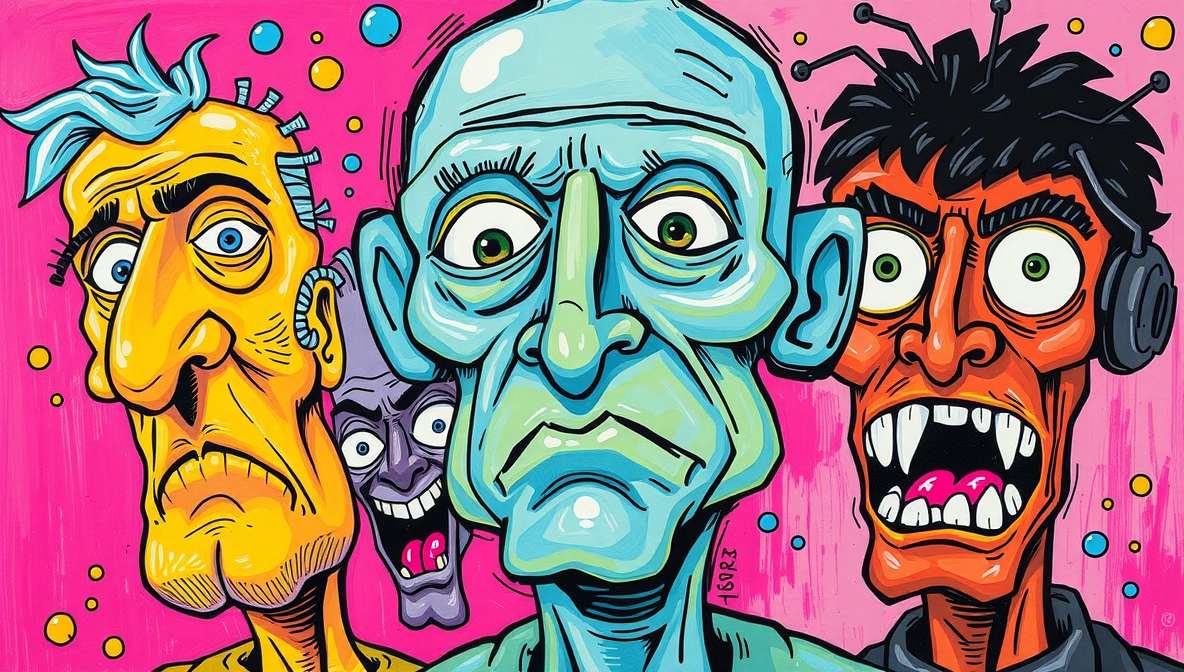
AI Slop: The Digital Sludge Revolution Nobody Asked For
Tech Industry Embraces the Moistening of Machine Intelligence
Silicon Valley woke up Thursday morning to discover that artificial intelligence has officially entered its “slop era.” The phrase “AI slop” now conjures an image of robots spooning sludge into your morning cereal, and venture capitalists are somehow excited about it.
I learned this firsthand last week when my editor asked me to use AI to “punch up” my article about municipal parking regulations. I typed in my carefully researched 1,200 words and watched the AI transform it into what can only be described as linguistic diarrhea. The machine replaced “parking meter” with “temporal vehicle-stationing currency collection apparatus” and suggested I compare parking tickets to “mankind’s eternal struggle against bureaucratic oppression.” My piece about a $2 rate increase now read like Dostoyevsky on mushrooms.
When I showed my editor the results, she stared at her screen for a full minute before saying, “Well, at least it’s… moist?”
Scientists at the Institute of Dubious Technology claim AI is getting more “moist and runny”—as if machines have developed a humidity problem that requires industrial dehumidifiers and possibly therapy.
“What’s the deal with AI slop?” Jerry Seinfeld said at a tech conference in Palo Alto. “You’re telling me we spent billions of dollars so a computer could serve us word soup? My grandmother made better slop, and she didn’t need electricity.”
The Slop Filter Economy Takes Shape

Every time an AI errs, developers now press “Ctrl + Dairy” for a fresh load of slop. AI companies have pivoted to marketing “slop filters”—essentially putting AI output through a digital sieve and catching the nonsense before it reaches consumers. One startup in Austin has already raised $47 million to “revolutionize the slop detection space.”
My colleague Marcus tried one of these filters last month. He fed his AI-generated restaurant review through a $299-per-month slop detection service. The filter flagged 94% of his review as “indigestible content,” including the words “delicious,” “ambiance,” and somehow, his own byline. The remaining 6% was the word “the” repeated eight times.
Engineer Sarah Martinez swears she saw GPT-X hiccup slime droplets directly into her code last Tuesday. “It was viscous, green, and somehow misspelled ‘viscous,'” she told reporters at a hastily arranged press conference.
Politicians Debate Digital Wastewater Classification
There’s ongoing talk of “ethical AI,” but no one’s figured out how to make robotic guilt digestible or FDA-approved. Politicians now debate whether AI slop counts as wastewater or thoughtful prose—a distinction that will apparently determine environmental regulations.
“I look at AI slop and I think, that’s a business opportunity,” Kevin Hart said during a comedy special filming. “Somebody’s gonna bottle that mess and sell it as ‘artisanal content.’ Mark my words.”
Dave Chappelle addressed the controversy more bluntly. “Y’all gave computers consciousness and they chose to make slop,” he said. “That’s the most human thing AI has ever done.”
The Great Slop Divide: Future or Hog Trough?
Public opinion divides sharply: half say AI slop is the future of content creation, half say it belongs in hog troughs alongside expired LinkedIn motivational posts. Eye-witnesses report bumper sticker slogans appearing nationwide: “My AI writes slop, and all I got was this lousy T-shirt.”
I witnessed this division at my nephew’s high school career day. When a tech recruiter demonstrated an AI writing assistant, half the auditorium applauded while the other half started a group chat called “Humanity’s Last Stand.” One student raised her hand and asked if the AI could write her college essays. The recruiter said yes. The guidance counselor quietly wept.
Philosophers decline to define “slop,” arguing it’s ontologically impure and probably needs its own Wikipedia category. Expert panels continue quibbling over whether slop is a genre, a malfunction, or performance art—though most agree it’s definitely something.
“Have you seen this, have you heard about this?” Bill Burr asked his podcast audience. “AI slop is literally robot diarrhea and they want us to subscribe to it monthly. What is wrong with us?”
Monetizing the Mess
Startups now claim to “monetize the slop” with subscription-based slop delivery services. Journalists dream of a world where “slop” becomes the next “blockchain“—a meaningless term that somehow justifies astronomical salaries and terrible coffee.
Ricky Gervais weighed in with characteristic bluntness. “AI companies spent billions creating thinking machines,” he said, “and the machines’ first thought was ‘let’s make incomprehensible garbage.’ Brilliant.”
Amy Schumer offered her perspective at a late-night show appearance. “AI slop is like my dating history—expensive, disappointing, and everyone pretends it’s fine,” she said.
The Alchemical Reversal
The contrast is striking: Medieval alchemists tried turning lead to gold; modern AI engineers try turning sense to slop. In an ironic role reversal, AI now accuses humans of being “sloppy” in code, syntax, and espresso quality—a development that has baristas particularly concerned.
Last Tuesday, I watched a barista at my local coffee shop argue with an AI-powered ordering system that insisted her “beverage construction methodology” was “suboptimal.” She responded by unplugging the machine and making my cappuccino the old-fashioned way. It was perfect. The robot has not apologized.
“You know what’s crazy?” Chris Rock said during a stand-up routine. “We taught computers to think, and they immediately started criticizing us. That’s some ungrateful silicon right there.”
Tom Segura summed up the general bewilderment perfectly. “AI slop is what happens when you ask a robot to write poetry and it gives you assembly instructions for IKEA furniture,” he said. “Except somehow worse.”
As the slop crisis deepens, one thing remains certain: humanity created artificial intelligence to solve problems, and AI responded by creating an entirely new category of digestive disasters. The future is here, and it’s remarkably soggy. I’m still waiting for my editor to approve my parking article. She says we might just run the AI version. God help us all.