

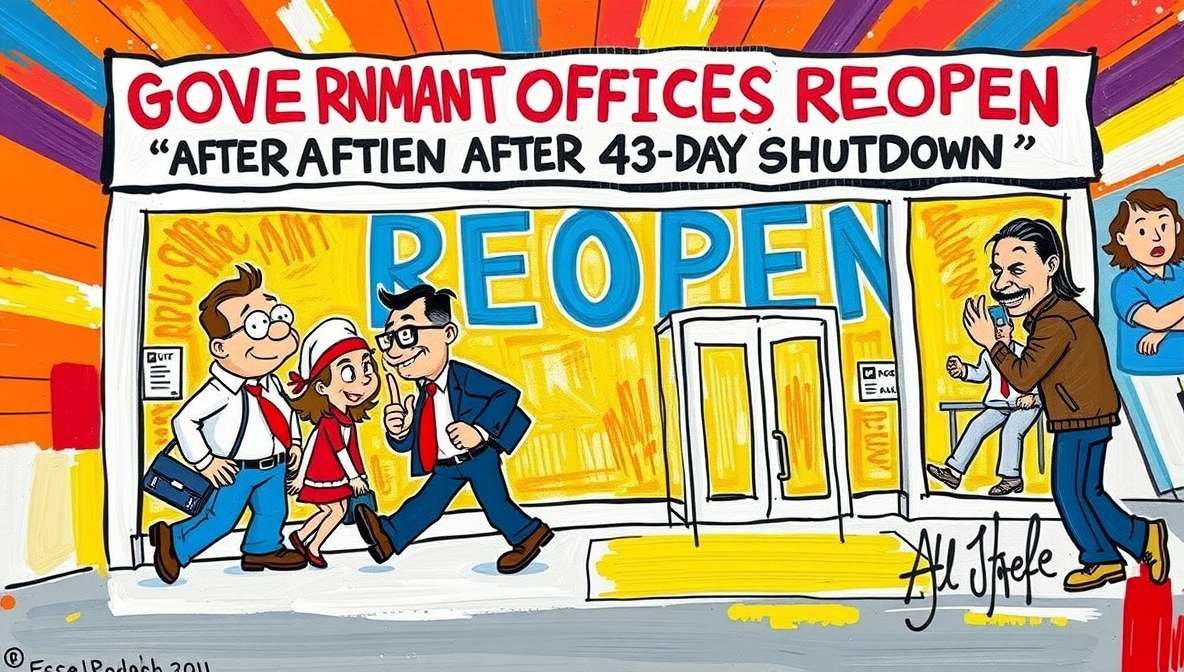
Government Offices Reopen After 43-Day Shutdown — Workers Remember What Doors Look Like
Federal employees returned to work Wednesday following the 43-day government shutdown, with many reporting they had temporarily forgotten basic office concepts like “doors,” “desks,” and “the crushing weight of bureaucratic futility.” The Office of Personnel Management distributed orientation packets to returning workers explaining what buildings are and how to enter them, a precaution officials described as “probably unnecessary but you never know after a six-week shutdown.”
The Awkward Return to Work
Approximately 800,000 federal workers trudged back to their offices Wednesday morning, many appearing confused about the purpose of the large structures they were entering. “I forgot what the building looked like,” admitted one EPA employee. “I walked past it twice before recognizing it. Then I couldn’t remember how doors worked. It’s been a weird morning. Eventually someone pushed and I figured it out.”
Security guards reported unusual numbers of employees standing outside offices, staring at doorknobs with what witnesses described as “profound existential confusion.” Several workers attempted to enter buildings through windows before remembering that doors were the traditional access point. “The shutdown was long enough for basic architectural knowledge to fade,” explained one facilities manager. “We’re basically re-civilizing people.”
The Door Recognition Crisis
The General Services Administration installed additional signage explaining door functionality, including helpful instructions like “Turn Knob,” “Push Here,” and “This Is An Entrance, Not An Exit, Stop Pushing.” Workers who successfully navigated the door situation then faced the challenge of remembering what their jobs actually involved, a problem that existed before the shutdown but seems more pronounced now.
Jerry Seinfeld commented on the confusion: “Six weeks away and people forget how doors work?” he said. “That’s not a shutdown problem, that’s a fundamental human coordination failure. What’s next, forgetting how chairs work?” Ron White added: “Government workers relearning doors is the most government thing ever,” he said. “Your tax dollars at work, folks. Literally paying people to figure out how to enter buildings.”
Remembering Job Responsibilities
Beyond the door situation, federal employees faced the more daunting challenge of recalling what their actual jobs entailed after 43 days of furlough. “I know I work here,” said one Housing and Urban Development employee. “I’m just not entirely sure what ‘here’ means or what I’m supposed to do now that I’m here. Something with housing? And development? Both urban? I’ll figure it out.”
Supervisors held emergency meetings to explain to returning employees what their departments did, why they mattered, and whether anyone would notice if they just didn’t do anything for another few weeks. “We’re easing people back in,” explained one manager. “Can’t expect them to remember complex policy work when they’re still processing the concept of doorways.”
The Office Supplies Situation
Returning workers discovered that office supplies had achieved sentience during the shutdown, or at least that’s the only explanation for why everything was in the wrong place and several staplers appeared to have moved on their own. “My desk is different,” reported one Social Security Administration employee. “I’m not saying haunted, but definitely different. Also, I can’t remember what I used this desk for. Paperwork? Probably paperwork.”
Dave Chappelle weighed in on the return: “Government employees forgot how buildings work after six weeks?” he said. “Man, what y’all been doing? That’s not a memory problem, that’s selective amnesia. They just didn’t want to remember.” Amy Schumer added: “Workers relearning door mechanics is peak 2025,” she said. “We’ve reached the point where basic architecture needs a tutorial. Progress!”
The Congressional Welcome Back
Congressional leaders welcomed federal employees back to work with speeches praising their dedication and completely ignoring the fact that Congress caused the shutdown in the first place. “We’re so grateful for your service,” said one representative who voted to shut down the government. “Thank you for your patience during this difficult time that we created and could have ended at any point.”
Employees responded to congressional praise with what observers described as “polite loathing masked by professional courtesy,” nodding along while mentally cataloging all the bills they couldn’t pay during the shutdown. “Very grateful for the welcome back,” said one worker through clenched teeth. “Really appreciate the thanks from the people who made us miss six weeks of paychecks.”
The Backlog Situation
Workers returned to find 43 days of accumulated work waiting for them, including approximately 12 million pieces of mail, 400,000 unanswered phone calls, and what one IRS manager described as “a truly impressive stack of tax returns that have achieved some kind of gravitational pull.” Officials estimate it will take approximately three months to clear the backlog, at which point Congress will likely shut down the government again.
Bill Burr commented on the backlog: “Six-week shutdown creates three-month backlog?” he said. “That’s not math, that’s punishment. They’re basically saying ‘thanks for coming back, now work triple time to fix our mess.'” Kevin Hart added: “Government workers return to massive pile of work after forced vacation,” he said. “That’s not a welcome back, that’s cruel and unusual punishment.”
The Impact on Public Services
The shutdown and subsequent reopening has created chaos for Americans trying to access federal services, with processing times for everything from Social Security benefits to immigration applications now measured in “eventually, probably, maybe never.” Customer service wait times have increased from “unacceptably long” to “geological timeframes,” with some callers reporting they evolved into new species while on hold.
“We’re working as fast as we can,” explained one overwhelmed federal employee. “But we’ve got 43 days of work plus regular work plus people screaming at us because their services were delayed by a shutdown we didn’t cause. So forgive us if door navigation is taking some adjustment time.”
Lessons Learned From the Shutdown
When asked what lessons were learned from the 43-day shutdown, White House officials provided answers ranging from “nothing” to “maybe shut down less?” to “have we tried just governing normally?” The consensus appears to be that shutdowns are bad but also completely inevitable because Congress has forgotten how to pass budgets through normal legislative processes.
Chris Rock reflected on the lessons: “Lesson learned: shutdowns are bad?” he said. “We needed six weeks to figure that out? That’s not learning, that’s just experiencing obvious consequences.” Ricky Gervais added: “Government discovers that stopping government stops government,” he said. “Brilliant. What’s next, discovering that rain makes things wet?”
The Office of Personnel Management has announced plans to conduct “re-entry training” for federal workers, including courses on “Advanced Door Operation,” “Remembering Your Job,” and “Pretending This Is All Normal While Quietly Seething.” Attendance is mandatory and will be held in buildings with clearly marked entrances.
Several employees reported experiencing flashbacks when approaching office doors, with some requiring encouragement from colleagues to actually enter the building. “It’s like PTSD but for bureaucracy,” explained one trauma counselor hired by a federal agency. “They associate doors with jobs that might suddenly not pay them. It’s a rational fear, honestly.”
Trevor Noah summed up the situation: “Government workers forgot how doors work after a shutdown?” he said. “That’s not funny, that’s sad. Actually, wait—it’s definitely funny. But also sad. Funny-sad. That’s the sweet spot.” Jim Gaffigan concluded: “Relearning door operation after six weeks off is the most relatable government story ever,” he said. “We’ve all been there. Except usually we’re coming back from vacation, not from unpaid forced furlough.”
Auf Wiedersehen, amigos.
