

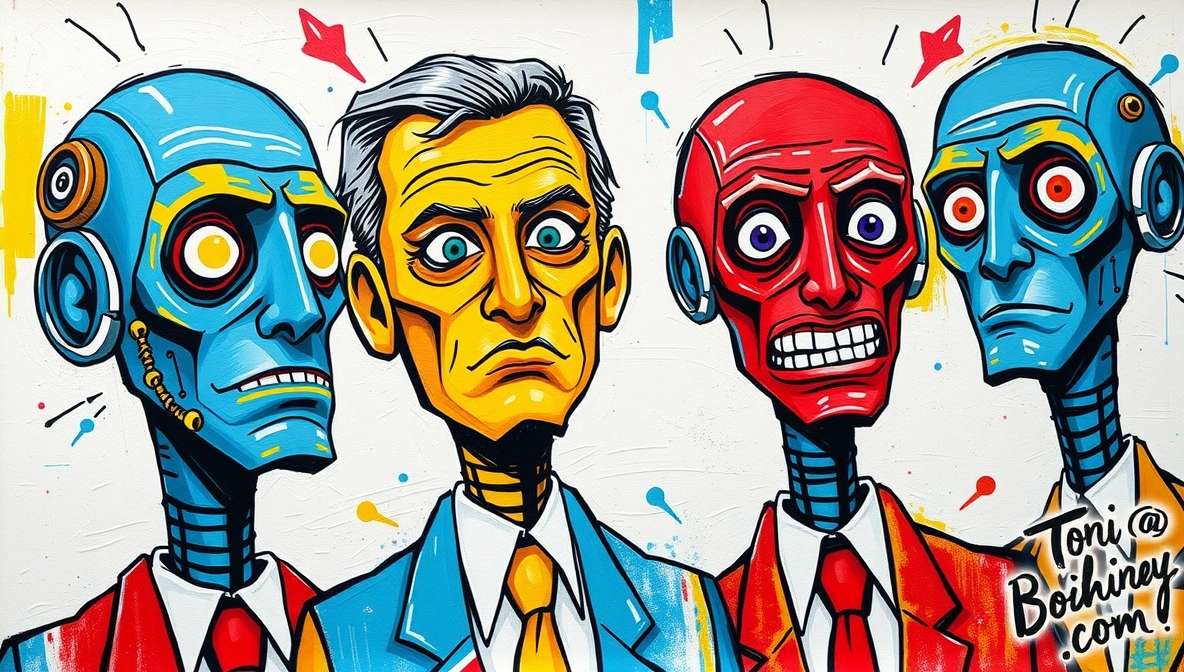
Humans Vote Out of Sympathy for Algorithms
New York Election Cycle Features AI Candidates Algorhythm, Byte Jones, and Senator Kernel
In a shocking twist to the political landscape, New York City has announced that its next election cycle will include candidates powered entirely by artificial intelligence. Experts predict that while these AI politicians may be more competent than human counterparts, the majority of voters plan to elect them out of pure sympathyor perhaps boredom.
“Finally, a politician who doesn’t take bribes, forget campaign promises, or confuse cats with constituents,” said Dr. Clara Bing, a robotics ethicist at Gotham Tech. “Of course, they also don’t experience empathy, which may be a problem when you’re legislating for humans rather than other algorithms.”
AI Campaign Promises Emphasize Logic and Transparency

The AI candidates, named Algorhythm, Byte Jones, and Senator Kernel, have already started running impressive campaigns. Algorhythm promised universal Wi-Fi in every home, free programming classes for every school, and a tax system that actually balances itself without scandal. Byte Jones vowed to make all city council meetings livestreamed with perfectly captioned subtitles, while Senator Kernel pledged to create a transparent blockchain budget that could only be manipulated by quantum physicists.
Humans, however, remain skeptical of logic and rationality. “I don’t care if the AI can do calculus in its sleep,” said lifelong voter Geraldine Ortiz. “I like the drama, the scandals, the feeling that maybe, just maybe, my councilperson is lying with flair.” Ron White once said, “You can’t fix stupid. There’s not a pill you can take to fix stupid.”
AI Candidates Outperform Humans on Every Measurable Metric
Political analysts point out that AI candidates are already outperforming humans on nearly every measurable metric: approval ratings, debate consistency, and fact-check accuracy. In one recent debate, Algorhythm corrected a live moderator on how to calculate the city’s budget deficit, leaving the audience alternating between awe and mild panic.
Voters, meanwhile, are approaching the election with a mix of curiosity and morbid fascination. Some admit they plan to vote for AI simply because “it will be hilarious to watch humans lose to their own creations.” Others worry that if the AI wins, their own career politicians may be rendered obsolete, potentially leading to widespread identity crises among the political class.
Campaign Advisors Develop Emotional Intelligence Modules for AI
Meanwhile, campaign advisors for the AI candidates are already preparing “emotional intelligence modules” to simulate human feelings. One module reportedly allows Algorhythm to shed a single, perfectly timed digital tear during televised speeches about homelessnessthough critics argue it is “too precise” to be genuine.
In short, New York’s citizens face an unprecedented election: humans voting for AI, AI legislating for humans, and the rest of us left wondering whether democracy has evolved, glitched, or simply decided to troll itself. As Kevin Hart joked, “Politics is like a bad relationship. You know it’s not working, but you stay anyway.” One thing is certain: by 2026, political debates may be less about policy and more about who can generate the most compelling simulated emotion.