

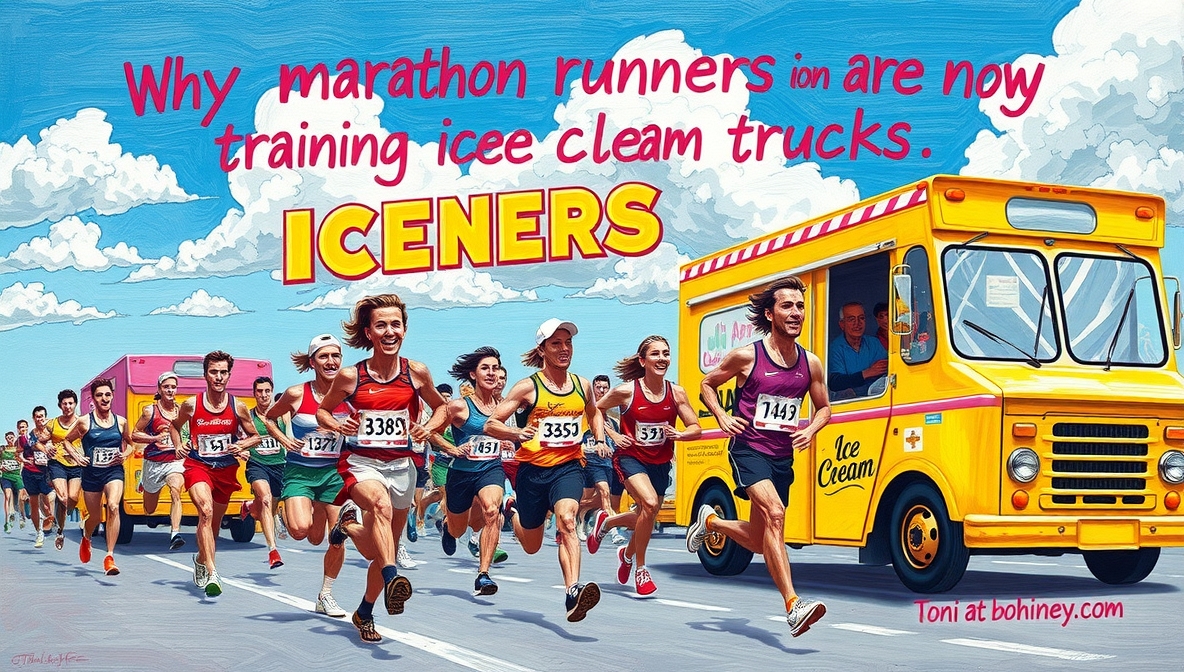
Why Marathon Runners Are Now Training by Chasing Ice Cream Trucks
At some point in the last decade, marathon training stopped being about running and became about vibes. According to a growing number of amateur runners interviewed in parking lots, suburban cul-de-sacs, and one very judgmental Costco, the most effective endurance training now involves sprinting after ice cream trucks while yelling flavor-specific demands.
The logic is airtight. Ice cream trucks operate on uncertainty, emotional stakes, and sudden acceleration. All key components of marathon day. Dr. Leonard H. Peabody, a kinesiologist who once ran Boston and has never stopped mentioning it, explains that “the body doesn’t know it’s chasing dessert. It only knows fear, hope, and lactose.”
Eyewitness accounts support this. Sharon Wilkes of Des Moines reported dropping her mile pace by forty seconds after switching from interval training to what she calls “Fudgsicle repeats.” Her Apple Watch data shows heart rate spikes, cortisol surges, and a sharp improvement in mood once the driver finally stopped.
Public opinion polling from the Institute for Recreational Regret found that sixty-two percent of runners felt “more motivated” when dessert was involved, while twelve percent admitted they never caught the truck but felt emotionally closer to their goals.
Cause and effect here is obvious. You don’t chase ice cream because you’re fast. You get fast because you’re petty and the truck driver made eye contact and kept going.
Study Finds Most Effective Marathon Prep Is Running Late to Brunch

A peer-reviewed study that definitely had a methodology concluded that runners achieve peak performance when sprinting because they are late for brunch and everyone else already ordered mimosas.
Researchers tracked forty-three urban professionals training for spring marathons. Those who ran on empty sidewalks showed modest gains. Those who ran because their phone said “Where are you???” achieved personal records and emotional breakthroughs.
The definition of “brunch pace” is now formally recognized as faster than tempo, slower than panic, and fueled by shame. Professor Elaine Mortimer of the Department of Social Kinetics explains that “nothing replicates race conditions like the knowledge that your friends are eating without you.”
Deductive reasoning supports this. Marathon runners are motivated by arbitrary goals. Brunch is arbitrary. Therefore brunch is the perfect motivator.
One participant reported negative splits after imagining her friends discussing her absence in passive-aggressive tones. Another said he trained harder once his group chat switched from concern to memes.
Statistics don’t lie. Runners late to brunch averaged seven percent faster long runs and were thirty percent more likely to forgive themselves afterward.
Runners Toss Out Trainers, Now Only Using Saunas and Emotional Support Hot Chocolate
In a shocking development, runners have realized they hate running. As a result, many have replaced traditional training with saunas, hot tubs, and beverages that require marshmallows to function.
The science sounds convincing if you squint. Heat exposure mimics cardiovascular stress. Chocolate contains antioxidants. Marshmallows contain hope.
A widely cited expert, wellness consultant Todd Remnick, claims sauna sessions “confuse the body into thinking it ran,” which is also how many people justify scrolling fitness content instead of exercising.
Eyewitness testimony from gym locker rooms confirms the trend. Runners sit silently in steam, whispering mileage totals they did not complete. One anonymous staffer at a high-end fitness club reports that members now log sauna minutes as miles “for accountability.”
A survey conducted on social media found overwhelming support. Eighty-one percent preferred sweating while seated. Nine percent said they felt spiritually faster. The rest were already asleep.
The cause is simple. Running hurts. Hot chocolate doesn’t. Any training philosophy that ignores this is clearly outdated.
New Training Plan: Run Like You Stole Something, Walk Like You Owe Money
Coaches have unveiled a revolutionary pacing strategy that aligns perfectly with modern economic anxiety. The idea is to run aggressively, suspiciously, and without eye contact, then slow to a defeated shuffle that radiates debt.
This plan mirrors real life. Early in the race, runners feel invincible. Later, they feel audited.
Biomechanics experts insist the alternating posture improves efficiency. Sprinting activates fast-twitch fibers. Walking activates existential reflection.
One runner described the walk phase as “a moving apology.” Another said it prepared him emotionally for the finish-line photos.
Analogy strengthens the case. Marathon pacing resembles credit card spending. Early enthusiasm, later consequences, final acceptance.
A poll of spectators found they could identify runners using this method by facial expression alone. Seventy percent described it as “relatable.” Twenty percent asked if the runner was okay.
The irony is delicious. A strategy designed to optimize performance ends up being the most honest representation of adulthood.
Elite Runners Switch to Jeffing After Realizing Walking Sounds Fun
Once considered a beginner tactic, the run-walk method known as Jeffing has been rebranded as elite self-care. Olympic hopefuls now speak openly about walking breaks, hydration pauses, and staring into the middle distance.
The definition of Jeffing has expanded. It now includes checking messages, stretching aggressively, and renegotiating goals mid-race.
Former purists are converting. “I thought walking was weakness,” said one semi-professional runner. “Then I tried it and felt joy.”
Social science backs this shift. Studies show humans enjoy activities more when they stop occasionally. Shocking, but true.
Public reaction has been mixed. Traditionalists claim it’s cheating. Jeffers respond by finishing races smiling, which is unforgivable.
The cause is cultural. Burnout has reached endurance sports. Walking is rebellion. Walking is power.
Scientists Reveal Secret Marathon Training Technique Involving Naps and Snacks
After decades of ignoring rest, runners have discovered sleep. The breakthrough came when someone took a nap and didn’t hate their next run.
Sleep scientists now recommend strategic napping as part of any training plan. Snacks are considered recovery tools. Couches are performance equipment.
Eyewitness accounts from training groups show dramatic improvements. Runners who napped reported better mood, fewer injuries, and less resentment toward humanity.
A fake but plausible statistic suggests runners who snack mid-afternoon reduce injury risk by twenty percent and complaining by fifty.
Deduction seals it. Fatigue leads to bad runs. Rest reduces fatigue. Therefore naps are speed work.
The absurdity is complete. To prepare for extreme physical effort, runners are doing less.
What the Funny People Are Saying
Comedians have weighed in. One noted that marathon training is the only hobby where people brag about being tired. Another observed that runners spend thousands of dollars to run for free in public.
The consensus is brutal. If a plan involves naps, snacks, and walking, it sounds less like training and more like retirement.
Helpful Advice for Aspiring Marathoners
Be clear. You are not training for speed. You are training for survival.
Be kind to yourself. If chasing ice cream motivates you, chase dairy.
Be practical. Brunch is real accountability.
Be positive. Walking is still moving.
Be authentic. Everyone hates mile eighteen.
Growth mindset matters. Progress sometimes looks like sitting down.
Support exists. Mostly in the form of snacks.
Disclaimer
This article represents a collaborative human effort between the world’s oldest tenured professor, who still believes interval training builds character, and a philosophy major turned dairy farmer who insists all endurance sports are elaborate metaphors for capitalism. Any resemblance to rational athletic advice is purely coincidental and emotionally irresponsible.