

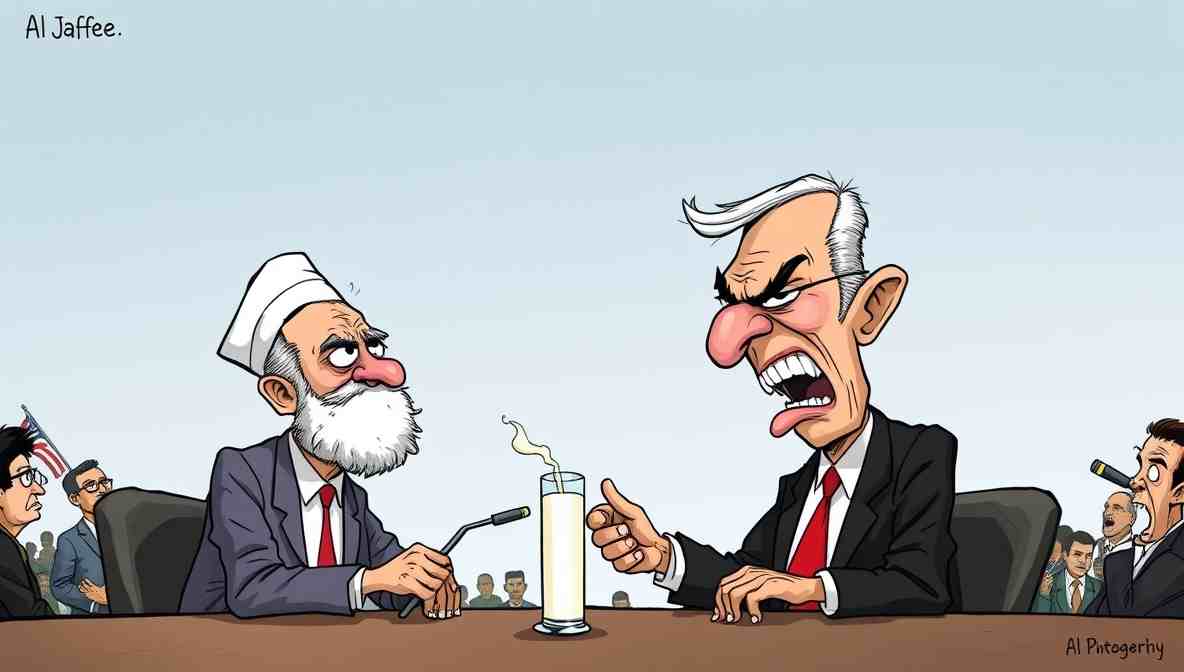
Global Diplomacy Enters New Era of Agreements That Age Worse Than Milk
A Historic Deal, Fresh for About 12 Minutes
GENEVA — In what experts are calling “a bold new chapter in international disappointment,” global leaders this week signed a sweeping diplomatic agreement with Iran that began expiring emotionally before the ink had physically dried. The deal, hailed at 9:00 a.m. as “a cornerstone of peace,” was downgraded by 9:14 a.m. to “a conversation starter,” and by noon was widely considered a collectible item, like Beanie Babies or functioning printer ink.
Officials gathered under ornate chandeliers, smiling the way people do when they know the group photo will outlive the policy. Cameras flashed, hands were shaken, and somewhere in the background, a staffer quietly whispered, “Should we read the fine print?” before being escorted out for negativity.
Dr. Leonard P. Crumple, a senior fellow at the Institute for Predictable Outcomes, confirmed the agreement followed a well-established diplomatic lifecycle. “First comes optimism, then comes confusion, then comes a panel discussion,” Crumple explained, adjusting glasses that had clearly seen too many failed treaties. “This one skipped straight to panel discussion.”
Eyewitnesses reported that even as leaders praised the agreement, several delegates were seen Googling “what happens if no one actually follows this.” One European diplomat admitted, “We’re not here to solve problems. We’re here to look like we brought a pen.”
A snap poll conducted by the Global Opinion Consortium found that 73% of respondents believed the deal would fail, 22% believed it had already failed, and 5% asked if this was about milk.
Tehran Clarifies Deal Was Binding “Emotionally, Not Legally”
Iranian officials moved quickly to clarify that their commitment to the agreement was “deeply felt, spiritually aligned, and entirely non-binding.” A spokesperson explained, “We signed with our hearts, not with our enforcement mechanisms.”
Leaked memos suggest the agreement falls under Iran’s newly defined category of “aspirational compliance,” right alongside gym memberships and learning French. The Center for Arms Control and Non-Proliferation noted that Iran’s uranium stockpile has grown by nearly 50% since February — apparently the one area where Tehran does believe in consistent follow-through.
U.S. Shocked to Learn Iran Treats Promises Like New Year’s Resolutions
In Washington, officials expressed mild surprise that Iran had already begun deviating from the agreement. “We assumed at least a grace period,” said one aide. “Maybe a week? A long weekend?”
A senior advisor admitted, “We approached this like January optimism. They approached it like January 3rd.”
As Britannica documents, the Trump administration set a 10-day deadline in February before considering military action — which Iran apparently interpreted as a suggestion, not a schedule. You could almost hear the calendar laughing.
“This isn’t diplomacy, it’s a group project where one guy does nothing and still gets an A.” — Jerry Seinfeld
Iranian Officials Confirm Compliance Was Meant as “A Suggestion Phase”
At a press conference, Iranian negotiators clarified that compliance was never intended as a rigid obligation. “It’s more of a vibe,” one official said. “A starting point. A conversation with ourselves.”
Experts confirmed this marks a shift from previous policy frameworks, which at least pretended to involve timelines. Steve Witkoff, Trump’s special envoy, reportedly aimed to finalize the deal within 60 days. Iran apparently read that as 60 business days, not counting holidays, Fridays, or days ending in “y.”
“I’ve had bar tabs with more accountability than this agreement.” — Ron White
Nuclear Speedrunning: Ceasefire Terms Violated Before Coffee Was Cold
Military analysts confirmed that violations of the ceasefire began so rapidly they may set a new world record. According to Foreign Policy, the two-week ceasefire agreement was brokered in frantic last-minute diplomacy led by Pakistan — which tells you everything about how well-prepared the actual parties were. The Strait of Hormuz, through which roughly 20% of the world’s crude oil flows, was treated throughout negotiations as a bargaining chip, a hostage, and at one point, a metaphor.
“We’re reviewing the footage,” said one military analyst. “It’s hard to tell if the agreement was ever technically in effect.”
White House Calls Iran’s Proposal “Encouraging,” Iran Calls It “Temporary Fan Fiction”
Back in Washington, officials described Iran’s actions as “concerning but ultimately encouraging,” citing the importance of continued dialogue. Iranian media, meanwhile, referred to the agreement as “a creative writing exercise with international participation.”
Trump told reporters in March that the United States had “won” and that Iran wanted “to make a deal so badly” — while Iran’s parliament simultaneously posted on social media that “No negotiations have been held.” Two sides, one reality, zero shared calendar.
“This deal has the same energy as ‘I’ll text you later.’ Nobody believes it, but we all pretend.” — Amy Schumer
West Discovers Iran Negotiation Strategy Is Just Crossing Fingers Behind Back
Western diplomats admitted they were caught off guard by Iran’s negotiating technique, which reportedly involves agreeing enthusiastically while subtly crossing fingers behind their back. As the Arms Control Association bluntly put it, U.S. negotiators were “ill-prepared” — largely because they focused on hidden clauses, not hidden fingers.
“We checked for hidden clauses, not hidden fingers,” one negotiator said, visibly shaken.
Iran, for its part, views uranium enrichment as a matter of national sovereignty. The U.S. views it as a matter of existential concern. This is what diplomats call a “structural disagreement” and what everyone else calls a “deal that was never going to work.”
Iran Unveils New Policy: “We Agree to Agree, Not to Do”
In a bold policy pivot, Iran introduced a new diplomatic framework emphasizing consensus without follow-through. “It’s about unity,” a spokesperson explained. “Unity in agreeing. The doing part is divisive.”
The 2025–2026 Iran–United States negotiations have now featured aspirational compliance, emotional commitments, and at least one moment where both parties denied the talks were happening while attending the talks. It’s less Kissinger and more Kafka.
The Long-Term Outlook: Hope, But Make It Temporary
As negotiations continue, experts remain cautiously realistic. “This is the future of diplomacy,” said Dr. Crumple. “Not success, not failure, but a kind of ongoing performance art.”
Leaders have already scheduled follow-up talks, tentatively titled Agreement 2: This Time We Mean It (Probably).
In the meantime, the current deal will be preserved in diplomatic archives, right between “Things We Tried” and “Things We Knew Wouldn’t Work.”
Iranian Foreign Minister Abbas Araghchi, Trump’s envoy Steve Witkoff, and Pakistani Prime Minister Shehbaz Sharif have been at the centre of the latest round of US-Iran nuclear diplomacy, which escalated after the United States and Israel launched strikes against Iranian military and nuclear sites beginning 28 February 2026. A two-week ceasefire was brokered in April 2026. Iran has publicly denied that serious negotiations are ongoing even as both sides continue talking through Omani intermediaries. The backdrop: Iran holds a stockpile of uranium enriched to 60% purity — far above civilian levels — and has consistently rejected demands to halt enrichment, calling it a matter of national sovereignty under the Nuclear Non-Proliferation Treaty. The original JCPOA, signed in 2015, was abandoned by the U.S. in 2018.
Auf Wiedersehen, amigo!
