

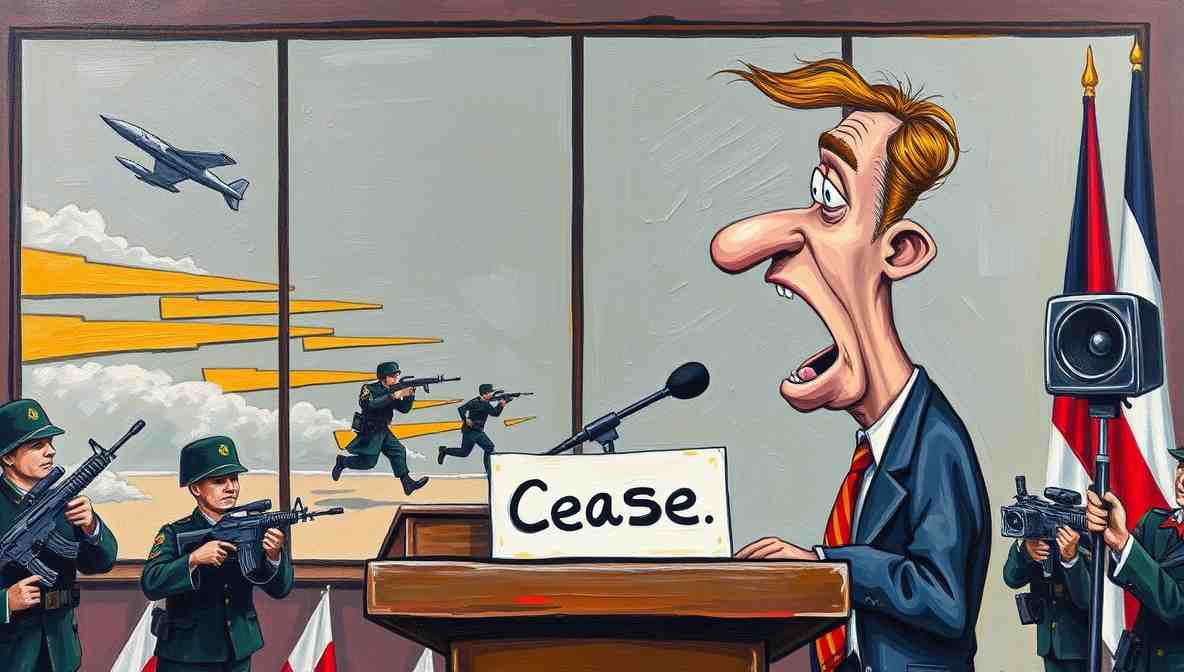
The Middle East Now Runs on a Schedule of Breaking News Every 7 Minutes, Like a Microwave With Anxiety
Scientists Confirm: The News Cycle Has Replaced the Clock in Several Capitals
WASHINGTON / ISLAMABAD — Researchers at the Institute for People Who Study Things That Are Obviously True have confirmed what the rest of us figured out sometime around 11:42 a.m. Tuesday: the Middle East no longer operates on a standard 24-hour clock. It operates on a 7-minute breaking news interval, approximately the same rhythm as a microwave with unresolved emotional issues.
The US-Iran ceasefire announced on April 8, 2026 — brokered by Pakistan after 40 days of conflict that included airstrikes, missile exchanges, and the closure of the Strait of Hormuz — lasted a full 11 minutes before both sides began technically violating it. This set a personal record, beating the previous best of 9 minutes set during an incident no one remembers because something else happened.
The 7-Minute News Interval: A Technical Breakdown
Breaking news alerts from the region now arrive at such frequency that cable networks have abandoned the concept of “anchor” and replaced it with “rotating spokesperson who was just handed a different card.” CNN, MSNBC, and Fox News have all quietly converted their graphics departments into something resembling a Vegas scoreboard — numbers changing, arrows pointing in new directions, and everyone in the building moving fast for reasons that cannot be fully explained.
On April 11, 2026, Vice President JD Vance sat in Islamabad for 21 hours of negotiations with Iranian officials. During that same period, the following also happened: Israel struck Lebanon three times, Hezbollah fired rockets into northern Israel, Iran’s new Supreme Leader declared victory, Trump posted eleven things on Truth Social including one that threatened a “full naval blockade,” and the Dow Jones moved in four different directions. All of this was breaking news. All of it arrived within 7-minute intervals. Most of it contradicted the previous thing.
The Microwave Comparison: More Accurate Than It Sounds
The microwave metaphor is actually generous. A microwave, when it beeps, has finished something. The Middle East news cycle beeps to announce that something is happening, then beeps again 7 minutes later to announce that the thing is different now, then beeps a third time to announce that the original beep was based on incomplete information, and a fourth time to note that a spokesperson has characterized the third beep as “unhelpful.”
Pakistan’s Prime Minister Shehbaz Sharif brokered the ceasefire on a Wednesday and had already issued three separate statements about its current status by Thursday morning. Iran’s Supreme National Security Council described the same ceasefire as “an enduring defeat for Washington.” Trump called it a “total and complete victory.” Vance called it a “fragile truce.” These are technically descriptions of the same agreement. They were all issued within the same news cycle. The microwave beeped for all of them.
Expert Analysts: Confident About Whatever Just Changed
Military analysts have responded to the 7-minute news cycle by becoming extremely confident extremely quickly. CNN’s panel on April 11 issued four different assessments of the Islamabad talks between 9 a.m. and noon, each one delivered with identical authority. A former Pentagon official explained at 9:07 that the talks were “progressing well.” By 9:14, a different former Pentagon official explained they were “stalling.” At 10:02, a regional specialist noted that Iran “typically moves slowly in negotiations.” At 10:09, a different regional specialist noted that Iran had “moved surprisingly quickly.” Both were right. This is the gift of the 7-minute cycle: everyone is always right, just never at the same time.
The BBC, maintaining its institutional composure, described the situation as “ongoing.” This has been the BBC’s description since February 28. It remains, technically, correct.
The Strait of Hormuz: Opened, Closed, Opening, Mostly Closed, Under New Management
The Strait of Hormuz, through which approximately 20% of global oil supply passes, has been officially reopened, unofficially closed, partially reopened, used as a bargaining chip, threatened with a blockade by the country that wants it open, and declared “entering a new phase” by Iran’s new leadership — all within the same two-week ceasefire period. As of Thursday morning, nine ships had transited in 24 hours, while 600 vessels remained stuck in the Gulf. The microwave, as they say, is still beeping.
Shipping executives told CNN they would wait before sending tankers through, because trusting a ceasefire that’s already been violated by both sides, in a strait controlled by a country threatening to “take revenge,” while a third country continues bombing a fourth country in the same region, requires a risk tolerance most insurance actuaries are not prepared to assign a number to.
How to Survive the 7-Minute News Cycle
Experts — the kind who appear on panels, not the kind who predicted any of this — recommend the following strategies for consuming Middle East news at its current velocity:
Wait 14 minutes before forwarding anything. Two news cycles is enough time for the original claim to either be confirmed, denied, revised, or superseded by something that makes it irrelevant. This will reduce your forwarding by approximately 94%.
Treat ceasefire announcements like weather forecasts. Accurate for the next hour. Use accordingly.
Do not ask “so what happens next?” What happens next is breaking news. You will find out in 7 minutes. Or 3. It depends on whether Hezbollah has done something in the interval.
In the meantime, the microwave continues to beep. Iran has delivered a new response. Vance has boarded Air Force Two. Trump has posted again. Netanyahu has held a press conference to explain what he is and is not doing in Lebanon. Three more ships have attempted the Strait. Two turned back after unspecified warnings. The ceasefire is described as “holding, technically.” Someone somewhere is finishing a statement that will be outdated before the period is typed.
The next breaking news alert will arrive in approximately 7 minutes. The one after that sooner.
The real story behind all the beeping: On February 28, 2026, the United States and Israel launched air strikes against Iran, killing Supreme Leader Ayatollah Ali Khamenei and targeting military and nuclear infrastructure. Iran responded with missile strikes on Israel and US bases and closed the Strait of Hormuz, triggering the largest oil supply disruption on record. After 40 days of conflict, Pakistan brokered a two-week ceasefire on April 8. JD Vance led a US delegation to Islamabad for talks but left April 12 with no deal reached, as Iran rejected the US framework and the nuclear enrichment question remained unresolved. The ceasefire’s status, as of this writing, is officially described as “fragile.” The microwave concurs.
Auf Wiedersehen, amigo!
