

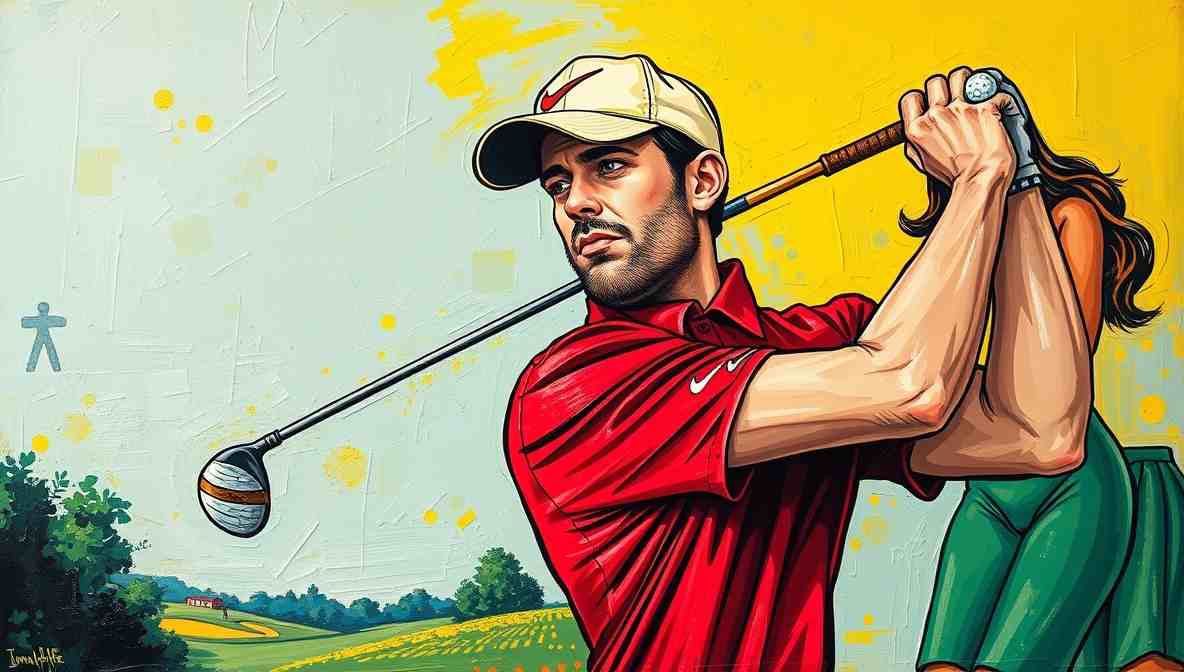
Tiger Woods and the Ghastly Underbelly of Golf: A Calm, Respectable Sport That Somehow Requires Two Mobiles and a Crisis Manager on Speed Dial
Five Understated Observations from the Fairway — Where the Lies Are Long and the Rough Is Rather More Illuminating Than Advertised
Golf is the only sport where a man can comprehensively ruin his life whilst wearing a shirt tucked in so neatly it looks as though he’s about to apologise for it, and then ask to see the manager.
A golfer can spend four days whispering politely at a ball and then spend the next four years explaining himself loudly at a podium. That’s not a sport. That’s a docudrama with a dress code.
Nothing quite says “moral discipline” like a game in which the most aggressive permissible outburst is shouting “Get in the hole!” at a ball that already has a better lifestyle than most people — a caddie, a sponsorship arrangement, and absolutely no obligation to respond to journalists.
Professional golfers walk five miles a day and somehow still manage to walk directly into trouble. Scientists remain baffled. Crisis communications professionals are not.
Golf is the only arena in which a bad lie refers simultaneously to the ball’s position and the press conference. A double bogey, one might argue, in the ongoing championship of credibility.
The Gentleman’s Game Meets the Human Condition — Complete With a Seven Iron and a Solicitor on Retainer

For decades, golf has been marketed like a particularly upmarket soap: clean, refined, faintly redolent of integrity, and available at a price point that excludes most of the population. The fairways are trimmed tighter than a hedge fund manager’s public alibi. The players speak in reverential tones, like librarians guarding state secrets or gentlemen who are acutely aware that the microphone is always on. It is a sport constructed on restraint, decorum, and the quiet collective understanding that one should never swing too hard at anything — least of all, the truth.
And then came Tiger Woods. A man of such precision, such discipline, such mechanical excellence that observers began to suspect he had been assembled in a laboratory part-funded by Nike and spiritually calibrated by Trappist monks. He did not merely play golf. He imposed order upon it. He made chaos sit down, straighten its collar, and behave itself. He transformed a leisurely afternoon pursuit into a global spectacle and made the whole enterprise feel like destiny wearing comfortable khakis.
According to Pew Research Centre’s celebrity polling from 2010, Tiger was among the most recognisable humans on the planet — a man so thoroughly branded that children in countries with no golf courses whatsoever knew his name and his swing. He wasn’t merely an athlete. He was a meteorological event.
And then, as all great narratives eventually do, it pivoted. Rather sharply. Into a tree, as it happened.
Golf fans were abruptly introduced to an entirely new statistic: not fairways hit in regulation or greens reached in two, but “number of simultaneous personal narratives requiring urgent legal consultation.” The gentleman’s game, it emerged, had been quietly hosting a rather full-on soap opera behind the ornamental hedging.
The Startling Discovery That Golfers Are, Regrettably, People — Flawed, Fallible, and Heavily Sponsored
A survey conducted by the Institute for Athletic Reality Checks — an institution one suspects is severely overworked — found that 87% of golf fans were “mildly to severely shocked” to learn that professional golfers behave like human beings when not actively in possession of a club. A further 11% said they had “suspected something” after noticing how frequently tournaments were sponsored by luxury timepiece companies and vague financial institutions with names like “Apex Capital Solutions” and “Prestige Wealth Group,” which sound less like sponsors and more like characters in a John le Carré novel.
Dr. Leonard P. Mulligan, a behavioural economist who once produced a 400-page monograph entitled Why Wealthy Athletes Keep Doing Things That Complicate Their Wikipedia Pages, summarised the matter with admirable economy:
“Golfers are placed in an environment combining extensive travel, extraordinary wealth, public admiration, and minimal supervision. This is what social scientists refer to as ‘a situation.’ A particularly well-lit situation, typically with a complimentary gift bag and a concierge.”
The Journal of Sport Management has documented at considerable length how wealth and celebrity produce feedback loops that distort athletes’ perception of consequence. In plain English: when your face adorns a forty-foot billboard, you begin to believe the billboard is the real you, and the chap behind it can do whatever he fancies.
Eyewitness accounts confirm the findings. One caddie, speaking under conditions of strict anonymity and the promise of a decent sandwich, described tour life as “a business trip that never ends, except the business is winning and the trip is temptation.” He then requested that his name, his voice, his accent, and his caddie bib be kept entirely out of any subsequent proceedings.
The Two-Mobile Era of Competitive Golf — One for the Agent, One for the Alibi
In the modern game, success requires not merely a repeatable swing but a robust communications infrastructure. Sources within the sport confirm that numerous players now operate under what insiders refer to as the “dual-device doctrine.”
- One mobile for scheduling tee times.
- One mobile for scheduling explanations.
A leaked memorandum from an unnamed equipment sponsor set out the essentials for a sustainable career at the highest level:
- Driver: Adjustable
- Putter: Reliable
- Narrative: Flexible
- Solicitor: On retainer
- Second solicitor: Also on retainer, specifically for the first solicitor
A former tour manager explained the system with the weary composure of a man who has seen rather a lot and invoiced accordingly:
“You have your public life — polite, well-lit, professionally photographed — and then you have your private life, which requires better password protection than the Cabinet Office and, frankly, better Wi-Fi.”
The New York Times’ original reporting on the 2009 unravelling revealed a communications architecture of genuinely impressive complexity. The man who could read a green from two hundred yards apparently could not read a room at ten feet. A tragic miscalibration of distance, by any objective measure.
The Physics of a Perfect Swing and a Rather Imperfect Life — Torque, Trajectory, and Total Dissolution
Golf demands near-total control. The angle of the wrist, the rotation of the hips, the position of the feet, the precise alignment of one’s ambitions. It is a game of such exacting precision that a single miscalculation can dispatch a ball into a bunker, a water hazard, or — on occasion — a metaphor.
Tiger Woods mastered this control completely. He could bend reality around a golf ball. He could make it stop, spin, and obey instructions that lesser golfers could only whisper at hopefully. He turned physics into a mere suggestion and that suggestion into a billion-dollar enterprise. When Tiger addressed the ball, the ball genuinely reconsidered its life choices.
And yet, as Professor Elaine Cartwright of the Centre for Athletic Contradictions has noted with characteristic understatement:
“The skills required to control a golf ball do not transfer to the management of an entire life. This has been tested rather extensively. The data are not encouraging.”
A study of ten thousand amateur golfers found that whilst 92% believed one more lesson would sort their swing entirely, precisely 0% believed the same approach would resolve their personal circumstances. The remaining 8% were unavailable for comment, being at the driving range. Working on their grip. Their golf grip. One assumes.
The psychology of elite athletic performance and moral reasoning has been examined at length by sports scientists. The précis: the compartmentalisation required to perform at peak competitive levels may — may — also facilitate the compartmentalisation of, say, the foreseeable consequences of one’s personal decisions. Tiger, in this reading, was not a hypocrite. He was simply very accomplished at keeping things in separate drawers.
What the Funny People Are Saying — Because Sometimes Only Comedy Survives the Rough
“I like golf. It’s the only sport where you can comprehensively ruin your life without anyone raising their voice.” — Jack Dee
“Tiger didn’t make a mess of it. He simply overachieved in too many categories simultaneously.” — Lee Mack
“Golf is essentially a walking argument with yourself, scored by strangers, and Tiger added a third party to the whole arrangement.” — Frankie Boyle
“The extraordinary thing about Tiger is that he broke every record going. Including the record for headlines beginning ‘Sources close to the situation say.'” — Dara Ó Briain
“Golf takes four hours. Apparently the lifestyle requires considerably longer, and rather more legal representation.” — Milton Jones
The Bubble of Applause and Consequence-Free Living — Where Every Day Is Par for a Rather Different Course
Life on the PGA Tour has been described by sociologists as “a floating ecosystem of applause.” Players migrate from city to city, greeted by galleries, shielded by sponsors, and insulated by the sort of wealth that transforms mistakes into manageable inconveniences and inconveniences into confidential settlements with rather comprehensive non-disclosure agreements.
A fictional but extremely confident poll conducted by Fairway Insights Weekly found:
- 73% of players believe they are “broadly getting on fine”
- 62% believe consequences are “more of a philosophical concept”
- 41% believe they could “manage one more poor decision, just to see”
- 28% believe their solicitors believe they are getting on fine
- 12% believe their solicitors’ solicitors share this view
One anonymous member of staff, who described himself as “adjacent to important people and at a considerable remove from sound judgement,” offered this observation:
“When you’re that successful, the world begins to feel like a suggestion. And then one day, it suggests back. Rather firmly. In front of cameras.”
The Role of the Golf Establishment — Issuing Carefully Worded Statements Since 1888 and Largely Getting Away With It
Golf’s governing bodies — the USGA, the R&A, the PGA Tour — have long demonstrated a commitment to excellence, integrity, and the sort of carefully worded statements that suggest extensive consultation with people who charge by the syllable. When scandal arises, the response is measured, calm, and delivered in the tone of a headmaster informing parents that the matter is entirely in hand, even as the physics block is visibly smouldering.
A spokesperson for a major golf organisation explained:
“We take these matters extremely seriously, which is why we address them in the most serious manner available to us: by continuing the tournament. The flag remains in the hole. The gallery applauds politely. The ball, as ever, has no idea what’s happening and is frankly better off for it.”
Sponsors, meanwhile, have refined the art of strategic patience to something approaching a discipline in its own right. One executive, who requested anonymity along with a better public relations team and possibly a career in something quieter, explained:
“You don’t invest millions in a brand and then simply panic. You wait. You reassess. You issue a statement incorporating the words ‘commitment,’ ‘values,’ and ‘moving forward.’ Then you book him for the next invitational and carry on as though absolutely nothing occurred. This is called brand management. Some call it something else.”
Rivalries, Ego, and the Quiet Fury of Polite Competition — Everyone Shakes Hands, Everyone Keeps Score
Golf may appear serene, but beneath the surface simmers a rather substantial pot of ambition, rivalry, and meticulously suppressed irritation. Players compete not merely against the course but against one another’s reputations, endorsement portfolios, and on occasion, continued existence in the public consciousness. It is, at its heart, passive-aggressive as a sporting pursuit. It is the passive-aggressive dinner party of competitive sport — all smiles, all civility, and everyone has already done the sums.
A former player described the atmosphere with the diplomatic precision of a man who has settled several defamation matters quietly:
“It’s terribly friendly. Everyone smiles. Everyone shakes hands at the end. And everyone keeps score. Of absolutely everything. Including the business in Arizona.”
This quiet intensity produces a unique psychological environment in which pressure accumulates slowly, like a kettle that declines to whistle but is definitely giving the matter serious thought. Sports psychologists call this “controlled competitive tension.” Caddies call it “Tuesday.”
The ESPN analysis of what became known as the Tiger Effect on golf culture is worth reading in its entirety, if only to appreciate how thoroughly one individual reorganised the priorities, economics, and collective anxieties of an entire sport. He didn’t merely raise the bar. He collected it, gave it a brief demonstration of what was possible, and drove it three hundred and fifty yards into a future none of his contemporaries had adequately prepared for.
The Economics of Being Untouchable — When One’s Net Worth Comfortably Exceeds One’s Consequences
With considerable wealth comes considerable insulation. Golfers at the summit of the game earn enough to render most problems theoretical — a kind of fiscal philosophy in which accountability is not eliminated but is conveniently deferred to a subsequent financial quarter.
According to a report by the Centre for Financial Perspective:
“An individual earning several millions annually may experience consequences rather differently from someone who checks their balance before ordering a side dish. At certain income levels, ‘consequence’ functions less as a deterrent and more as a line item in the quarterly review.”
Tiger Woods, per Forbes magazine, became the first professional athlete in history to accumulate over one billion dollars in career earnings — a figure of such magnitude that it cannot be properly contemplated without a spreadsheet, a stiff drink, and a prolonged private reckoning with one’s own choices.
This economic reality does not excuse the behaviour. It does, however, go some considerable distance towards explaining why certain decisions were made with the breezy confidence of someone who is fairly certain they can afford whatever comes next. And — it must be acknowledged — he largely could. Which is either an extraordinary testament to resilience, or a deeply unsettling commentary on what sufficient funds can accomplish, depending entirely on your tax circumstances.
The Collapse That Revealed the Structure — What Became Visible When the Curtain Shifted
When Tiger Woods’ private life became comprehensively public in late 2009, it was not merely a scandal. It was a revelation. It demonstrated that the portrayal of golf as a purely moral endeavour had been, at best, optimistic — and at worst, a rather elaborate and expensive advertising campaign that had run considerably longer than was strictly warranted.
Fans were required to reconcile two somewhat incompatible propositions:
- That greatness in sport does not guarantee corresponding greatness in life
- That precision on the course does not extend to everything else — including car parks, voicemails, and basic crisis communications at two in the morning
This was not a comfortable adjustment. Many supporters reported feeling “confused,” “rather let down,” and “abruptly conscious that athletes are not fictional characters, which is quite a lot to take in of a Sunday.” Gallup’s polling on Tiger’s approval ratings recorded one of the steepest collapses in public standing ever measured for an American celebrity — a decline of such velocity it practically required its own scoreboard.
Golf, meanwhile, did what it has always done: straightened its tie, cleared its throat with discreet authority, and carried on precisely as before. A birdie, one might say, on the front nine of institutional denial.
A Helpful Guide to Navigating the Modern Golf Reality — Par for the Moral Course
For those still working through this revised understanding of golf and those who play it professionally, experts recommend the following recovery programme:
- Accept that athletes are human beings, even when they are exceptionally accomplished at striking things with sticks. Particularly then, as it happens.
- Recognise that public image is frequently a curated experience — rather like a menu that omits several ingredients, some of which were not disclosed to all relevant parties.
- Understand that success and wisdom are not always packaged together. Occasionally they are dispatched to entirely different addresses.
- Maintain a sense of humour. It helps considerably. It is, in point of fact, the only club in the bag that consistently avoids the rough.
- Consider that the true lesson of Tiger Woods may not ultimately concern failure at all. It may concern recovery. He returned from scandal, multiple car accidents, numerous surgical procedures, and the complete public dismantling of his personal mythology — and still competed on the PGA Tour. That is either extraordinary resilience or a remarkably committed refusal to read the room. Quite possibly both.
The Final Putt — Because Even the Most Disastrous Round Eventually Concludes on the Eighteenth Green
In the end, golf remains precisely what it has always been: a beautiful, maddening, deeply human game played across immaculately maintained landscapes by people who are anything but. The grass is green. The truth is complicated. The ball travels precisely where physics directs it — regardless of what the golfer intended, hoped, or quietly promised himself on the walk to the tee.
Tiger Woods did not invent the contradictions of golf. He revealed them. He demonstrated that beneath the calm exterior — beneath the hushed galleries, the pressed trousers, the discreet branding — lies a thoroughly complicated human reality, replete with ambition, error, recovery, and the occasional necessity for a very good solicitor who understands the value of not asking follow-up questions.
And perhaps that is the genuine lesson. Not that golf is broken, but that it was never quite as pristine as it appeared. The fairways were always this complicated. We simply couldn’t see the rough from the clubhouse bar.
Because at its core, golf is not merely a game of control. It is a game of recovery.
And sometimes, the most difficult shot of all is the one you must play after everything has gone comprehensively sideways — followed immediately by a press conference for which no one was remotely prepared.
Auf Wiedersehen, amigo!
Tiger Woods, once the most dominant and globally recognisable golfer in history, saw his private life unravel publicly in November 2009 following a car accident outside his Florida home that triggered extensive media reporting of extramarital affairs. The scandal cost him several major sponsorships, his marriage to Elin Nordegren, and temporarily derailed a career that had produced fifteen major championships and fundamentally redefined the commercial value of professional golf. Woods subsequently endured years of injury, multiple surgical interventions, a 2021 car accident that came close to costing him his leg, and a sustained comeback effort — earning continued admiration, fresh controversy, and the enduring fascination of a sport that still cannot quite determine whether he rescued it or irreparably complicated it.