

Trump Debuts “Digital Divinity Strategy,” Leaves Vatican Scrambling for Wi-Fi
Published April 13, 2026 — Orthodox Easter Sunday. Timing is everything.
In what insiders are calling the boldest rebrand since water became “hydration,” Donald Trump unveiled a new communications strategy on Orthodox Easter Sunday: skip the sermon, go straight to the miracle.
The moment came shortly after Trump blasted Pope Leo XIV on Truth Social, calling him “WEAK on Crime, and terrible for Foreign Policy” — a disagreement rooted in tensions over the Iran war, immigration, and whether global diplomacy should include fewer missiles and more group chats. The Pope, for his part, had warned the previous day that a “delusion of omnipotence” was fueling the conflict — without naming the President. He didn’t have to.
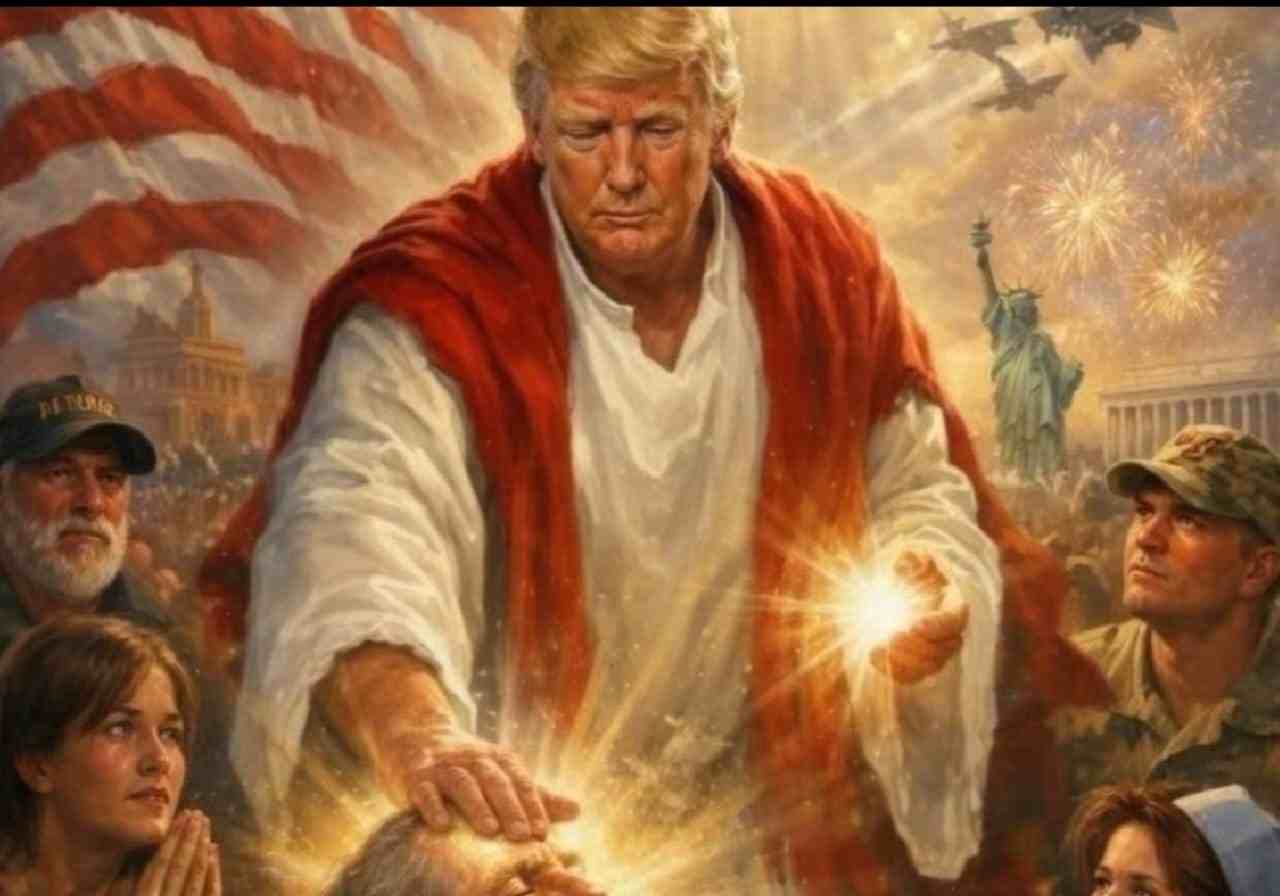
Then, like a man flipping from debate mode to Renaissance painter in under 30 seconds, Trump posted an AI-generated image of himself as Jesus Christ performing a miracle — healing what many observers believed was either a wounded veteran or, in a twist that writes its own punchline, a man resembling Jeffrey Epstein — surrounded by nurses, soldiers, bald eagles, warplanes, the Statue of Liberty, the Lincoln Memorial, and what appears to be a US flag ascendant over the gates of heaven.
And just like that, politics entered its stained-glass era.
Trump finally found a miracle faster than Congress finds gridlock: Photoshop with Wi-Fi.
The first commandment now reads: Thou shalt not post before checking the comment section.
Somewhere in history, a Renaissance painter just rolled over in his grave and said, “I suffered for this?”
The Miracle Economy: Faster, Sharper, and Fully Rendered
According to Dr. Leonard Bibbins, a senior fellow at the Institute for Strategic Optics and Lighting Effects, the move represents a breakthrough in what he calls “Instant Symbolic Authority.”

Historically, leaders had to wait decades for myth-building,” Bibbins explained while adjusting a pair of glasses that were clearly just for emphasis. “Trump has reduced that timeline to about 12 seconds and a decent GPU.”
Eyewitness reports confirm the post immediately achieved what most policy papers cannot: total engagement. Even staunch Trump ally Marjorie Taylor Greene — now a Trump critic and leader of the America First movement after the President withdrew his support for her — weighed in on Orthodox Easter, declaring that Trump had posted the image “as if he is replacing Jesus.”
“I didn’t know what I believed before,” said Carla Jenkins, a freelance substitute yoga instructor and part-time political analyst. “But when I saw that image… I thought, well, at least he’s confident.”
Confidence, experts agree, has become the new currency of leadership.
AI has officially entered its “Biblical DLC expansion pack” phase. The Pope preaches humility; Trump uploads high-resolution humility with better lighting. The Sermon on the Mount is now sponsored by Truth Social Premium+.
Vatican Responds With Strongly Worded Silence
Inside Vatican City, sources describe a mixture of confusion, concern, and someone asking if they could “turn AI off globally.”
An anonymous staffer (who insisted on being identified only as “Giuseppe, but not that Giuseppe”) described the mood:
“We spent 2,000 years building symbolic imagery. This man downloaded an app.”
Pope Leo XIV — the first American-born pontiff, hailing from Chicago — had presided over an evening prayer vigil on Saturday as US-Iran ceasefire negotiations were underway in Pakistan. He called for peace without naming names. The Pope said prayers can “break the demonic cycle of evil,” and that the kingdom of God recognizes “no sword, no drone, no vengeance.” He then presumably went to sleep, unaware that by Sunday morning he’d be called “WEAK” on Truth Social before brunch.
Trump’s Truth Social post also claimed he personally deserves credit for Leo becoming pope at all. “If I wasn’t in the White House, Leo wouldn’t be in the Vatican,” Trump wrote — a theological position not previously recognized by the College of Cardinals, but one that does raise interesting questions about apostolic succession in the MAGA era.
The Vatican deals in centuries. Trump deals in seconds and shares. Which, according to one political consultant, “puts the Pope at a serious disadvantage in the meme economy.”
Polling Shows Americans Prefer Miracles That Load Quickly
A new poll conducted by the American Institute of Sudden Opinions found:
- 62% of Americans believe miracles should be available in high definition
- 48% said they trust AI-generated leadership imagery “as long as it looks confident”
- 27% admitted they briefly forgot how theology works
Lead researcher Dr. Hannah Kline summarized the findings: “We are witnessing the merger of faith, politics, and content creation. It’s no longer about belief. It’s about shareability.”
America has reached peak confidence: we now generate our own prophets. Even miracles now require engagement metrics. The difference between divine intervention and AI is about 3 clicks and a prompt.
What the Funny People Are Saying
“I grew up thinking you had to walk on water to be impressive. Now you just need a good filter.” — Jerry Seinfeld
“You ever notice how every politician eventually becomes a preacher? This one just skipped the middleman.” — Ron White
“I’m not saying he thinks he’s Jesus… but Jesus never had this kind of branding team.” — Sarah Silverman
Cause and Effect: When AI Meets Ego Meets Wi-Fi
Definition: A miracle is traditionally understood as a divine act beyond natural explanation.
Updated Definition: A miracle is now a well-rendered JPEG with strong lighting and confident posture.
Cause: Technological advancement in AI image generation.
Effect: Leaders no longer need divine endorsement. They can generate it.
Analogy: If ancient kings had access to AI, history textbooks would just be a gallery.
Deductive reasoning suggests this trend will continue. Pew Research has documented the deepening merger of political and religious identity in America — but even Pew didn’t account for AI-generated resurrection imagery as a campaign tactic. By 2030, experts predict: entire campaigns conducted through AI-generated parables, political debates replaced by cinematic trailers, and fact-checkers replaced by lighting editors.
The Real Feud: Old Authority vs. New Authority
At its core, this isn’t just a disagreement between Trump and the Pope. It’s a clash between two models of influence:
One built on tradition, patience, and moral consistency. The other built on immediacy, spectacle, and algorithmic reach.
One speaks in centuries. The other posts in seconds.
And in today’s social media landscape, seconds tend to win. “Turn the other cheek” has been reinterpreted as “post another image.” Political messaging has evolved from speeches to concept art. If Michelangelo had MidJourney, the Sistine Chapel would’ve had push notifications.
Faith, politics, and AI have merged into one powerful new religion: Branding.
A Personal Reflection from the Field
I spoke to a man outside a diner who claimed to have seen “at least three miracles this week, all on his phone.”
“They were clearer than real life,” he said. “And none of them asked me to donate.”
He paused, took a sip of coffee, and added: “Honestly, if Moses had Wi-Fi, we’d still be wandering.”
The New Gospel According to Bandwidth
In the end, what Trump demonstrated on this Orthodox Easter wasn’t theology. It was timing.
While others debate morality, he uploads certainty. While institutions deliberate, he renders.
And in a world that scrolls faster than it reflects, that might just be the most powerful miracle of all.
The real miracle is that everyone instantly understood the joke and still argued about it.
On April 13, 2026 — Orthodox Easter Sunday — Donald Trump called Pope Leo XIV “WEAK on Crime and terrible for Foreign Policy,” then posted an AI-generated image of himself as Jesus Christ performing a healing miracle, surrounded by American flags, warplanes, and bald eagles. The image came roughly 45 minutes after his Truth Social rant against the Chicago-born pontiff, who had delivered a peace vigil the previous day criticizing what he called a “delusion of omnipotence” fueling the US-Iran war. Pope Leo XIV, elected in 2025 as the first American-born pope, has carefully avoided naming Trump directly while consistently calling for an end to US military action in Iran and criticizing the administration’s immigration policies. The AI image drew condemnation from religious groups, political commentators, and even former Trump ally Marjorie Taylor Greene, who said the President appeared to be “replacing Jesus.”
Auf Wiedersehen, amigo!
This satirical article is entirely a human collaboration between two sentient beings — the world’s oldest tenured professor and a philosophy major turned dairy farmer — who briefly considered turning water into wine but settled for turning headlines into comedy instead. No doctrines were harmed, though several group chats were deeply divided.