

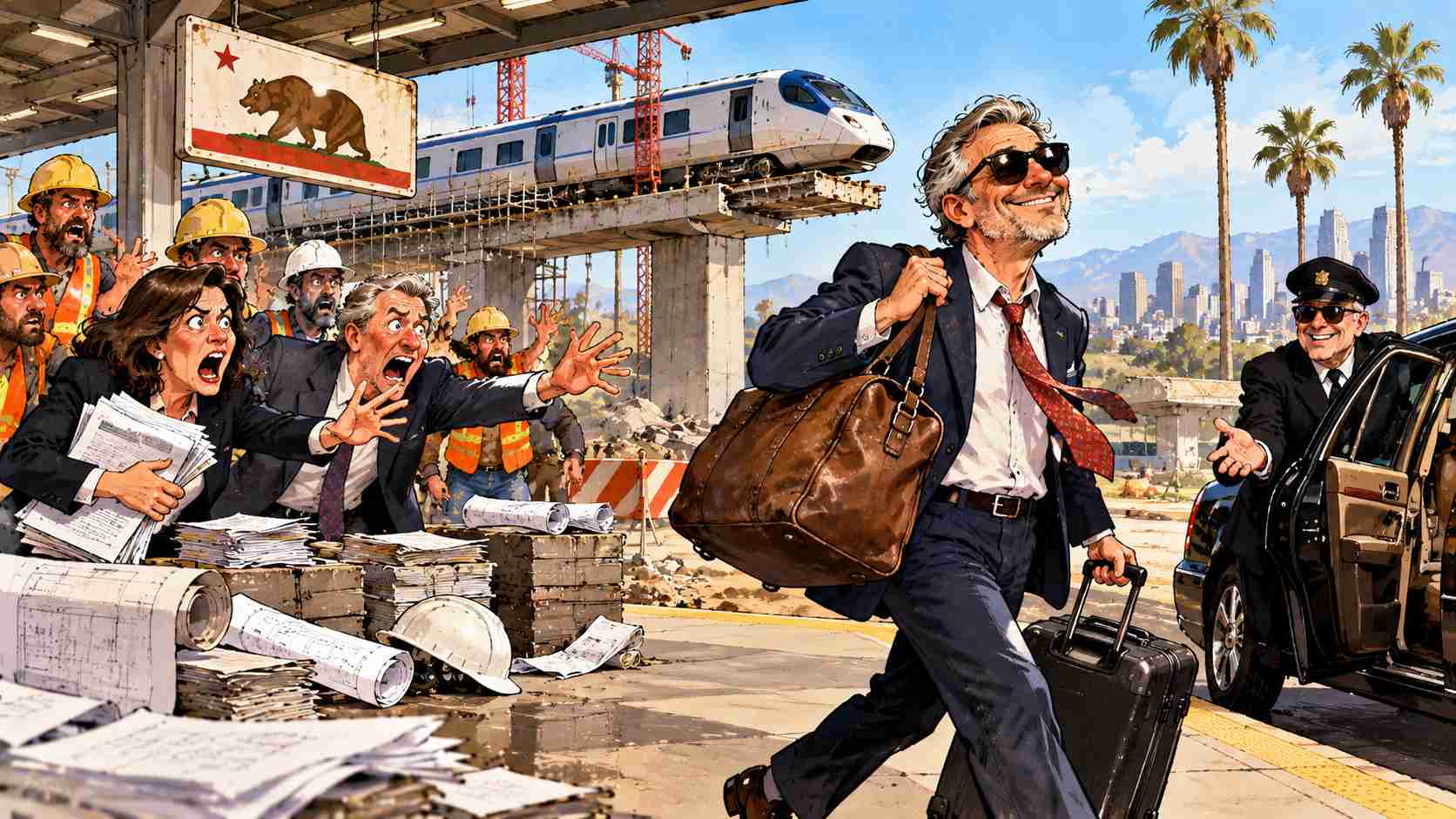
Bullet Train Boss Departs. Consultants Keep the Minibar Receipts.
SACRAMENTO, California — The chief executive of California’s high-speed rail project has resigned, achieving something that has eluded his organization for years: a successful departure.
California High-Speed Rail CEO Ian Choudri Steps Down
Ian Choudri stepped down amid mounting pressure over delays, funding troubles and consultant expenses. According to CalMatters’ investigation, inspectors identified nearly $600,000 in questionable taxpayer-funded travel. At least someone associated with California’s transportation revolution has been moving around the country.
The scandal included consultant trips involving premium transportation, restaurants, a cigar lounge and an escape room. An escape room! California hired people to build a railway, and they apparently needed professional assistance escaping a locked space. This may explain why the train has been struggling to leave the drawing board.
The Expense Report, Line by Line
A photocopy of one consultant’s expense report, handed to a reporter in a parking structure by a person who declined to give a name or a floor, listed a $212 dinner described as “stakeholder alignment,” a $64 cigar entry coded “ambient research,” and a $39 escape-room ticket filed under “contingency planning.” A margin note from an auditor read only, “Did they escape?” The attached receipt did not say.
A railway enthusiast in Fresno offered a simple assessment: “For that much money, I expect the consultants to arrive on an actual train.” His neighbor disagreed. “First they have to figure out which end goes forward.”
Why the California Bullet Train Keeps Missing Its Schedule
California dreamed of whisking passengers between major cities at magnificent speeds. Instead it created the first transportation system in which the passengers age faster than the infrastructure. A baby born when planning began can now attend meetings about why the baby cannot take a train to college.
The project’s defenders correctly point out that construction is happening and major engineering, environmental and land-acquisition hurdles are real. Those are serious challenges. Yet they become slightly harder to explain when taxpayers hear that a consultant needed an expensive trip to an escape room while the project needed an escape from consultants.
The California High-Speed Rail Authority says construction continues across the Central Valley, and the state’s Legislative Analyst’s Office has spent years reminding everyone what the project costs. Nobody has yet found a way to fold the reports into a train.
State officials have also approved a contract for three high-speed trainsets, with testing planned later in the decade. Buying trains before passengers can ride them seems sensible by California standards. It is a considerable improvement over buying passengers and hoping a railroad eventually appears.
What the Board Minutes Say
Minutes from a recent state briefing record four performance measures: miles of track, dollars spent, consultants entertained and governors photographed near safety helmets. The first category lagged behind expectations. The other three enjoyed record-breaking enthusiasm. Under “other business,” the minutes note that a motion to define the word “ahead” was tabled until after lunch.
A Transportation Economist Weighs In
“Most megaprojects run over budget,” said a transportation economist who studies large public works and asked that her university not be named, because it also has a parking garage. “What’s unusual here is the cigar lounge. In thirty years I’ve never seen a rail budget with a humidor.”
The Traditional Railway Model vs. the California Model
To appreciate the scale of California’s ambitions, consider the traditional railway model. First you build a line. Then you sell tickets. Finally you provide a snack that tastes like its packaging. California has explored an alternative: hold hearings, commission reports, litigate routes, announce victories, and periodically remind everyone that trains are a wonderful idea.
The new chief executive will inherit an unenviable task. He must balance politics, engineering, budgets and public confidence, while ensuring that travel expenses are used for travel that somehow relates to trains.
The state’s greatest transportation breakthrough may come when someone establishes that the shortest distance between two California cities is not through a consultant’s minibar.
5 Humorous Observations About the California Bullet Train
- They’ve been building this thing since I had hair. I’ve watched a whole generation of kids grow up, get a driver’s license and sit in traffic next to the train that doesn’t exist yet. That’s not a transportation project, that’s a long-distance relationship with a concrete pillar.
- An escape room. They paid to be locked in a room and solve puzzles to get out. Folks, that’s the project. They already live in an escape room. It’s got a budget and a press office.
- Cigar lounge, I get. Everybody has a rough week. But you can’t write “cigar” on an expense form and expect the state of California to go, “Ah, rail research.” That’s a guy who’s never lied on a form before, and honestly I respect the honesty.
- Every other country builds a bullet train and it shows up. Japan did it in the sixties. In the sixties! They had slide rules and a dream. We’ve got laptops and a consultant named Chad.
- The only fast thing about California high-speed rail is how quickly a person can resign from it. That’s the real bullet. He’s gone before the paperwork lands.