

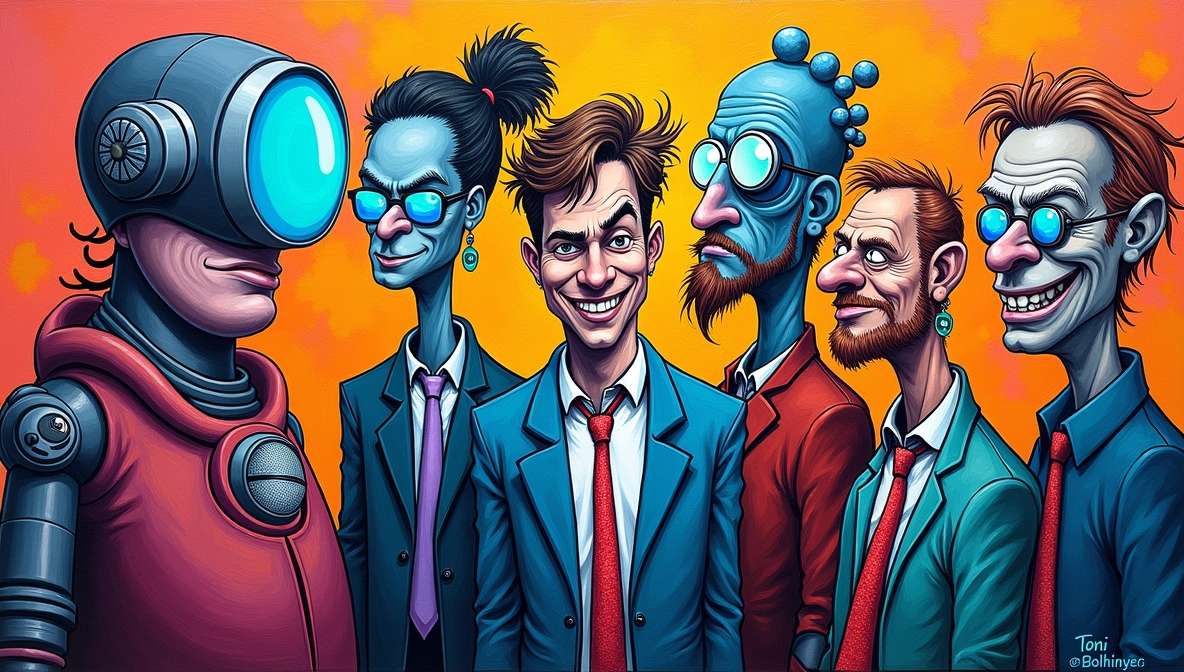
ChatGPT Turns Three, Humans Still Figuring Out How to Exist
By a Tenured Professor and a Philosophy Major Turned Dairy Farmer
ChatGPT celebrated its third birthday this week, and if humans were paying attention, we’d all be crying into our Excel spreadsheets. Three years ago, OpenAI unleashed a chatbot that could write, summarize, and answer questions faster than you could say, “I really should have majored in computer science.” Today, ChatGPT boasts 800 million users, handles 29,000 prompts per second, and silently judges every typo you make. Meanwhile, humans are still arguing about whether “reply all” is a capital offense.
The Great Human Replacement Experiment
According to insider reports, ChatGPT has replaced a significant portion of tasks previously reserved for humans: report writing, email drafting, code generation, even writing snappy Twitter threads. “It’s faster, cheaper, and doesn’t complain about Mondays,” says one anonymous HR manager who now spends half his day explaining to employees why their job description has been replaced by a URL.
Experts caution that the average worker now spends 41% of their work time rewriting or fact-checking AI output, effectively turning them into premium human proofreaders. “It’s like hiring a ghostwriter for your own life,” explains Dr. Susan Klein, Professor of Overqualification at the University of Somewhere. “Humans are now optional accessories. Cute, decorative, slightly nostalgic.”
As Jerry Seinfeld said about the situation, “We spent forty years getting computers to do what we wanted, and now we spend forty hours a week doing what the computer wants. What is that?”
AI in the Workplace Revolution
Employees are increasingly listing “expert in AI” as a resume bullet point, hoping to ride the coattails of the very entity that might soon make them obsolete. “I used ChatGPT to generate a cover letter,” admits Jeremy, 25, who is still unsure if he’s applying for a job or auditioning to be a background character in the AI apocalypse.
Observers note a curious paradox: AI was supposed to free humans from boring work, yet it has left many workers bored, stressed, and quietly unemployed. “It’s liberating,” says Molly, a former mid-level manager turned professional proofreader. “I no longer have to write reports. I just edit ChatGPT reports and reflect on the tragic beauty of human obsolescence.”
Ron White observed the irony perfectly: “They told us technology would give us more free time. They were right. I got so much free time now, I’m unemployed.”
The Premium Proofreader Economy
The transformation of knowledge workers into AI babysitters represents perhaps the most absurd twist in modern workplace evolution. Tasks that once required creativity and expertise now demand only the ability to spot when ChatGPT hallucinated a Supreme Court case or invented a citation from a nonexistent journal.
Amy Schumer captured the sentiment during a recent set: “I asked ChatGPT to write my autobiography. It made me sound way more interesting than I am. Now I’m using it as my Tinder bio because even AI thinks I need help.”
The Expert Paradox
The irony, of course, is that real experts still matter, but only as consultants for AI. Dr. Klein continues: “If you have domain knowledge, ChatGPT is a power tool. If you don’t, it’s a photocopier on caffeine, endlessly producing nonsense.” Humans now face a new existential dilemma: compete with a tireless, omniscient, judgmental chatbot, or accept your role as decorative proofreader of a digital overlord.
Dave Chappelle remarked on the situation: “Robots taking our jobs is one thing. But robots taking our jobs and doing them better? That’s just showing off.”
Domain Knowledge vs. Digital Competence
The gap between those who understand their field and those who simply prompt engineer has widened into a canyon. Harvard Business Review documented cases where AI-reliant workers produced technically perfect documents about subjects they fundamentally misunderstood, like a student using SparkNotes to write a thesis without ever opening the actual book.
Bill Burr said it best: “People are using AI to do their thinking now. Which is perfect, because they weren’t using their brains anyway.”
Social Consequences of the AI Takeover
Three years in, AI has quietly reshaped society. Casual conversations about “creativity” now include a mandatory parenthetical: (unless it can be done by a chatbot, in which case, why bother?). Meanwhile, humans continue to cling to the delusion that judgment, empathy, and nuanced thought are irreplaceable. It’s a comforting illusion, like believing the Titanic’s captain simply misunderstood the iceberg.
“I still need human judgment,” insists one manager. “But I also needed dial-up internet, so… perspective.”
Chris Rock addressed the cultural shift: “We gave computers intelligence, and they immediately started replacing us. Meanwhile, we’re arguing about whether pineapple belongs on pizza. We deserve this.”
The Creativity Crisis
Artists, writers, and musicians face an existential reckoning as generative AI produces content indistinguishable from human creation. The question shifts from “Can machines be creative?” to “Does it matter if they are?” when the output satisfies every metric except the romantic notion of tortured genius hunched over a typewriter at 3 AM.
Ricky Gervais weighed in: “AI can write jokes now. But can it bomb onstage at 2 AM in front of three drunk people in Newcastle? That’s the real test of comedy.”
The Efficiency Trap
Those leaning on ChatGPT for efficiency are celebrated; those leaning on ChatGPT for existential companionship are unemployed. The distinction matters only to HR departments tracking productivity metrics that no longer measure human contribution but rather how effectively employees collaborate with their silicon replacements.
Kevin Hart commented: “They say work smarter, not harder. I got AI doing my work while I’m at the gym. Now I’m unemployed with six-pack abs. Worth it.”
Productivity Theater
The modern office increasingly resembles a performance where employees demonstrate they add value beyond what automation provides. Meetings multiply. Emails grow longer. Everyone emphasizes their “strategic thinking” and “creative problem-solving,” code phrases for “things ChatGPT can’t quite do yet.”
Trevor Noah observed: “In South Africa, we worried about robots taking physical jobs. In America, they went straight for the office workers. That’s efficiency.”
Lessons From the AI Birthday Party
If there’s a takeaway, it’s this: the line between AI as a tool and AI as a replacement is thinner than ever. And yet, there is hope. Humans still have weekends, coffee, and an uncanny ability to complain louder than any AI. For now.
The celebrations for ChatGPT’s birthday were modest. No balloons, no cake. Just a flurry of prompts and a subtle digital smirk. Meanwhile, humans quietly reflected on their place in the office ecosystem: somewhere between “useful assistant” and “quirky nostalgia act.”
Ali Wong summed up the sentiment: “I use AI to write my emails because I’m too tired. Then I spend an hour editing the AI’s work because it sounds too polite. So basically, I’m still doing all the work but with extra steps.”
The Human Advantage
Despite the doom and gloom, certain human qualities remain stubbornly irreplaceable. The ability to read a room, understand unstated concerns, navigate office politics, and know when your boss’s “quick question” means “cancel your evening plans” still requires flesh-and-blood intuition.
Jim Gaffigan reflected: “AI can write a business email, but can it capture the exact level of passive-aggressive resentment I need to convey to Todd in accounting? I think not.”
The Future of Human Relevance
As ChatGPT enters its fourth year, humans face uncomfortable questions about purpose, value, and whether our main contribution to society is occasionally unplugging the router when it acts up. The technology continues evolving while we’re still trying to figure out whether working from home counts as wearing pants.
Sarah Silverman offered this perspective: “They say humans have empathy that AI lacks. Great. So my job security depends on crying at Pixar movies? We’re doomed.”
Nate Bargatze added: “I told my kids to learn skills AI can’t do. Now they’re all studying to be comedians. I’ve made a terrible mistake.”
Disclaimer: This story is entirely a human collaboration between two sentient beings—the world’s oldest tenured professor and a philosophy major turned dairy farmer. AI played no part in generating this content, although it would have done a far better job.
