

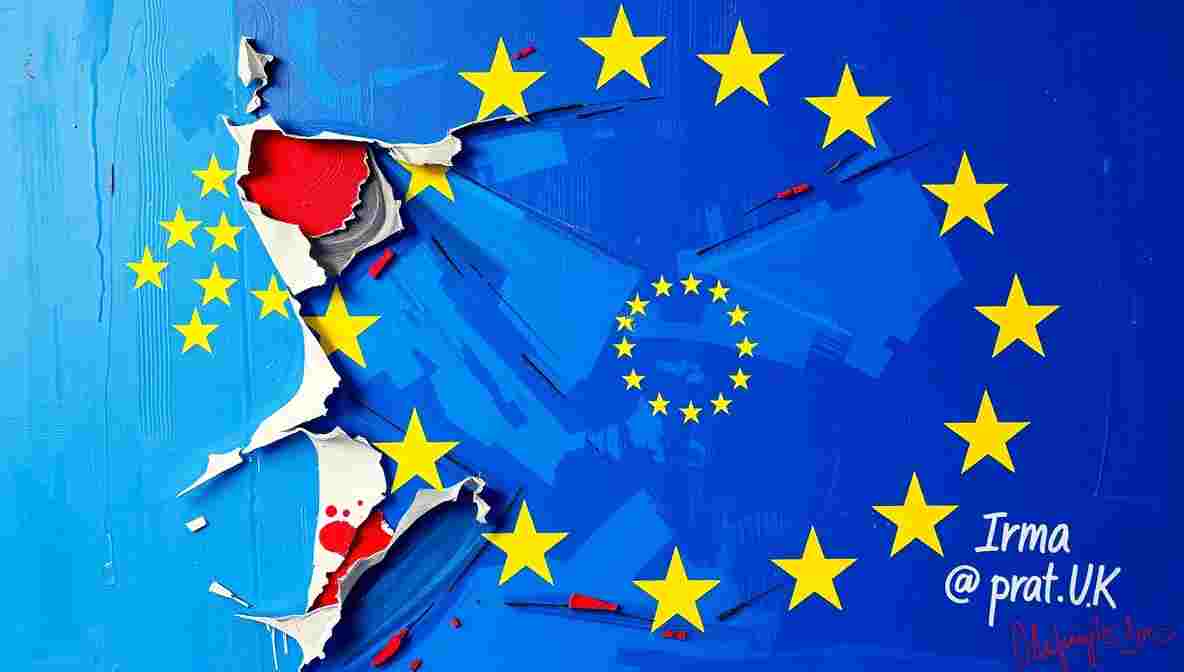
In a stunning display of transatlantic tough love, the United States has informed the European Union that access to America’s magnificent market is no longer free, fabulous, or French — it’s now firmly priced at 15%. Pay up, wear the badge, or watch your BMWs and Brie age gracefully in a container ship off the coast of New Jersey.
Europe Discovers the American Dream Has a Cover Charge
The European Union, long accustomed to lecturing America on everything from data privacy to the correct way to eat cheese, has finally been handed an invoice. The bill reads: 15% tariff on most EU exports, $750 billion in U.S. energy purchases, and $600 billion in American investments. If the EU doesn’t pay, their goods sit in a ship. Or get quarantined. Either way, not America’s problem.
Washington sources described the mood in Brussels as “somewhere between a Parisian shrug and a full German engineering meltdown.”
The Velvet Rope Policy: America’s Club Has Rules Now
For decades, European nations enjoyed the kind of access to American markets that most countries can only dream about — and paid approximately nothing for the privilege. Then came the invoice. Under the new trade framework, the EU must now cough up a 15% tariff on automobiles, pharmaceuticals, semiconductors, and basically anything with a foreign vowel in its name. Steel and aluminum? That’ll be 50%, danke schön.
European Commission President Ursula von der Leyen — who reportedly showed up to trade negotiations with a PowerPoint and a disappointed sigh — eventually agreed to the deal at Trump’s golf course in Scotland, which experts agree was a very on-brand venue for a transaction of this magnitude.
Observations From the Cheap Seats (Which Are Now Tariffed)
- The EU spent three months insisting it wouldn’t pay tariffs, then paid tariffs. This is also how most people handle gym memberships.
- America offered Europe “stability and predictability.” Europe offered America “$750 billion in energy purchases.” One of these sounds like a parent, and one sounds like a teenager who just crashed the car.
- The word “shall” does not appear anywhere in the trade agreement. Experts noted the language gets “very weak in places.” Much like the EU’s negotiating position.
- European leaders called the deal “unbalanced.” American leaders called it “winning.” Both are correct, which is somehow the funniest part.
- The EU agreed to buy $40 billion in American AI chips. So Europe is now essentially paying America to build the robots that will eventually replace their workers. Efficiency!
- Wine and spirits are NOT covered by the deal. Which means Franco-American relations remain at their traditional setting: tense, tipsy, and unresolved.
- If your BMW sits in a New Jersey port long enough, it technically becomes a New Jersey car. This is legally unclear but spiritually accurate.
- The EU Trade Commissioner said “this is the most favorable deal the U.S. has extended to any partner.” The bar was apparently in a basement only accessible via tariff.
- Brussels officials spent the day “briefing journalists to defend the deal.” Washington officials spent the day playing golf. One of these approaches seems more relaxing.
- The agreement contains phrases like “agrees to consider” and “intends to consider the possibility to cooperate.” In legal terms, this is called a wish list. In American terms, it’s called a win.
- European pharmaceutical companies now face a 15% tariff ceiling. That’s still less than the markup on aspirin at an American hospital, so everyone’s getting a deal, relatively speaking.
- The U.S.-EU Framework Agreement is technically not binding. So it’s basically a very expensive pinky promise with 15% interest.
- The EU said it would “immediately take necessary steps” on lobster. America waited for years for Europe to get serious about trade. Europe finally did, and it was about lobster.
- Multiple European leaders warned the deal would “harm competitiveness.” Multiple American leaders responded with the economic equivalent of a thumbs up emoji.
- Somewhere in Brussels, there is a bureaucrat staring at a spreadsheet labeled “leverage” that is completely empty.
What Comedians Are Saying About the EU Paying to Play
Jay Leno said, “The EU signed a deal where they buy $750 billion in American energy. That’s a lot of money for a continent that’s been telling us to use less energy since 1995.”
Bill Maher said, “Europe called the deal unbalanced and then signed it anyway. Which is honestly the most European thing I’ve ever heard.”
Jon Stewart said, “The agreement uses the phrase ‘intends to consider the possibility.’ That’s not a trade deal, that’s a horoscope.”
Conan O’Brien said, “Trump closed the EU deal at his Scottish golf resort. Which means technically, NATO and tariff policy are now managed from the same zip code as the 18th hole.”
Trevor Noah said, “Europe said this deal was the best America offered any partner. Which means everyone else got an even worse deal. The bar is somewhere under the Atlantic.”
John Oliver said, “The EU agreed to buy $600 billion in American investments. That’s not a trade deal — that’s a hostage negotiation where the hostage pays the ransom and says thank you.”
Amy Schumer said, “Germany’s auto industry is paying 15% to ship cars to America. Meanwhile I paid 30% import duty on a handbag and nobody wrote a trade framework about it.”
Jimmy Kimmel said, “The deal doesn’t cover wine or spirits. So transatlantic drinking remains ungoverned, which is the one area where both sides clearly preferred no regulation.”
Stephen Colbert said, “The EU’s trade commissioner called this deal ‘the beginning.’ The beginning of what, exactly? A very expensive lesson in geopolitics?”
Chris Rock said, “Europe spent decades telling America how to run things. Now they’re paying 50% tariffs on steel and buying our energy. The student has become the invoice.”
Wanda Sykes said, “They signed this deal at a golf course. A golf course! At least when America used to shake down foreign governments, we had the decency to do it in an office.”
Dave Chappelle said, “The EU said no free riders. Which is funny, because for about forty years, everybody was a free rider and nobody sent a memo.”
America’s Market: Not a Right, a Privilege
The European Commission gamely insisted the deal was “an anchor of stability.” The White House described it as “making global history.” Both are technically correct, in the same way that paying $18 for airport wine is technically “enjoying a beverage.”
The U.S.-EU goods and services trade relationship surpassed €1.6 trillion in 2024. Under the new arrangement, Europe will pay to preserve the majority of that access, buy American energy at scale, and invest hundreds of billions in the U.S. economy. Not paying? Your goods sit in a ship. Or get quarantined. The United States, for its part, will continue to exist and be fine.
It’s not personal. It’s just business. American business. The best kind.
Auf Wiedersehen, amigo!