

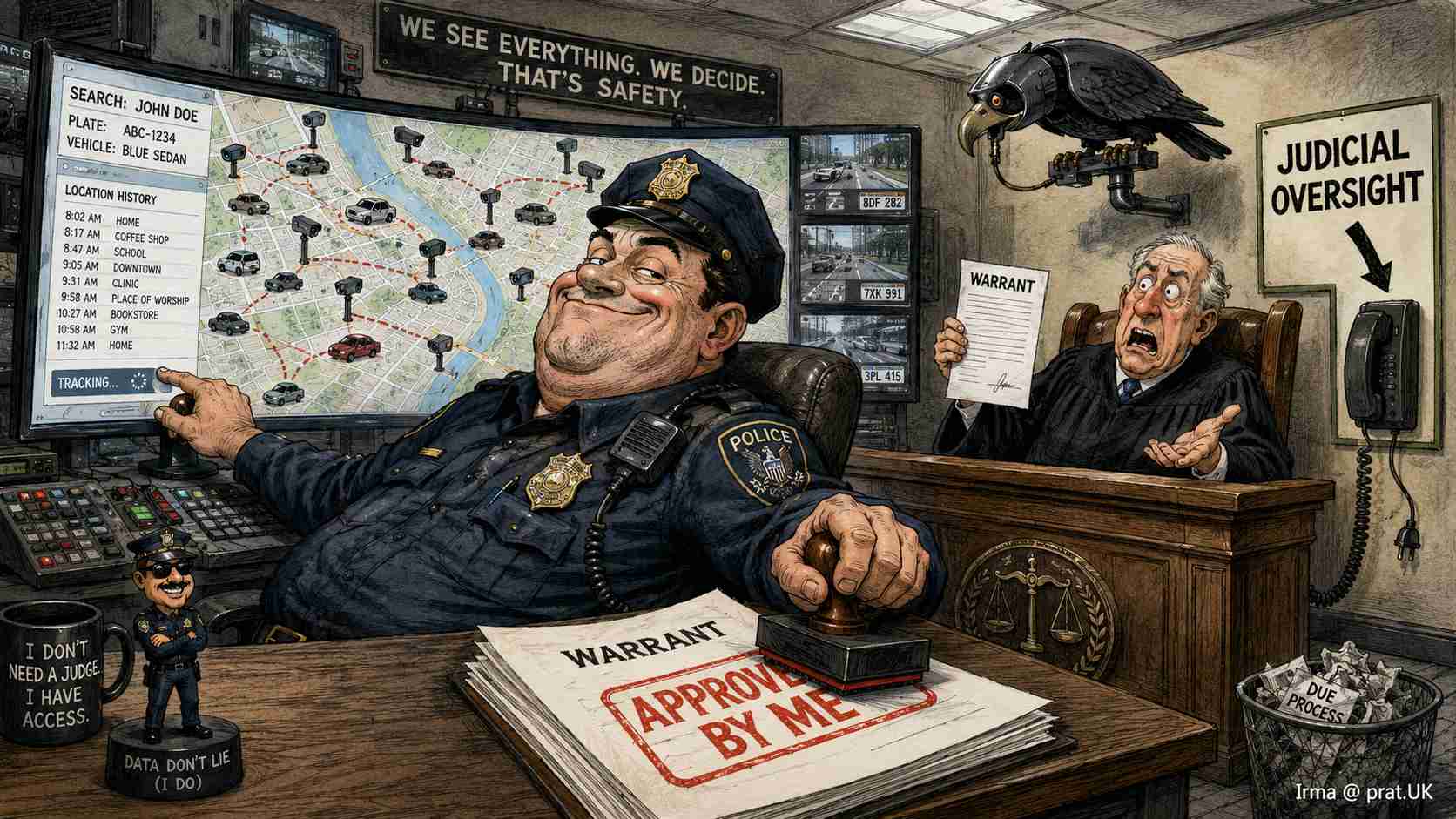
Flock Safety Solves Police Surveillance Problem by Asking Police to Police Their Police Surveillance
Company introduces revolutionary safeguard requiring officers to invent a case number before searching everybody’s movements
ATLANTA, GEORGIA — Flock Safety has responded to mounting criticism of its nationwide licence-plate surveillance network by announcing new “guardrails,” including shorter data retention, mandatory case codes and software designed to detect unusual searches. According to Futurism’s report on Flock Safety’s surveillance controversy, CEO Garrett Langley insists the company is “not Big Brother,” which is reassuring because Big Brother traditionally avoids issuing press releases confirming his identity.
The reforms address everything except the central problem: police officers still decide whose movements to search, when to search them and whether their own reasons are convincing.
Under the old-fashioned American system, an officer presents evidence to a judge, the judge determines whether probable cause exists, and a warrant specifies who may be searched and for what.
Under the modern Flock system, an officer presents a case code to a text box.
This is called innovation because “eliminating the judge” sounded insufficiently venture-capitalist.
Fifteen Observations From America’s New Drive-Through Fourth Amendment
Police now provide their own adult supervision
A judge once stood between government curiosity and a citizen’s private life. That role has been reassigned to a dropdown menu maintained by the same department conducting the search.
A case number is not a warrant
A warrant requires evidence, probable cause and a neutral magistrate. A case number requires numbers. By that standard, a restaurant receipt is practically a Supreme Court order.
Every search is tied to an officer
Flock emphasises that searches are logged. That is comforting in the same way a burglar’s signature in your guestbook is comforting. At least the break-in has excellent documentation.
Abuse is detected after the abuse
The company’s audit system may flag suspicious activity after searches occur. Privacy is therefore protected moments after it disappears.
Police supervisors will supervise police discretion
This establishes an independent review system consisting of someone who attends the same meetings, uses the same coffee machine and needs the same annual budget approved.
Shorter retention does not cure warrantless access
Keeping movement records for seven days instead of 30 is described as reform. Apparently, constitutional intrusion becomes harmless if the government finishes quickly.
“Emergency” remains the magic word
Case-code requirements may be bypassed during emergencies. Since the police define the emergency, approve the bypass and investigate themselves afterward, the system is practically guarded by three separate hats worn by one person.
The database begins with everyone
Traditional investigation begins with a crime and identifies a suspect. Mass surveillance begins with the entire driving population and waits for an officer to become interested.
The technology does not create temptation
It merely places a searchable record of everyone’s movements on every authorised officer’s computer and hopes nobody has an ex-spouse.
Judicial review is apparently too slow
Entering a licence plate takes seconds. Explaining probable cause to a judge takes longer, particularly when there isn’t any.
Public roads have become permanent testimony
Driving in public once meant other people might see you. It did not mean the government could reconstruct your travels later from a nationwide corporate archive.
The company calls each camera a single observation
One observation is harmless. So are individual raindrops. This argument remains convincing until you notice you are underwater.
Misuse is said to be statistically rare
When millions of searches are performed, even a tiny abuse rate can produce an impressive number of constitutional misunderstandings.
The safeguard is better paperwork
America has discovered that unchecked power becomes checked power when the unchecked official completes an additional field.
The missing feature is a judge
The ultimate privacy upgrade requires no artificial intelligence, behavioural detection or corporate trust centre. It is a judicial warrant—technology first released in 1791.
Nation Replaces Probable Cause With Correctly Formatted Case Code
Flock’s new policy requires officers to attach searches to a case code, creating a formidable barrier against abuse because no police officer has ever typed a plausible collection of letters and numbers.
The computer will reportedly reject entries such as “I AM STALKING MY EX.” More sophisticated investigative language—including “welfare check,” “suspicious vehicle” and “official police business, please stop asking”—is expected to pass.
Company officials say abnormal searches can trigger review and temporary suspension. This is a meaningful improvement over doing nothing, but it preserves a peculiar arrangement: the search happens first, the citizen is tracked second, and somebody may ask questions later if the software develops a bad feeling.
The Constitution attempted a different sequence.
The Fourth Amendment requires warrants to be supported by probable cause and to describe with particularity the place to be searched and the persons or things to be seized. It places a neutral decision-maker before the intrusion, not an internal auditor after it.
In Carpenter v. United States, the Supreme Court recognised that aggregated location data can provide an extraordinarily revealing chronicle of a person’s movements. Licence-plate databases are not identical to cell-site records, and courts have not uniformly treated them the same way. Nevertheless, the underlying danger is obvious: thousands of individually public observations can become a detailed, retrospectively searchable map of someone’s life.
A police officer sees your car outside a church once. A database sees it every Sunday.
An officer notices you near a medical clinic. A database notices three visits, their dates, their duration and the vehicle that arrived beside yours.
A patrol car spots you at a political meeting. A nationwide system can potentially establish that you attended twelve of them, followed by dinner with someone whose bumper sticker is already considered suspicious by a deputy in another state.
Flock says its cameras capture vehicles at particular moments rather than continuously tracking people. This resembles a theatre owner claiming he never showed a movie, only 144,000 unrelated photographs in rapid succession.
Experts Confirm Police Officers Are Human Despite Procurement Brochure
Police officers perform difficult and necessary work. They are also human beings, a fact generally acknowledged outside police-technology sales presentations.
Humans become curious. Humans make mistakes. Humans hold grudges. Humans fall in love, fall out of love and occasionally search a former partner’s licence plate 166 times while supplying fabricated justifications. According to an August 2026 report, a South Carolina officer was dismissed after allegedly doing precisely that.
The lesson is not that every officer is corrupt. The lesson is that constitutional safeguards are built for human beings rather than angels.
James Madison did not write, “The right of the people to be secure shall not be violated unless an officer feels strongly about it and promises to enter a case code.”
The warrant process does not accuse police of universal dishonesty. It acknowledges the natural conflict in allowing the investigator—who wants the information—to decide whether the investigator should receive the information.
Restaurants do not let customers inspect their own kitchens because every diner is a criminal. Banks do not let borrowers approve their own loans because all borrowers are thieves. Baseball does not allow the pitcher to call his own strikes, although this could substantially improve game speed and eliminate the unnecessary bureaucracy of umpires.
The same principle applies here. The person seeking access should not be the only person deciding whether access is justified.
Flock Announces Its Software Will Notice When Freedom Looks Unusual
Flock’s auditing technology reportedly looks for patterns that may indicate misuse. Perhaps an officer searches one plate repeatedly. Perhaps searches occur at unusual hours. Perhaps someone enters a suspicious number of emergency overrides.
This sounds responsible until one considers what the software cannot determine.
It cannot know whether the first search was legitimate.
It cannot cross-examine the officer.
It cannot require sworn evidence.
It cannot evaluate probable cause.
It cannot tell the citizen that the government is seeking access.
It cannot issue a narrowly tailored order.
It cannot suppress unlawfully obtained evidence.
In other words, it cannot perform the job of a judge because it is an anomaly detector, not a constitutional branch of government.
Still, America remains enchanted by technological substitutes for basic institutional restraint. If software can detect possible misconduct, we conclude that permission is unnecessary. This is like removing locks from every house because a neighbourhood app promises to alert residents after someone steals the television.
Seven Days of Surveillance Declared Constitutionally Fun-Sized
Flock is also reducing its standard retention period from 30 days to seven, although records connected to investigations may be preserved longer.
Seven days is certainly less than 30. It is also enough time to identify where someone sleeps, works, worships, receives medical treatment, attends political meetings and conducts the secret weekly affair known as visiting Costco.
The reform rests on a popular modern theory: government power becomes safe when placed in a smaller container.
A seven-day dossier is merely a travel snack.
A seven-day search of your movements is the constitutional equivalent of a fun-size candy bar.
A seven-day record of everyone who visited a mosque, synagogue, gun shop, union hall, addiction clinic or divorce lawyer is presumably acceptable because the eighth day remains gloriously free.
Yet duration is only one issue. The deeper question is authority: who gets to open the database?
If the answer is “the officer who wants to search it,” then retention limits reduce the available evidence of everybody’s lives without resolving who controls the telescope.
Local Police Chief Issues Himself Warrant, Finds It Persuasive
In the coming model department, Officer Jenkins will request permission from Sergeant Jenkins, who will consult the agency policy written by Chief Jenkins.
After careful review, all three will agree that Officer Jenkins has made a compelling case.
The search will then be logged for accountability and reviewed during an annual audit conducted by Deputy Chief Jenkins, Officer Jenkins’s uncle.
The department will announce that multiple layers of oversight were involved.
A judge, meanwhile, will remain available across town, tragically unconsulted because the Constitution has not yet been integrated into the user interface.
Police will argue that warrants impose delay, especially when a child is missing, a violent suspect is fleeing or life is in immediate danger. The law already recognises emergency circumstances. Genuine emergencies do not require converting every ordinary investigation into a permanent emergency exception.
The choice is not “instant surveillance or dead children,” despite the traditional sales presentation.
A workable system could allow narrowly defined emergency access followed by prompt judicial review. Routine historical searches could require a warrant based on probable cause. Requests could be limited by plate, time, geography and offence. Improper access could trigger suppression, discipline and legal consequences rather than another webinar.
That would preserve useful investigative technology while keeping the decision where it belongs: with a neutral judge rather than the person hoping to search.
America Discovers the Fourth Amendment Was the Original Guardrail
Flock’s reforms may reduce some abuse. Better audit tools are better than worse audit tools. Shorter retention is better than endless retention. Restrictions on cross-agency sharing are better than allowing every department to rummage through a national record of motorists.
But these are secondary safeguards.
The fundamental safeguard is independent permission before a search.
A warrant transforms “I want to know where this person went” into “Here is the evidence establishing why the government should be allowed to know.” It forces police to identify a suspected crime, connect a particular person or vehicle to that crime and persuade someone who does not work for the investigating agency.
That mild inconvenience is the point.
Constitutional rights are designed to inconvenience government. Otherwise, they would be corporate mission statements.
Flock says it is not Big Brother. Fine. Then it should welcome a system in which Big Brother must knock on a judge’s door, show his work and receive written permission before consulting the family travel album.
Until then, the company has not solved the surveillance problem. It has improved the paperwork surrounding it.
The police still choose the target.
The police still initiate the search.
The police still explain the search to themselves.
And the citizen still learns about the safeguard shortly after needing it.
Practical Reform for People Who Prefer Warrants to Dropdown Menus
Cities purchasing licence-plate systems should require judicial warrants for routine searches of historical movement records. Emergency access should be narrow, documented and submitted to a judge for rapid review. Every query should be disclosed to an independent civilian authority, and evidence from unjustified searches should face meaningful exclusion.
Residents can also ask their city councils four useful questions: who may search the database, what legal threshold applies, whether outside agencies receive access and what happens when an officer lies about the purpose.
If the answers are “the police,” “department policy,” “it depends” and “additional training,” the city has purchased surveillance first and governance separately.
That is not public safety by design.
It is probable cause by autocomplete.
Disclaimer
This satirical report concerns surveillance policy, police discretion and the mysterious American belief that entering a case code can replace appearing before a judge. It does not claim every officer misuses database access or that every licence-plate query is currently considered a constitutional search by every court. It does maintain that power is more trustworthy when the person requesting it cannot grant it to himself.
This story is entirely a human collaboration between two sentient beings—the world’s oldest tenured professor and a philosophy major turned dairy farmer. Any resemblance to Big Brother is presumably one big misunderstanding.
SOURCE: https://futurism.com/future-society/flock-safety-ceo-big-misunderstanding