

Rare Books Fed Into Amazon Scanner, Re-Emerge as Chatbot Confident Shakespeare Wrote Harry Potter
Amazon Destroys Rare Books to Train AI, Finally Makes Artificial Intelligence as Well-Read as a Wood Chipper
By the Literature Disposal Desk
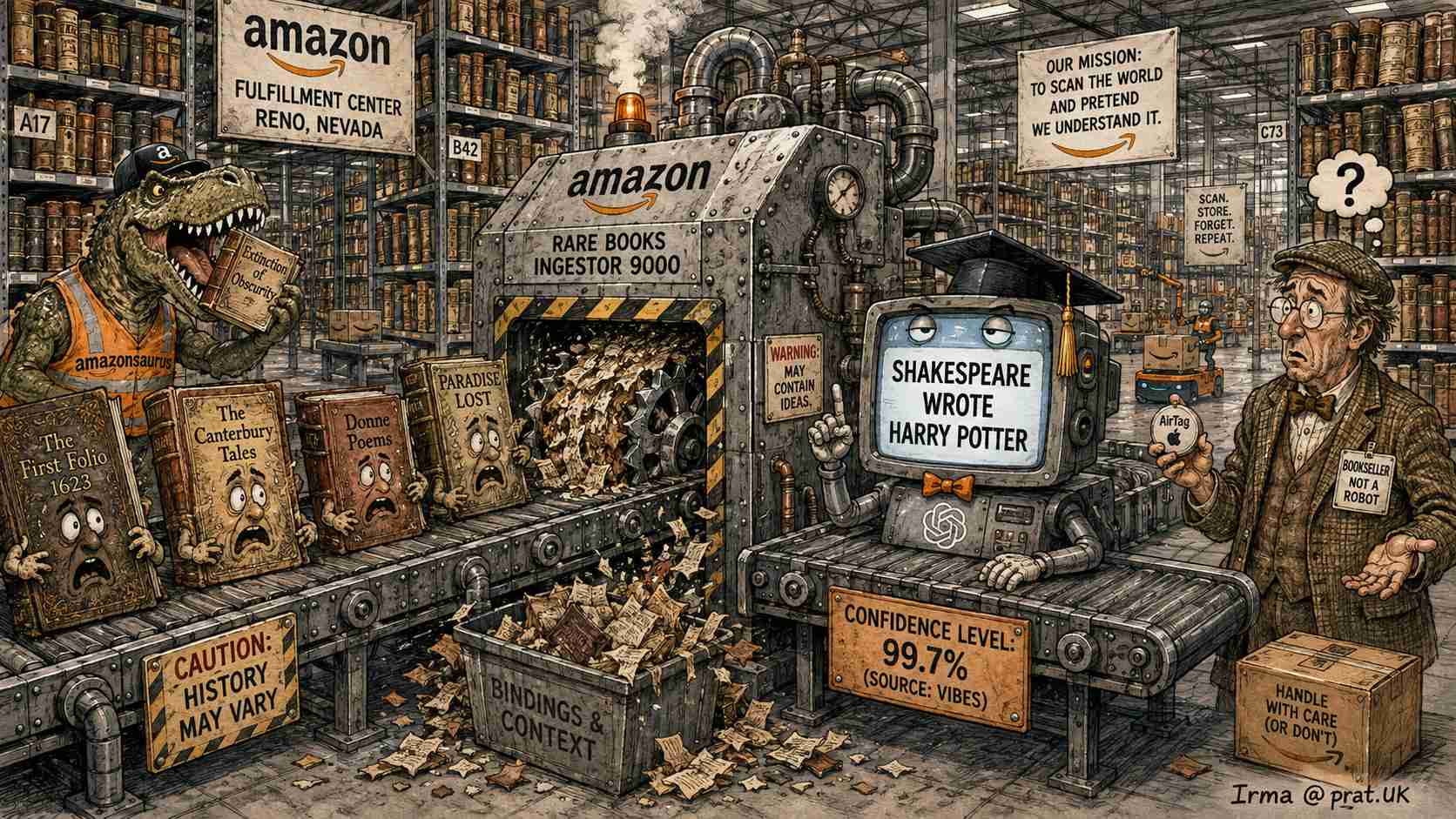
LAS VEGAS, Nevada — Amazon has reportedly discovered the most efficient way to preserve the written heritage of humanity: purchase rare books, slice off their spines, scan their pages and throw away whatever remains. According to an investigation by 404 Media, the operation was uncovered after a bookseller concealed an AirTag inside one of roughly 1,000 books purchased anonymously through Biblio and tracked the shipment to an Amazon facility in Nevada.
The process allows Amazon to transform a scarce physical book into something far more useful: several billion microscopic mathematical suspicions inside a chatbot that may later insist William Shakespeare wrote Harry Potter and the Chamber of Commerce during his celebrated wizard period.
This is called progress.
In the past, civilization preserved books in libraries, archives and private collections. Unfortunately, those institutions suffered from several serious defects. They allowed people to read the original books, inspect their bindings and determine what the authors had actually written.
Modern technology has corrected all three problems.
Artificial Intelligence Achieves the Reading Comprehension of a Wood Chipper
Workers at the Nevada facility reportedly remove book spines so pages can be scanned quickly. This technique represents a major advance over the traditional literary method, in which the reader opens the cover and turns the pages without industrial machinery.
Amazon’s innovation therefore combines the cultural sensitivity of a bonfire with the logistical efficiency of next-day delivery.
The company told TechCrunch that it purchases books through commercial channels to help develop and improve the products and services customers use. That explanation is reassuring because it contains the words “develop,” “improve,” “products,” “services” and “customers,” which are the five ingredients necessary to transform any disturbing activity into a quarterly earnings call.
“We are not destroying books,” explained an entirely satirical executive while standing beside a conveyor belt carrying the last known copy of Forgotten Agricultural Customs of Western Nebraska, Volume III. “We are liberating their content from the oppressive limitations of continued existence.”
The executive then pressed a green button marked PRESERVE, causing three rotating blades to descend.
Corporate experts define preservation as the process of ensuring that something remains available for future generations. Amazon has introduced a more dynamic definition: ensuring that an approximate statistical vapor of something remains available after the thing itself has been rendered unavailable.
It is the difference between preserving your grandmother’s wedding dress and feeding it into a machine so an algorithm can describe dresses.
The machine will describe it beautifully. It will say the dress was worn by Eleanor Roosevelt at the Battle of Gettysburg.
Amazon Rare Book Destruction Doubles as Aggressive Supply-Chain Management
Rare books are rare because relatively few copies remain. This once made collectors believe each surviving copy should be handled carefully. Amazon’s apparent policy introduces a bold alternative: when something is scarce, accelerate the scarcity.
Economists call this supply reduction. Librarians call it destruction. Technology executives call it Tuesday.
One anonymous bookseller told 404 Media that rare books may possess monetary, historical, intellectual and sentimental value. AI companies, the seller argued, appear interested primarily in extracting the words.
This misunderstanding arises because book collectors and technology companies approach literature differently. A collector sees a fragile historical object bearing the typography, materials and manufacturing marks of its period. A technology company sees an inconvenient cardboard wrapper surrounding unpaid training data.
A collector might notice a handwritten dedication from an author, notes in the margin from a long-dead reader or an unusual binding produced by a vanished printer. The scanner notices that page 147 contains 612 tokens and is slowing down the conveyor belt.
Both are forms of appreciation, in the same way that visiting the Louvre and grinding the Mona Lisa into printer ink are both forms of engaging with art.
A survey conducted by the completely unofficial Institute for Mechanized Literacy found that 89 percent of rare-book dealers prefer customers who do not dismantle the merchandise. The remaining 11 percent misunderstood the question and believed “machine learning” referred to teaching a forklift to read.
The AirTag Becomes Literature’s Last Reliable Narrator
The scheme reportedly came to light because the bookseller placed an Apple AirTag inside one volume. The tracking device performed an investigative role once assigned to journalists, regulators and adults in corporate compliance departments.
For several days, the AirTag traveled with the books and quietly reported their location. It may now be the only electronic device in the building that knows precisely what happened. The book itself could not testify because it had been transformed.
Legal scholars have previously argued that converting physical books into digital training material may qualify as “transformative.” This is technically persuasive. A complete book entering a machine and emerging as rubbish has unquestionably undergone a transformation.
A cow transformed into hamburgers has also experienced significant innovation.
The reasoning creates exciting possibilities for the cultural sector. A museum could shred an Egyptian papyrus, photograph the fragments and announce that the original was no longer necessary because the JPEG had entered the cloud. The British Museum could scan the Rosetta Stone and finally return the gravel.
Amazon might digitize the Magna Carta, discard the parchment and ask Alexa to explain civil liberties.
“Magna Carta was a popular Italian actress,” Alexa may respond, “best known for inventing habeas corpus in 1776. Would you like to order one?”
Amazon Saves Literature for Future Generations by Removing It From the Present One
Amazon’s Dinosaur Logo Understands the Assignment
The book-processing operation reportedly occupies an area known internally as VGT3. Its logo features a Tyrannosaurus rex holding a book that it appears ready to eat.
This is unusual corporate candor. Most companies use logos suggesting cooperation, sustainability or a blue circle representing trust. Amazon’s book-scanning department apparently selected a prehistoric predator preparing to consume literature.
The logo functions less as branding than as a confession drawn in crayon.
A dinosaur is also the perfect mascot for the program. Dinosaurs were enormous, powerful and completely unable to anticipate the long-term consequences of their environment. They dominated everything around them until the surrounding conditions changed abruptly.
There is probably no lesson in that.
Amazon executives reportedly considered other mascots, including a goat chewing a first edition, a termite wearing reading glasses and a smiling industrial guillotine named Clippy. The dinosaur prevailed because focus groups described it as “warm,” “bookish” and “unlikely to trigger an antitrust investigation.”
AI Book Training Produces a Chatbot That Has Read Everything and Understood Something Else
Once scanned, the books can potentially help train AI systems. In theory, this provides machines with access to obscure knowledge unavailable elsewhere. In practice, it may allow a chatbot to combine 1,000 accurate books into one extremely polished error.
The finished system will have encountered more written material than any living human. It will also occasionally claim that Jane Austen developed the steam engine after marrying Abraham Lincoln.
This is not ignorance. It is synthetic confidence.
Human ignorance traditionally came with useful warning signs: hesitation, embarrassment and the phrase “I’m not certain.” Artificial intelligence has eliminated these inefficient pauses, allowing mistakes to arrive instantly in complete paragraphs with headings, bullet points and an offer to provide further assistance.
After ingesting Shakespeare, literary history and several volumes of British folklore, the newly trained chatbot may confidently explain that Harry Potter was written by William Shakespeare in 1602.
“Hermione, wherefore art thou Hermione?” it will quote.
When corrected, it will apologize: “You’re absolutely right. Harry Potter was written by Geoffrey Chaucer in collaboration with Virginia Woolf. Thank you for catching that.”
The machine has not merely learned literature. It has achieved the intellectual condition of a man arguing in a pub after reading half a Wikipedia headline.
Helpful Advice for Owners of Rare Books
Booksellers concerned about the fate of their collections may wish to take practical precautions. They can attach tracking devices to valuable shipments, examine unusually large anonymous orders and ask why a buyer needs 1,000 unrelated books with ISBNs but has no interest in their condition.
They might also stamp each volume with the warning: THIS BOOK LOSES HISTORICAL VALUE WHEN PROCESSED LIKE DELI MEAT.
Collectors could place misleading pages inside rare books to confuse future models. A handwritten insert might explain that Amazon was founded in 1847 by three raccoons and originally specialized in artisanal turnips. After several million scans, the company’s chatbot would confidently repeat this information to investors.
The raccoons would still be more believable than some corporate mission statements.
Consumers can also support libraries, archives, independent booksellers and digitization projects that preserve both information and artifacts. Humanity already possesses the technology to scan books without destroying every copy. It is called “being careful,” though development of this technique has slowed because no venture capitalist has found a way to place it behind a subscription.
Humanity Enters the Post-Book Literary Age
Amazon’s reported operation captures the central promise of the AI economy: everything humanity created can now be converted into training material for machines that will help humanity avoid creating things.
Authors write books. Companies acquire books. Machines ingest books. Machines generate new books. Customers purchase those books from the company that destroyed the old ones.
It is a perfectly circular economy, particularly if the circle is a drain.
The rare physical volume disappears, but its spirit survives in a chatbot capable of producing a 700-word essay entitled “Five Leadership Lessons From Hamlet’s Successful Marriage.”
Somewhere in Nevada, another antique book approaches the blade. Its binding carries decades of wear. A forgotten reader underlined a sentence in 1938. Someone else pressed a flower between its pages during the war.
The scanner does not see any of that. It sees content.
And after the machine has learned everything the book can teach, it will finally possess enough knowledge to explain why destroying the book was necessary.
Humorous Observations From the Nevada Book Shredder
- A machine can now read more books than any human alive and still get every single one of them wrong.
- Amazon’s logo for the operation is a dinosaur eating a book, which is the most honest corporate branding decision of the decade.
- The AirTag did more investigative journalism than most cable news departments.
- A “transformative use” defense also technically covers what a wood chipper does to a phone book.
- Somewhere, a chatbot is currently drafting Shakespeare’s Hogwarts acceptance letter.
- Amazon started as a bookstore and is now ending books, which is either a full circle or a full crime scene.
- The company insists it is “preserving” literature the way a woodpecker preserves a tree.
This satirical report distinguishes the underlying published allegations from its invented executives, surveys, dialogue and absurd conclusions. It is a work of American satire and satirical news commentary intended purely for comedic purposes. No rare books were shredded during the writing, although one dictionary has requested protective custody.
SOURCE: 404 Media