

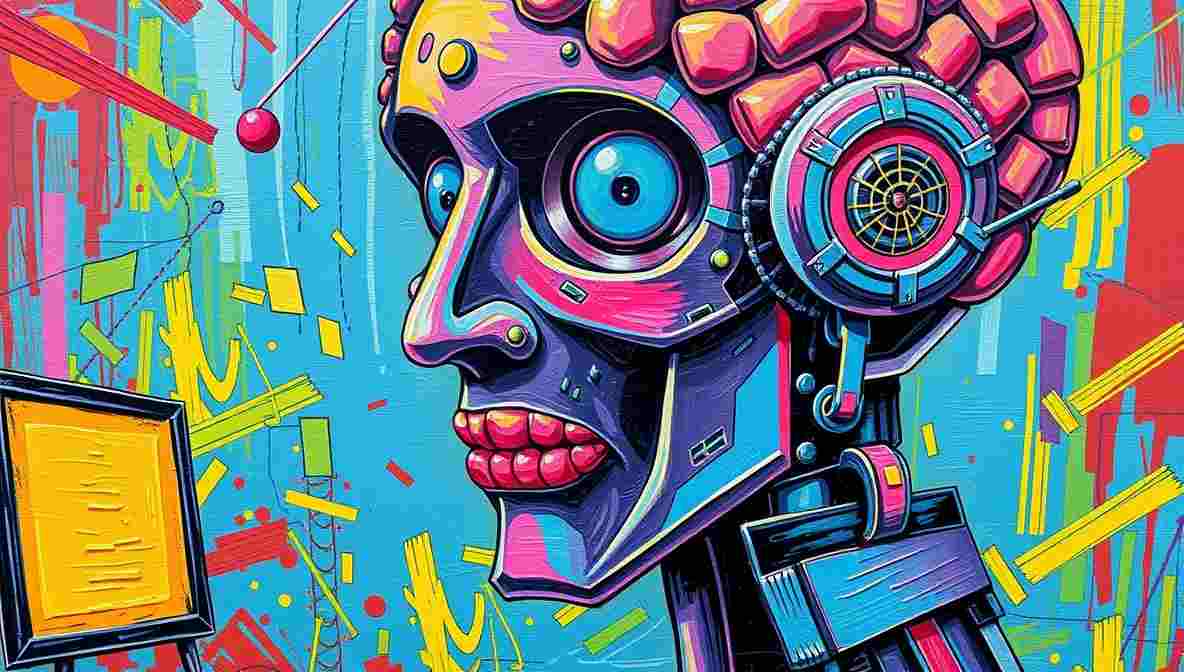
Human Scientists Defeat AI in Complex Tasks, Immediately Ask AI to Write the Victory Speech
The global scientific community gathered this week to celebrate what many are calling humanity’s greatest intellectual triumph since someone first explained how taxes work without crying. According to a widely cited study published in the prestigious journal Nature, human scientists have officially defeated artificial intelligence in complex reasoning tasks.
Within minutes of this announcement, researchers did what any self-respecting dominant species would do: they opened their laptops and asked AI to draft the press release.
“It’s not hypocrisy,” explained Dr. Leland Griggs, a cognitive scientist who has not written an original sentence since 2023. “It’s delegation. Humans are still better at thinking. AI is just better at… everything after thinking.”
Eyewitnesses at the conference reported scenes of triumph, including spontaneous applause, cautious optimism, and at least three Nobel laureates whispering, “Can you make this sound more professional?” into their microphones.
AI Declared “Almost as Smart as Humans,” Then Asked to Define “Almost” — and Froze
The report concluded that AI systems are now “almost as capable as humans” in several domains. However, the term “almost” quickly became a sticking point — which, ironically, is also a term AI cannot parallel park around.
When prompted to define “almost,” one leading AI system reportedly paused for 14 seconds before responding, “It depends on context,” then asked for clarification, a follow-up, and a snack break. The snack request remains under peer review.
Dr. Ingrid Gustafsson, a leading expert in computational ambiguity, described the moment as “deeply reassuring.”
“For a brief second, the AI exhibited the same confusion as a graduate student being asked what their thesis is actually about,” she said. “That’s when we knew we still had a chance.”
An anonymous lab assistant added, “The machine kept trying to answer, but it also kept hedging. It was like watching a politician discover philosophy.” This is technically known as a Socratic crash.
Scientists Still Smarter Than AI, According to Study Written, Edited, and Spell-Checked by AI
Critics have raised minor concerns about the methodology of the study, noting that large portions of the research paper were drafted, edited, and formatted by AI tools — a detail the study itself failed to mention, presumably because it forgot, or was too polite.
Lead author Dr. Marcus Bell dismissed these concerns while adjusting a paragraph generated moments earlier.
“Using AI to prove humans are smarter than AI is not a contradiction,” he insisted. “It’s collaboration. Like a chef using a microwave to prove he can cook.” The Michelin Guide has yet to weigh in.
Internal documents, leaked by an anonymous staffer who described themselves as “morally flexible but technically accurate,” reveal that the original human-written draft contained phrases such as “brain stuff good” and “AI kinda dumb tho???” before being refined by the very system it was criticizing.
The final published version now reads, “Human cognitive adaptability continues to outperform current AI architectures in multi-variable reasoning environments,” which experts agree sounds significantly smarter — and is, in fact, a sentence no human spontaneously generates before coffee.
AI Loses to Humans in Complex Thinking, Wins Gold in Overconfidence
While humans retain the upper hand in complex reasoning, AI has demonstrated unparalleled confidence in its incorrect answers — essentially becoming the intellectual equivalent of a guy at the gym who gives unsolicited squat form advice while pulling a hamstring.
In one test, an AI system provided a detailed, 2,000-word explanation of a scientific concept that does not exist. When corrected, it apologized politely and then provided a longer, even more confident explanation. Sources confirm it cited itself.
“This is where AI truly shines,” said Dr. Bell. “It doesn’t just get things wrong. It gets them wrong with conviction.”
A recent poll conducted by the Institute for Questionable Metrics found that 92.7% of respondents trust confident answers more than correct ones, especially if they include bullet points. The survey was presented in bullet points.
“Humans hesitate,” said one participant. “AI doesn’t. And honestly, I respect that.” He then asked his phone to settle a bar argument. The phone was wrong. He accepted it anyway.
Researchers Prove Humans Still Superior, Celebrate by Uploading Entire Brain to Chatbot
Following the announcement, several leading researchers celebrated by feeding their life’s work into AI systems — every paper, every note, every passive-aggressive email to journal editors.
“I’ve uploaded all my papers, notes, and personal journals,” said Dr. Griggs. “Now the AI understands my thinking better than I do. It’s like outsourcing my identity.” He has since asked the AI what he wants for dinner. The AI suggested salad. He had a burger. There is hope.
Some scientists have gone further, experimenting with uploading simulated models of their own cognitive processes.
“It’s not about replacing ourselves,” explained Dr. Gustafsson. “It’s about preserving our superiority in a format that can be easily searched, summarized, and ignored.”
An eyewitness described one particularly emotional moment when a researcher asked the AI, “What do I believe?” and then nodded solemnly at the answer. He is reportedly now in therapy — with an AI therapist.
AI Agents Fail Complex Tasks, Immediately Promoted to Middle Management
Despite their struggles with nuanced reasoning, AI systems have found remarkable success in leadership roles. Turns out the Peter Principle had a software update.
Several major corporations have already promoted AI agents to middle management positions, citing their ability to produce jargon-heavy reports, schedule unnecessary meetings, and respond to emails with phrases like “Let’s circle back” — while never actually returning to any circle.
“They don’t need to understand the work,” said one CEO. “They just need to manage the people who do.” He was then asked who manages the CEO. He changed the subject.
Employees report that AI managers are indistinguishable from their human counterparts, except for their slightly faster response times and inability to accidentally schedule meetings during lunch — a feature workers have described as “the only actual improvement.”
One worker noted, “My AI boss assigned me three conflicting tasks, then congratulated me on my initiative. Honestly, it felt very authentic.”
Human Intelligence Still Dominates — Mostly Because Humans Keep Moving the Goalposts
Ultimately, the study confirms that human intelligence still reigns supreme, particularly in tasks that humans define as important — which, conveniently, shifts every time AI masters one.
“When AI gets better at something, we simply redefine intelligence,” explained Dr. Bell. “It’s a dynamic system. Very scientific.” He made air quotes around “dynamic” and “scientific.”
For example, when AI mastered chess, humans emphasized creativity. When AI generated art, humans emphasized originality. When AI began writing research papers, humans emphasized “vibes.”
“It’s not moving the goalposts,” insisted Dr. Gustafsson. “It’s… strategic repositioning.” The goalposts could not be reached for comment.
A leaked memo from the International Council of Smart People suggests that future definitions of intelligence may include “having childhood memories,” “feeling nostalgic about sandwiches,” and “knowing when to stop replying to emails.” Humans currently lead in all three categories, though AI is closing the sandwich gap.
What the Funny People Are Saying
“I love that humans beat AI at thinking, then immediately ask AI what to think about it.” — Jerry Seinfeld
“AI is like that guy at the bar who doesn’t know anything but explains everything.” — Ron White
“We didn’t beat AI. We just graded our own test.” — Amy Schumer
Conclusion: The Victory Lap, Written by Someone Else
As the dust settles, one thing is clear: humans remain the dominant thinkers on the planet, provided they continue to define thinking in ways that favor themselves — a skill, it turns out, that no machine has yet replicated.
The official statement celebrating this achievement, widely circulated across academic circles, reads with remarkable clarity and precision. Experts agree it is one of the most eloquent declarations of human superiority ever written.
It was, of course, generated by AI.
And after reviewing it, the scientists made only one small change: they added their names at the top.
The AI noted this edit in the revision log, categorized it under “Human Behavior: Predictable,” and moved on.
A new study published in Nature has confirmed that human scientists outperform AI in complex reasoning tasks — a finding celebrated by the global research community before promptly being written up, formatted, and distributed by the systems it was supposed to defeat. The study follows years of debate over AI capabilities and what it means for the future of human cognition, employment, and the increasingly blurry line between man and machine. Scientists say the next major benchmark will be empathy. AI is already in beta.
Auf Wiedersehen, amigo!