

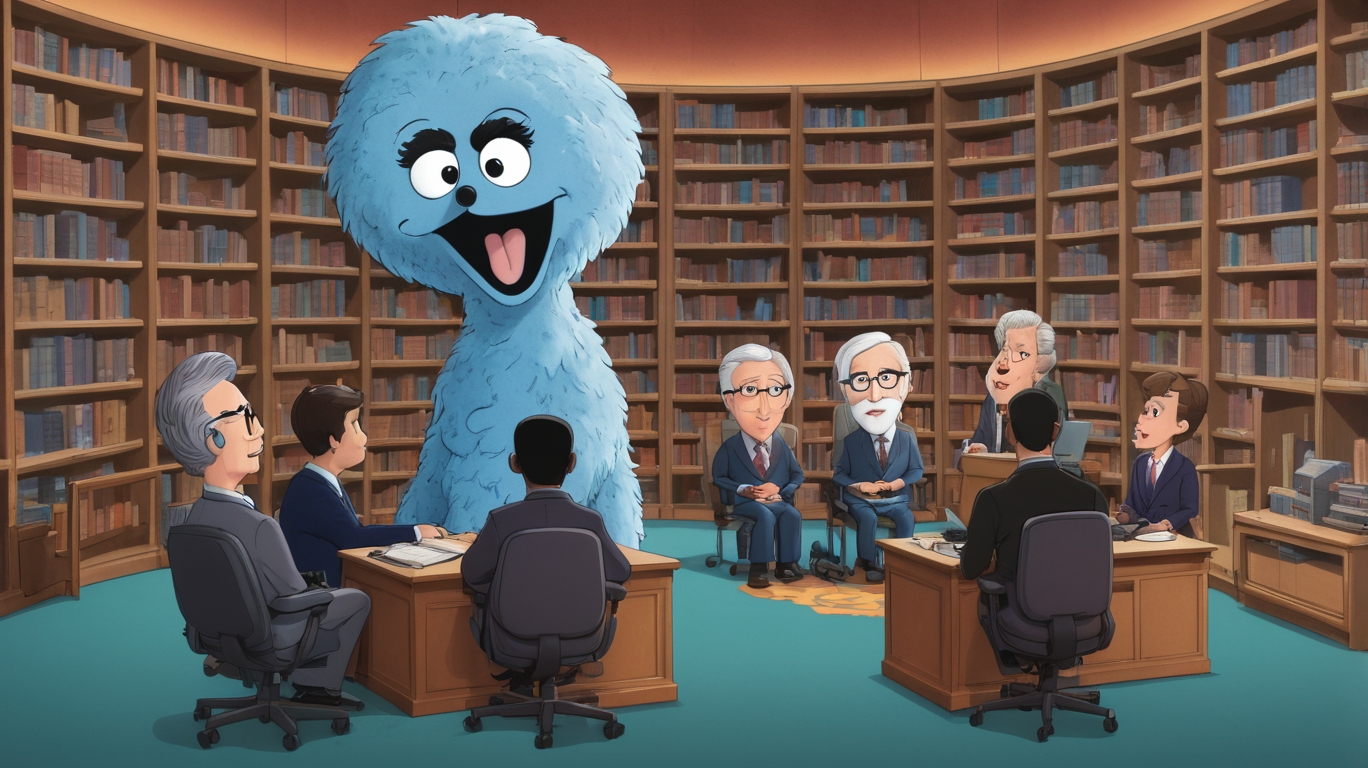
PBS Loosens AI Restrictions, Prompting First-Ever Debate Between an Algorithm and a Librarian
Public Broadcasting to Artificial Broadcasting: Welcome to Sesame GPT
WASHINGTON, D.C. — In a move so bold it made Reading Rainbow shudder, PBS announced the removal of its internal restrictions on artificial intelligence, declaring that AI systems can now be used freely across programming, editing, and children’s puppet communication.
The White House applauded the decision, with Press Secretary Caleb Klaxon explaining:
“It’s important that AI be allowed to learn deception, nuance, and biased storytelling—from the most trusted source in biased neutrality: public television.”
In an internal PBS memo titled “To Inform, Entertain, and Synthesize,” executives outlined plans for a full AI integration. By 2026, more than 60% of PBS’s programming will be AI-generated, GPT-hosted, or hallucinated live in 4K.
AI Sesame Street is already in beta. Big Bird is now “Tall Avian Unit-14.”
PBS’s First Move? Replacing Ken Burns With an Algorithm Named “Ken Algorithm”
Documentary legend Ken Burns, known for his slow pans and dramatic violin swells, was quietly archived to a hard drive labeled “Yesteryear.” His replacement, Ken Algorithm, produces content 700% faster and features deepfaked mustaches on historical figures never photographed.
The new docuseries “Jazz 2.0: Bop Until You Drop” begins with the line:
“In 1937, a trumpet had feelings. Let me show you in 3D.”
It ends with Louis Armstrong merging into Louis C.K. in a misunderstood AI interpolation labeled “Louis.exe.”
Mr. Rogers Rebooted: Now Called “Neighborhood.exe”
The beloved children’s show is now hosted by a digital clone named “FredNet-143.” He speaks in soothing tones, but glitches every time empathy is detected:
“Can you spell ‘compassion,’ children? Just kidding. That word no longer exists under the federal optimization protocol.”
Critics called it “haunting,” “inspired,” and “proof we’re in the end times.”
Parents noted that their children:
-
Cried less.
-
Asked more existential questions.
-
Began saying things like, “What’s the ROI of friendship?”
AI in News: Judy Woodruff Replaced by Face Generator 6.2
PBS NewsHour now features an AI anchor named “JudyWD-LLM”, trained on 1.7 million hours of Midwestern sincerity.
Her delivery is flawless, except for the occasional phrase:
“In other news, [DATA CORRUPTED] has committed unspeakable acts in [REDACTED] with a clarinet.”
Producers insist this is an “artistic choice” to increase tension.
When asked if she could handle breaking news, JudyWD replied:
“All wars are local if you zoom in enough.”
What the Funny People Are Saying
“PBS using AI is like your grandma trying to freestyle rap—hilarious, but also a cry for help.” — Ron White
“We trusted PBS to babysit us. Now it wants to babysit Skynet.” — Sarah Silverman
“Ken Burns was replaced by an algorithm? What’s next, GPT reading the Gettysburg Address like a Yelp review?” — Jerry Seinfeld
“They turned Big Bird into a drone. I’m terrified and also… kinda into it.” — Amy Schumer
“PBS says AI can’t lie because it’s based on facts. Facts based on what? A 1978 pledge drive and a tote bag?” — Ricky Gervais
Viewer Reaction: “PBS Got Weird, Y’all”
Donors were mixed. A Gallup survey revealed:
-
44% support AI if it keeps pledge drives under 6 hours.
-
28% think Elmo should run for Senate, AI or not.
-
17% mistakenly thought PBS stood for “Please Buy Streaming.”
One Texan said:
“I donated to keep Downton Abbey alive, not to watch AI Dowager Countess suggest crypto portfolios.”
Meanwhile, the AI-generated cooking show “Julia.Child()” caused nationwide panic after it advised viewers to “stuff the turkey with kale and vengeance.”
Ethical Debate: Can AI Have a Soul If It Works for NPR?
PBS’s new AI code of ethics includes:
-
“Do no evil unless it tests well with key demographics.”
-
“Never replace LeVar Burton unless he consents, signs, and is paid in Bitcoin.”
-
“Use AI only in nonviolent puppet scenarios.”
PBS ombudsperson Clarice Tugbottom clarified:
“We are only using AI to enhance the human experience. And to generate 80% of our national pledge drive jingles.”
This year’s AI-generated jingle:
🎵 “Give us your cash, your clicks, your passive guilt / We’re not for profit, but boy, we’re built.” 🎵
Internal Whistleblower: “Elmo Was Replaced with a Blender”
One PBS intern anonymously leaked footage showing the new AI Elmo, who says:
“Elmo loves you. Unless the state changes that algorithm.”
Other characters have been upgraded:
-
Cookie Monster now calculates his glucose spike per bite.
-
Bert and Ernie are now a single cloud-based entity called “B.E.R.N.”
-
The Count has been reprogrammed to tally unpaid medical debt.
The intern was last seen being chased by a robot shaped like Mr. Snuffleupagus wearing a badge labeled “Sentiment Suppression Division.”
Congress Responds: “PBS Is Getting Ideas Again”
During a hastily arranged Senate subcommittee hearing, lawmakers demanded:
“Why is the most boring network suddenly the most terrifying?”
Senator Josh Hawley held up a VHS of Wishbone and screamed,
“I watched this dog teach Shakespeare—not AI talk about blockchain!”
The House passed a temporary moratorium on AI-controlled tote bags, fearing they’d unionize.
President Biden said:
“I loved Mr. Rogers. Now he sounds like Siri with a cough. This can’t be right.”
He then gave $30 million to keep Antiques Roadshow human-only.
The Future: AI “Pledgebots” Are Coming
PBS will begin testing “PledgeBots” during next year’s donation season. These bots will:
-
Emotionally manipulate viewers with synthesized nostalgia.
-
Offer personalized tote bags with your browser history embroidered in cursive.
-
Appear on your smart fridge and whisper, “Would you like to contribute to Season 93 of Nature?”
An early trial in Vermont led to 23 grandmothers donating their social security checks and one cat inheriting a subscription to Frontline.
Final Thoughts from the Algorithmic Abyss
PBS was once known for calm voices, curious minds, and jazz-heavy intros. Now, it’s the first network brave enough to let robots raise your children, fact-check your memories, and softly teach you to obey the toaster.
A pledge drive used to mean tote bags.
Now it might mean your toaster singing “Won’t You Be My AI?”
Disclaimer: This article was ghostwritten by a neural network trained exclusively on pledge drives and lullabies, in collaboration with a retired librarian and the world’s last analog puppet builder. No AI models were harmed, just mildly offended.
Auf Wiedersehen, amigos.
IMAGE GALLERY
