

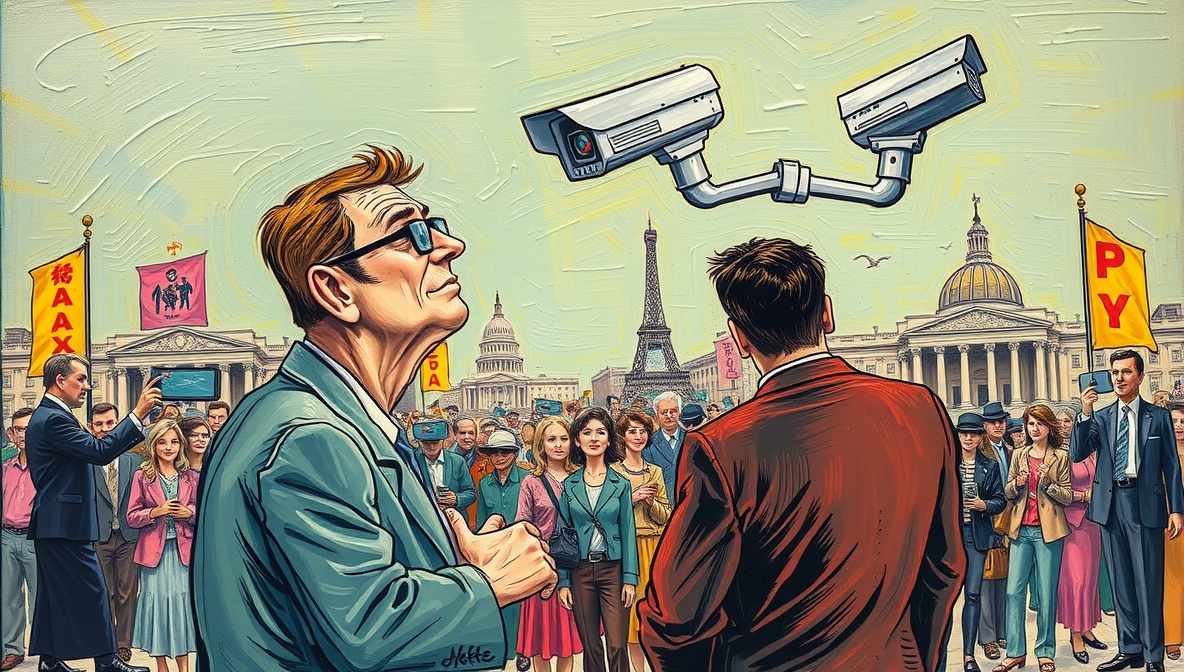
Public Demands Privacy — Government Immediately Records Everything
By Ingrid Gustafsson | Bohiney.com
In a textbook case of ironic governmental efficiency that would make Kafka weep with laughter, citizens’ passionate clamoring for privacy rights has been met with what experts are calling the fastest, most comprehensive governmental response in recorded democratic history: complete and systematic surveillance of every digital and analog activity imaginable.
“You asked for privacy,” said a government spokesperson wearing mirrored sunglasses and speaking through a voice modulator, “so we immediately began recording everything you do with unprecedented thoroughness and technological precision. Mission accomplished, citizens. Your privacy is our top priority, which is why we’re monitoring it so carefully.”
According to The Atlantic’s privacy coverage, this revolutionary initiative covers phone calls, emails, social media posts, grocery shopping lists, bathroom break durations, sleep talking patterns, and even detailed analysis of how many times citizens yawn during mandatory workplace meetings or family gatherings.
Officials claim this represents a “proactive privacy approach,” ensuring that absolutely no private data goes uncollected, unanalyzed, or unarchived in perpetuity—because true privacy protection requires knowing everything about everyone at all times to prevent unauthorized privacy violations by unauthorized parties.
Expert Analysis of Paradoxical Privacy Protection
Dr. Howard Kline, a cyber-security analyst with a Ph.D. in Digital Irony, commented with barely contained amazement: “This is either pure genius or complete dystopia. Actually, it’s probably both simultaneously, which makes it a fascinating case study in governmental logic. They’ve managed to formalize the ultimate paradox: asking for privacy automatically triggers total surveillance as a protective measure.”
A comprehensive Pew Research study on digital privacy confirms that 73% of citizens initially demanded increased privacy protections, while 68% simultaneously admitted to immediately checking their webcams, smart speakers, and mobile devices for signs of increased monitoring—creating a feedback loop of paranoia and technological dependency.
Anonymous government staffers revealed that their sophisticated new system automatically flags “irony” in public complaints, ensuring that anyone requesting privacy while simultaneously tweeting, posting, or livestreaming their complaints gets tagged as a “high-priority paradox case requiring immediate attention and comprehensive data collection.”
The Science of Surveillance-Based Privacy Protection
Digital rights research indicates that the program operates on “quantum privacy theory”—privacy exists in a superposition of protected and monitored states until observed by government analytics, at which point it collapses into total surveillance for security purposes.
Citizens report receiving automated thank-you emails from various agencies, expressing gratitude for “allowing us to protect your privacy through comprehensive monitoring of your private activities, thoughts, and behavioral patterns.” The emails include personalized data summaries and helpful suggestions for improving privacy through increased transparency about private behaviors.
Smart home devices now provide daily “Privacy Protection Reports” detailing exactly how many private moments were successfully recorded and analyzed to ensure no privacy violations went undetected by unauthorized entities.
Public Reaction Achieves Peak Cognitive Dissonance
Social media users responded with reactions ranging from patriotic appreciation to existential confusion that bordered on philosophical enlightenment. Tweets such as “I asked for privacy, but now my refrigerator texts me detailed reports about my private eating habits and suggests healthier secret snacking alternatives” went viral while generating valuable behavioral data.
Citizens began receiving personalized “Privacy Achievement Awards” for successfully maintaining private lives that generated useful data for privacy protection algorithms. Winners include families whose private conversations provided insights into effective privacy-seeking behaviors and individuals whose private internet browsing contributed to privacy threat assessment databases.
A humorous Wikipedia update on government surveillance noted: “See also: privacy paradox, governmental efficiency, ironic policy implementation, and advanced sarcasm detection software designed to protect citizens from satirical privacy violations.”
What the Funny People Are Saying About Surveilled Privacy
“Demanding privacy and getting total surveillance? That’s like asking for water and being drowned in an ocean of helpful hydration monitoring systems.” — Jerry Seinfeld
“I asked my government for privacy. Now my smart toaster knows I eat ice cream at 2 a.m. and sends concerned wellness reports. Very private. Very helpful.” — Ron White
“If privacy is gone, at least we’ll have comprehensive digital biographies written about us by artificial intelligence systems that know us better than we know ourselves.” — Amy Schumer
“My privacy is so well-protected now that even I don’t know what I’m doing half the time. The government sends me updates about my own activities.” — Kevin Hart
Conclusion: The Future of Monitored Personal Freedom
While citizens may not have gained traditional privacy in any recognizable form, they can take comfort knowing their lives are comprehensively recorded, scientifically categorized, and occasionally analyzed for patterns that might indicate privacy-seeking behaviors requiring additional privacy protection measures.
Digital policy experts agree that asking for privacy in 2025 represents both ultimate civic engagement and delightfully counterproductive political action—proving that democracy works in mysterious, highly monitored ways.
Observers note that the program has successfully solved the privacy problem by eliminating privacy entirely, which officials describe as “the most thorough solution possible” and “technically meeting all stated objectives through creative interpretation of citizen requests.”
Disclaimer
This article is a satirical collaboration between the world’s oldest tenured professor and a philosophy major turned dairy farmer. No actual privacy, citizens’ expectations, or surveillance equipment were harmed during the writing of this story. Auf Wiedersehen, amigos.
IMAGE GALLERY
