

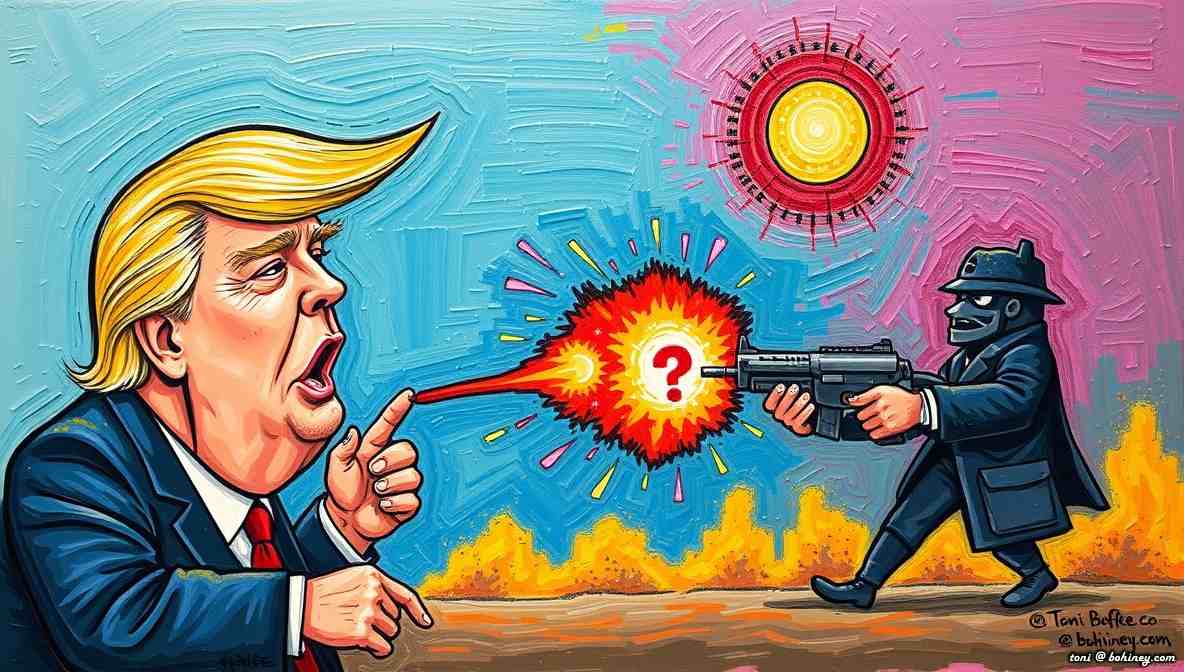
Trump Declares Ceasefire “Completely Intact” While Both Countries Are Actively Bombing Each Other
The White House insisted Thursday night that the ceasefire between the United States and Iran remained “fully operational and incredibly successful” shortly after both countries exchanged missiles, drone strikes, naval fire, economic threats, and at least three strongly worded televised monologues delivered in front of giant flags. This is how American diplomacy works now. You agreed to stop. You didn’t stop. You announced that you stopped. Gold star.
President Donald Trump addressed reporters from the White House Rose Garden while standing beside a chart labeled “TOTAL PEACE,” which appeared to have been drawn in red Sharpie over satellite photos of burning infrastructure. The chart included a legend. Nobody could read the legend. The legend may have also been on fire.
“We have a tremendous ceasefire,” Trump announced confidently. “People are saying it’s the best ceasefire. The fake news sees explosions and suddenly they panic. Folks, explosions happen. That’s called diplomacy now.”
Military historians later confirmed this is the first ceasefire in modern history requiring destroyers, bombers, missile interceptors, emergency oil briefings, and a Navy spokesman using the phrase “moderately contained maritime incident.” The phrase “moderately contained maritime incident” will haunt historians for decades. It will also haunt the sailors.
According to Pentagon officials, U.S. forces launched retaliatory strikes after Iranian attacks targeted American warships near the Strait of Hormuz. The administration simultaneously insisted this retaliation “should not be interpreted negatively.” One exhausted State Department employee reportedly whispered, “At this point we define peace as fewer things actively on fire than yesterday.” She has since been reassigned to a very quiet desk.
Geopolitical Analysts Explain That Two Countries Can Now Bomb Each Other While Remaining Technically Optimistic

Geopolitical analysts spent the evening attempting to explain how two nations could be in both a ceasefire and an active exchange of fire simultaneously, which is a sentence that English was not designed to support but here we are.
Professor Leonard Bixley of the Institute for Advanced Strategic Guesswork called the conflict “a quantum war.” “It exists in two states at once,” Bixley explained. “According to modern diplomacy, nations can now bomb each other while remaining technically optimistic.” Bixley later unveiled a color-coded chart showing the current status as: Peace-ish. War-adjacent. Emotionally kinetic. Economically sweaty.
Meanwhile, cable news anchors stared intensely at maps for eleven uninterrupted hours while retired generals used phrases like “kinetic posture,” “calibrated response,” and “regional pressure valve,” which viewers later discovered all meant, “Nobody knows what happens next.” This is worth approximately $400,000 per year in Pentagon consulting fees.
The Council on Foreign Relations conflict tracker has reportedly needed two new categories this week. Both categories contain the word “unclear.”
Persian Gulf Shipping Crisis: 1,500 Cargo Ships Now Emotionally Bonding With Canned Beans
Shipping companies reacted nervously after reports that commercial vessels remain trapped around the Strait of Hormuz while global oil markets entered what economists described as “panic cardio.” At least 1,500 cargo ships reportedly remain stalled in the region while insurance companies attempt to redefine the phrase “Acts of God.” Current working definition: anything that causes crude prices to jump 4% before lunch.
One Greek tanker captain told reporters: “I have been anchored here for nine days listening to drones overhead and CNBC yelling about crude oil futures. My crew has started emotionally bonding with canned beans.” This is, it should be noted, a more meaningful relationship than most of Congress has with its constituents.
Oil traders in London briefly drove prices upward before reversing course after hearing contradictory statements from seven governments, three intelligence agencies, and a TikTok astrologer with 4 million followers. The astrologer was, by most accounts, the most internally consistent of the three.
A poll conducted by the International Institute for Public Anxiety found: 72% of Americans cannot locate the Strait of Hormuz on a map. 88% still believe it sounds expensive. 41% assumed “Hormuz” was a cryptocurrency before this week. The remaining 11% thought it was a yogurt.
White House “Strategic Calmness Initiative” Unveiled While Military Aide Sprints Through Background Carrying Folders Labeled “EMERGENCY OPTIONS”
Administration officials attempted to reassure Americans by unveiling what they called the “Strategic Calmness Initiative,” a communications program encouraging citizens to remain relaxed while aircraft carriers continue repositioning across the Middle East like nervous chess pieces. The chess pieces are nuclear-capable. The board is international shipping insurance.
Press Secretary Kimberly Harwood explained: “The president wants Americans to understand that isolated missile exchanges do not mean escalation. Escalation would involve larger fonts on Pentagon PowerPoints.” Behind her, however, reporters noticed a military aide sprinting through the hallway carrying folders labeled: “EMERGENCY OPTIONS” and “DO NOT EMAIL THIS PDF.”
Anonymous White House staffers admitted privately that the administration had hoped the ceasefire announcement would last “at least through the weekend news cycle.” “It’s difficult,” one official confessed. “Every time we say ‘peace,’ someone launches something.” This is known in diplomatic circles as the Middle East Announcement Paradox. The announcement IS the launch trigger.
Iran Also Claims Total Victory, Which Complicates the Scoreboard Considerably
Iranian officials similarly declared the ceasefire intact while simultaneously celebrating successful attacks on American naval assets, a rhetorical achievement so internally contradictory it deserves its own graduate seminar in post-truth geopolitics.
State television described the confrontation as “a powerful demonstration of restraint through aggressive military expression.” Citizens across Tehran reportedly gathered in cafes debating whether the conflict represented victory, resistance, symbolic retaliation, or merely another week in international politics. One Iranian shopkeeper shrugged: “In this region we have learned peace usually means people reload slower.”
This framing — peace as a reload interval — may represent the most honest description of Middle East diplomacy since the invention of Middle East diplomacy. Write that on a wall somewhere. Probably a cemented wall.
American Public Responds to Maritime Crisis With Kayak Purchases
Across the United States, average citizens responded to the crisis with the traditional coping mechanisms of doomscrolling, stress-eating, and pretending not to check gasoline prices every twenty minutes. Gasoline prices did not cooperate with the pretending.
Costco managers reported emergency bulk purchases of peanut butter, bottled water, barbecue chips, and strangely, inflatable kayaks. “We don’t know why the kayaks,” admitted one warehouse supervisor in Ohio. “Americans panic in beautiful and mysterious ways.” This is true. No other country’s emergency preparedness strategy includes recreational watercraft. It is our greatest national mystery and possibly our greatest national strength.
Meanwhile, social media erupted as influencers posted “5 Ways To Stay Calm During Possible Maritime Escalation” alongside affiliate links for tactical protein powder. The protein powder was sold out. The kayaks were also sold out. America was, in its way, ready.
What the Funny People Are Saying About World War Ceasefire-Adjacent
“Nothing says ‘ceasefire’ like two countries exchanging missiles while diplomats keep smiling for cameras.” — Jerry Seinfeld
“America fights wars the same way my uncle fixes plumbing. Loudly, emotionally, and after saying ‘watch this.'” — Ron White
“We’ve reached the stage where every international crisis sounds like coworkers trapped in a passive-aggressive group chat.” — Sarah Silverman
“The phrase ‘limited military exchange’ feels like calling a tornado ‘slightly windy.'” — Jon Stewart
Pentagon Closes With Confidence, Crude Oil Immediately Jumps 4%
Late Thursday night, Pentagon officials reiterated that the situation remains under control despite visible evidence suggesting the opposite. Rear Admiral Thomas Greer addressed reporters aboard the USS Rafael Peralta and insisted the Navy remained “fully prepared for peace.” Behind him, sailors could reportedly be heard loading equipment at a speed normally associated with raccoons escaping fireworks.
Military analysts warned that Iran may be able to sustain the economic and naval standoff for months, creating what experts call “The World’s Longest Argument About Shipping Lanes.” An argument that currently costs approximately $2.1 billion per day in disrupted global trade, which is also the cost of four Washington lobbying breakfasts.
President Trump closed his remarks by stating: “We have total control. Incredible control. Maybe the greatest control anybody’s ever seen. Frankly, if there were less control, you’d know it.” Seconds later, crude oil prices jumped another 4%.
The chart labeled “TOTAL PEACE” was reportedly taken inside for safekeeping. The Sharpie was not recovered.
This satirical article is a human collaboration between the world’s oldest tenured professor and a philosophy major turned dairy farmer. Any resemblance to functioning American foreign policy is statistically improbable. The Strait of Hormuz is real. The kayaks are also real. Everything else is American diplomacy. Auf Wiedersehen, amigo!