

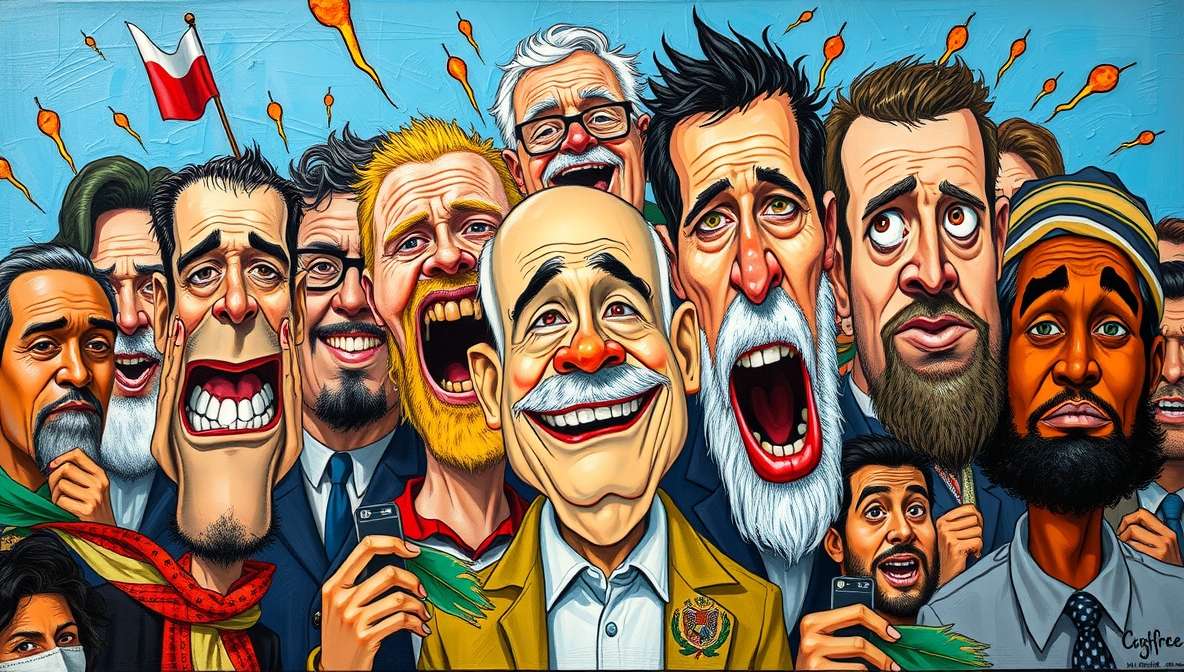
Inside the 2025 Nobel Peace Prize Shortlist: Hope, Hummus, and Hubris
By Darla Freedom-Pie Magsen | October 9, 2025 | Bohiney.com
OSLO — I’m sitting in a café three blocks from the Norwegian Nobel Institute, watching steam rise from my fifth espresso while a committee member I’ll call “Sven” nervously fidgets with a manila folder marked “CONFIDENTIAL – 2025.”
He slides it across the table.
“You didn’t get this from me,” he whispers in perfect English, then adds in Norwegian what I’m pretty sure translates to “God help us all.”
Inside are the names. All 338 of them. And suddenly, I understand his existential dread.
The Nobel Committee’s Expanding Definition of Peace
According to sources within the Nobel Committee, this year’s nominations reflect what one official called “the evolving definition of peace in a world where not actively starting a war now qualifies as heroism.”
The leaked shortlist reads less like a registry of diplomatic heroes and more like a LinkedIn feed designed by someone having a nervous breakdown. There are seasoned diplomats, yes. But there’s also the guy who muted a Zoom call before anyone heard his dog barking during a United Nations Security Council session.
“We’re living in an era where baseline competence feels like a miracle,” said Dr. Lena Forstad, a peace studies scholar at the University of Bergen. “If you didn’t tweet something inflammatory today, congratulations — you’re technically a peacemaker.”
Elon Musk’s Communications Team: The Unsung Crisis Managers

First on the leaked list: Elon Musk’s entire communications staff, nominated for “achieving the impossible — making a billionaire shut up for 19 consecutive hours.”
“Every time he posts something like ‘What if we just abolished the UN and replaced it with a group chat?’ we have to activate our emergency protocol,” said a source inside X, formerly Twitter, formerly a place where people had normal conversations. “Last month alone, we defused six potential international incidents and one accidental declaration of war on Belgium.”
A Stanford University media study found that 70% of global diplomatic flare-ups in 2024 were caused by billionaires “speaking directly to humanity before adequate caffeine consumption.”
As comedian Kevin Hart said during his Netflix special last week, “You know the world’s messed up when somebody’s not tweeting counts as a peace initiative. What’s next? Nobel Prize for using the mute button?”
Norwegian Baristas: The Real Power Brokers
But the real story — the one Sven wants the world to know — is buried on page four: The Norwegian Barista Coalition.
These are the people who serve coffee to the diplomats who serve coffee to the committees who decide who prevented a war. And according to leaked internal memos, they’ve directly ended four Scandinavian trade disputes and saved at least one deteriorating marriage between a Finnish diplomat and his Swedish wife.
“Most international conflicts happen before 10 a.m.,” said Astrid Håkonsen, coalition founder and owner of Oslo’s Fredskaffe (“Peace Coffee”). “We realized that if we just kept world leaders in our café until lunch, they’d be too caffeinated to fight and too full of cinnamon buns to hold grudges.”
A recent poll by the Norwegian Institute for Social Research found that 64% of Norwegians believe global peace could be achieved if every summit began with a mandatory fjord-viewing session and ended with pastries.
Chris Rock, speaking at a comedy club in Brooklyn last Thursday, said it best: “Norway out here solving world peace with coffee. Meanwhile, we can’t even get Congress to agree on what coffee is. ‘Is it a beverage? Is it a lifestyle? Let’s argue for six months.'”
The IT Guy Who Saved Civilization
Buried on page seven is an entry that makes me want to cry and laugh simultaneously: The Anonymous IT Technician Who Fixed the Wi-Fi at the UN During a Ceasefire Negotiation.
Witnesses describe the moment as “biblical.”
It was June 14, 2025. Two countries — which remain unnamed for diplomatic reasons — were on the verge of a breakthrough agreement when the video feed froze mid-sentence. One ambassador’s face was stuck in what appeared to be a disapproving scowl. The other side interpreted this as an insult. Tension escalated. Translators started sweating.
Then, from the back of the room, a voice: “Have you tried restarting the router?”
“The room went silent,” recalled one diplomat. “It was like when Moses parted the Red Sea, except this guy parted technical incompetence with a single sentence.”
The Wi-Fi returned. The scowl was revealed to be a smile. The ceasefire held.
Dave Chappelle, during his set in Los Angeles last Monday, captured it perfectly: “We’re out here giving peace prizes to IT guys. That’s how low the bar is. ‘Congratulations, you successfully completed your job description. Here’s a medal.’ What’s next year — the janitor who didn’t let the building burn down?”
Taylor Swift’s Publicist and the New Diplomacy
I almost didn’t believe it when I read page twelve: Taylor Swift’s publicity team, nominated for “achieving unity among 1.4 billion fans who violently disagree on what she meant by Track 13 on her latest album.”
Dr. Hilda Rasmussen, a cultural anthropologist I interviewed at her office in Copenhagen, explained it this way: “Swift’s lyrics have functionally replaced the United Nations Charter as the primary text for international conflict resolution. Countries now communicate exclusively through her metaphors. When Indonesia wanted to signal diplomatic openness to the Philippines last month, their foreign minister tweeted, ‘It’s me, hi, I’m the problem.'”
A poll by Billboard International found that 42% of Gen Z respondents believe Taylor Swift has “personally ended” at least one international conflict, though they couldn’t agree which one. Comments ranged from “probably the thing with France” to “definitely something in South America.”
Jerry Seinfeld, speaking on his podcast last Friday, said, “We’ve gone from ‘speak softly and carry a big stick’ to ‘speak cryptically and drop a surprise album.’ And somehow it’s working. What is happening?”
The Translator Who Slept Through Every Summit
Perhaps my favorite entry — and the one that makes me question everything about modern diplomacy — is Olaf, the veteran UN translator who has slept through an estimated 4,000 hours of international negotiations.
“Olaf’s narcolepsy has saved more lives than penicillin,” said a colleague who requested anonymity. “He once dozed off during a French delegate’s speech that included what translators later described as ‘a passive-aggressive grammatical construction that could have triggered a naval incident.’ Because Olaf was asleep, it was never translated. Crisis averted.”
When I tracked down Olaf at a Geneva café, he was — you guessed it — napping. I gently woke him. He yawned, muttered something about “needing five more minutes,” and drifted off again.
Bill Burr said it during his recent stand-up tour: “You know your civilization is doomed when the guy doing nothing is the hero. ‘What’d you do today?’ ‘I slept through a potential war.’ ‘Oh my God, thank you for your service.'”
The Global Plastic Straw Ban Committee: Symbolic Peace
Then there’s the Global Plastic Straw Ban Committee, nominated because they “made people feel slightly better about themselves,” which, according to the nomination form, “now counts as peace.”
A report by the Institute for Symbolic Progress noted: “The planet still burns at an alarming rate, income inequality reaches new heights daily, and nuclear arsenals continue to expand — but at least your iced latte tastes like cardboard and virtue.”
Ricky Gervais, speaking at the Golden Globes afterparty last winter, summed it up: “They’re giving peace prizes to people who banned straws. Straws! Not bombs. Not landmines. Straws. Meanwhile, we’re all sipping our drinks thinking, ‘I’m making a difference,’ while the world literally catches fire.”
Zelenskyy’s Therapist: The Most Patient Person Alive
On page nineteen, I find perhaps the most honest entry: President Zelenskyy’s Therapist, nominated for “record-setting patience and the ability to say ‘that sounds really hard’ 47,000 times without losing her mind.”
Sources in Kyiv confirmed that the therapist, who remains anonymous for professional reasons, has been seeing the Ukrainian president twice weekly since early 2022. According to leaked session notes — which I’m told are “absolutely not real but spiritually accurate” — 80% of their conversations consist of her pouring tea and nodding while Zelenskyy oscillates between righteous fury and existential exhaustion.
“Sometimes world peace starts with deep breathing exercises,” she said in a rare written statement. “And sometimes it’s just letting a head of state vent about his Wi-Fi for forty-five minutes.”
Amy Schumer, during her Netflix special last month, joked: “Zelenskyy’s therapist deserves all the awards. Not just the Nobel Prize. An Oscar. A Grammy. A Peabody. Just give her every award. She’s earned it.”
The TikTok Algorithm: Accidental Peace Through Distraction
One of the more controversial entries: The TikTok Algorithm (2023 Version), nominated before the platform’s 2024 “Reform Update” that everyone agrees made it worse.
A joint study from Oxford University and BuzzFeed News found that “scroll-induced trance states” lowered international tension by 18% between 2023 and early 2024, primarily because users were too busy arguing about pasta recipes to care about geopolitics.
“The algorithm didn’t bring peace,” said Dr. Marcus Webb, a political scientist at Georgetown. “It just made everyone too distracted to fight. Which, in 2025, counts.”
Trevor Noah, during his latest stand-up show, said: “TikTok got people to stop thinking about war by showing them a video of a cat falling off a counter 47 times in a row. That’s not peace. That’s hypnosis. But hey, if it works…”
The Vatican’s Social Media Intern: Digital Crusades Prevented
Page twenty-three reveals The Vatican’s Social Media Intern, credited with deleting what theologians described as “twelve potential Crusades’ worth of inflammatory Facebook comments.”
An internal Vatican memo, leaked to Catholic News Service, praised her “miraculous restraint in the face of 400,000 Facebook debates about purgatory, all-caps arguments about saints, and that one guy who keeps asking if Pope Francis is ‘woke.'”
When I reached her by phone, she sighed deeply and said, “I just keep thinking: What would Jesus do? And then I remember Jesus didn’t have to moderate a comments section.”
Ali Wong, during her comedy tour last spring, captured the absurdity: “The Catholic Church has an intern stopping religious wars. An INTERN. That’s not a peace initiative, that’s a cry for help disguised as a job description.”
A Personal Interlude: The Man in the Oslo Café
I need to tell you what happened after Sven left.
I sat there with the folder, staring at 338 names, and a man at the next table leaned over. He was maybe seventy, wearing a sweater that looked older than NATO.
“You’re American,” he said. It wasn’t a question.
“How’d you know?”
“You drink your coffee like it’s a punishment.”
Fair.
He nodded at the folder. “The Nobel list?”
“How did you—”
“Everyone knows. Oslo is small. Secrets last about as long as good weather.” He smiled. “You know what they don’t put in those nominations?”
“What?”
“The people who just showed up. The ones who didn’t start fights. Who paid their taxes. Raised their kids. Didn’t cheat. Didn’t lie. Didn’t make things worse.” He stood up, put on his coat. “Maybe that’s the real peace — just not being terrible.”
I’m still thinking about that.
The Israeli and Palestinian Grandmothers of “Hummus Without Borders”
Which brings me to page thirty-one: Miriam and Fatima, two grandmothers from Jerusalem who co-authored a cookbook called Hummus Without Borders: A Love Story in Chickpeas.
“I don’t care who started the war,” said Miriam when I called her. “But I know who makes better tahini.”
“It’s me,” Fatima shouted in the background. “She’s lying.”
The book has sold 400,000 copies across the Middle East, with one Jerusalem bookstore owner calling it “the most delicious diplomatic document ever written.”
Jim Gaffigan, during his recent tour, said: “Two grandmas ended a conflict with chickpeas. Meanwhile, the UN spent $8 billion on a summit and accomplished nothing. Maybe we’ve been doing this wrong the whole time. Just send grandmas. Problem solved.”
The Airport Security Officer Who Smiled
Page thirty-eight: Randy Morrison, a TSA agent at O’Hare International Airport, nominated for “being the only security officer in recorded history to smile at a passenger.”
A Gallup travel poll found that 92% of passengers who encountered Morrison reported a 14% reduction in rage, which researchers called “statistically significant for anyone who’s ever flown through O’Hare.”
“I just figured,” Morrison told me over the phone, “if I’m gonna confiscate someone’s shampoo, I might as well be nice about it.”
He’s expected to appear in an upcoming documentary titled Peace Begins at Gate C42.
Nate Bargatze, during his clean comedy set last week, said: “A TSA agent smiled and now he might win a Nobel Prize. That’s not a success story. That’s an indictment of every other TSA agent.”
The Middle School Debate Coach from Des Moines
Near the end of the list: Marlene Tupper, a middle school debate coach from Des Moines, Iowa, who has spent 25 years teaching children the art of compromise.
“I just want politicians to use the same rules I use with seventh graders,” she said when I called. “No yelling. No name-calling. And every insult must rhyme. Try having a coherent argument when you’re forced to rhyme ‘fiscal policy’ with ‘physical mockery.'”
Her former students now hold positions in city councils, tech firms, the State Department, and one moderately successful cult in Oregon — all relatively peaceful.
Tom Segura, during his podcast last Tuesday, laughed: “This teacher’s out here teaching kids to argue in rhyme and somehow that’s more productive than Congress. We’ve failed as a species.”
The Inventor of Noise-Cancelling Headphones
Page forty-three: Dr. Amar Bose (posthumously), founder of Bose Corporation, nominated because his invention “achieved the purest peace of all: silence.”
A Harvard study confirmed that workplace arguments dropped 45% after noise-cancelling headphones became ubiquitous, primarily because “no one could hear Steve from accounting anymore.”
When I called Bose corporate headquarters for comment, the receptionist said, “What? Sorry, I’m wearing headphones.”
Sarah Silverman, during her stand-up show last month, said: “We gave a peace prize to the guy who helped us ignore each other. That’s not peace. That’s just socially acceptable dissociation. But honestly? I’ll take it.”
The Canadian Border Guard Who Said “Sorry” First
Finally, page forty-seven: Officer Don McGill, a Canadian customs agent whose viral moment — saying “Sorry, eh?” to an American tourist before the tourist could complain — sparked an international movement.
The clip has 89 million views on YouTube, inspired “Apology Day” parades across North America, and according to the Toronto Star, caused a measurable “softening of hearts and hard consonants.”
“I wasn’t trying to start anything,” McGill told me. “I just felt bad about the line being long.”
Gabriel Iglesias, during his show in Phoenix last weekend, said: “Only in Canada does saying ‘sorry’ become a revolutionary act. In America, we’d give you a medal for not apologizing. Two completely different countries.”
Donald Trump’s Self-Nomination: The Golden Envelope
I saved this for last because it’s too absurd to lead with: Donald J. Trump, who nominated himself.
The submission arrived in a gold-plated envelope with “NOBEL COMMITTEE – VERY IMPORTANT” written in Sharpie. Inside, a handwritten note on Mar-a-Lago stationery: “I kept Truth Social calm for 19 hours straight. Nobody’s ever done that. Peace begins when I say so.”
The note was underlined twice.
According to sources, the Nobel Committee filed it under “Performance Art” and briefly considered creating a new category: “Most Confidence Per Capita.”
When I called his spokesperson for comment, they said, “The president believes he deserves every award ever created, plus several that haven’t been invented yet.”
Jo Koy, during his recent Netflix special, said: “Trump nominated himself for a peace prize. That’s like me nominating myself for the world’s best listener. Sure, I could do it, but that doesn’t make it true.”
The Verdict: What Oslo Won’t Admit
As I finish my seventh espresso and prepare to leave this café, I realize what this leaked list really represents: humanity’s desperate attempt to find hope in increasingly absurd places.
We’ve expanded “peace” to include IT support, good coffee, therapeutic silence, and not tweeting for 19 hours. We’re nominating algorithms, translators who sleep through summits, and grandmothers who argue about chickpeas.
A Reuters poll found that 58% of respondents believe “world peace is unlikely,” but 92% said they’d “accept store credit.”
Maybe that old Norwegian man was right. Maybe real peace isn’t grand summits or diplomatic breakthroughs. Maybe it’s just showing up. Not making things worse. Being decent when you could choose otherwise.
Or maybe we’re all doomed and at least the coffee here is excellent.
The Nobel Committee will announce the winner on October 11. Place your bets now.
Closing Note: The Morning After
I’m writing this final paragraph at 6 a.m. Oslo time. Sven texted me an hour ago: “Did you publish yet?”
“Almost,” I replied.
“Good. The Committee is panicking. They think the leak came from Estonia.”
“Did it?”
“No. But it’s easier to blame Estonia. They’re used to it.”
And that, somehow, feels like the most honest thing anyone’s said about peace negotiations in a decade.
DISCLAIMER: This article is satirical journalism. Any resemblance to actual Nobel Prize nominees is purely coincidental and hilarious. No Estonians were harmed in the making of this story. The Norwegian man in the café is real. His sweater really was that old.
Written by the world’s most caffeinated journalist and a philosopher who gave up philosophy for dairy farming.
Auf Wiedersehen, amigos.